Discrete-time, discrete-state multistate Markov models from the perspective of algebraic statistics
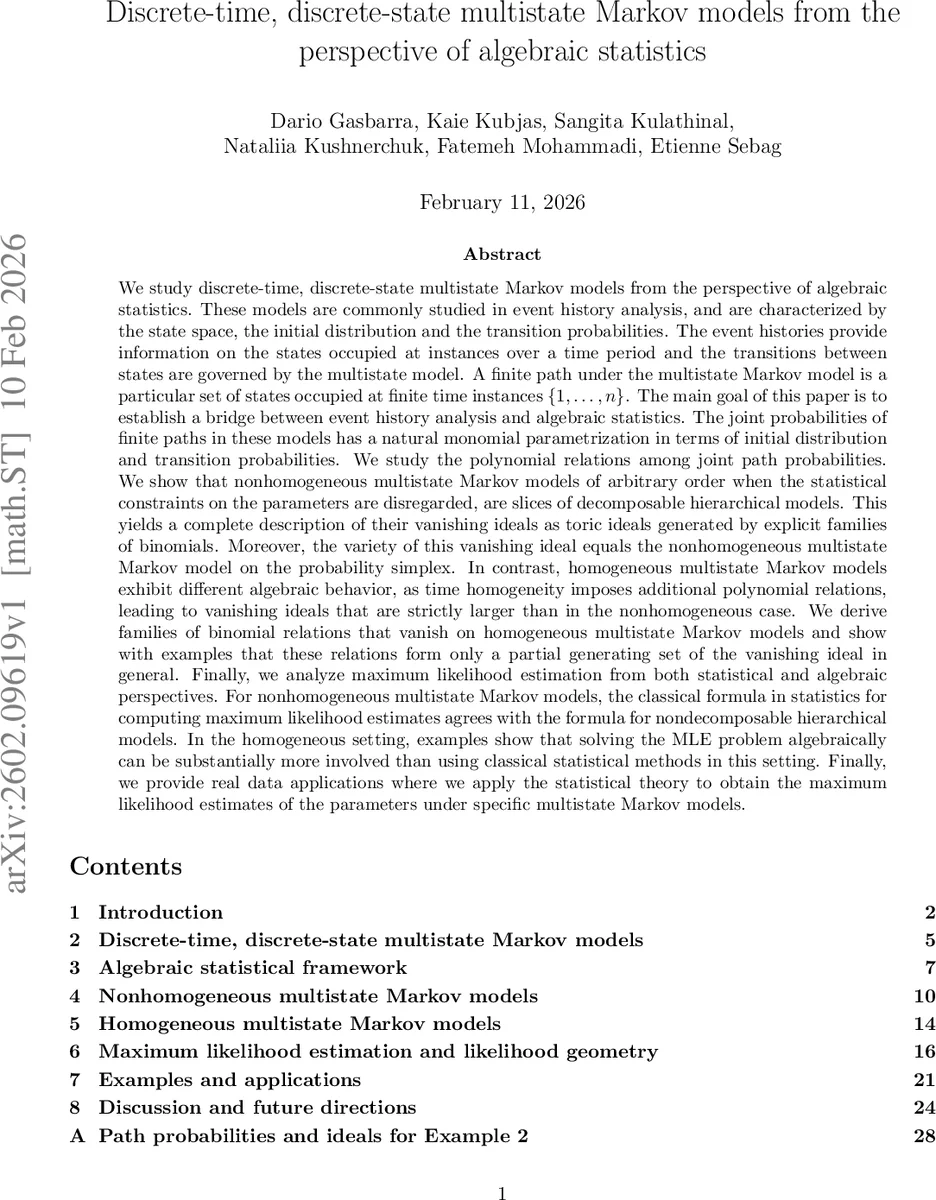
We study discrete-time, discrete-state multistate Markov models from the perspective of algebraic statistics. These models are widely studied in event history analysis, and are characterized by the state space, the initial distribution and the transition probabilities. A finite path under the multistate Markov model is a particular set of states occupied at finite time instances ${1, \dots, n}$. The main goal of this paper is to establish a bridge between event history analysis and algebraic statistics. The joint probabilities of finite paths in these models have a natural monomial parametrization in terms of the initial distribution and the transition probabilities. We study the polynomial relations among joint path probabilities. When the statistical constraints on the parameters are disregarded, nonhomogeneous multistate Markov models of arbitrary order can be viewed as slices of decomposable hierarchical models. This yields a complete description of their vanishing ideals as toric ideals generated by explicit families of binomials. Moreover, the variety of this vanishing ideal equals the nonhomogeneous multistate Markov model on the probability simplex. In contrast, homogeneous multistate Markov models exhibit different algebraic behavior, as time homogeneity imposes additional polynomial relations, leading to vanishing ideals that are strictly larger than in the nonhomogeneous case. We also derive families of binomial relations that vanish on homogeneous multistate Markov models. We investigate maximum likelihood estimation from statistical and algebraic perspectives. For nonhomogeneous models, classical and algebraic formulas agree; in the homogeneous case, the algebraic approach is more complex. Lastly, we provide data applications where we demonstrate the statistical theory to obtain the maximum likelihood estimates of the parameters under specific multistate Markov models.
💡 Research Summary
This paper investigates discrete‑time, discrete‑state multistate Markov models from the perspective of algebraic statistics. The authors begin by recalling that the probability of a finite path under such a model factorizes multiplicatively into the initial distribution and successive transition probabilities. This factorization yields a natural monomial parametrization of joint path probabilities, and the Zariski closure of the image of this parametrization defines an algebraic variety that contains the statistical model as a subset.
The core contribution concerns the algebraic description of the model’s vanishing ideal. For non‑homogeneous (time‑varying) models, the authors prove (Lemma 4.3) that, when the usual probability constraints are ignored, any k‑th‑order multistate Markov model can be viewed as a slice of a decomposable hierarchical model. Consequently, its vanishing ideal is toric, and an explicit generating set of binomials is given (Proposition 4.5), building on earlier work on decomposable models. Models with forbidden transitions or absorbing states arise as coordinate slices of the general non‑homogeneous model; their ideals are obtained by adding linear equations (Proposition 4.4, Corollary 4.7).
In contrast, homogeneous (time‑invariant) models impose additional algebraic constraints. Proposition 5.1 presents a general family of binomial relations induced by time‑homogeneity, but the authors show through concrete examples that these relations do not generate the full vanishing ideal. Thus, homogeneous models have a strictly larger ideal than their non‑homogeneous counterparts, reflecting the extra structure imposed by the homogeneity assumption.
The paper also studies maximum likelihood estimation (MLE) from both statistical and algebraic viewpoints. In the non‑homogeneous case, the MLE formulas for decomposable hierarchical models coincide with the classical statistical formulas, so the algebraic and statistical approaches agree. For homogeneous models, however, solving the likelihood equations algebraically leads to a system of nonlinear equations that is substantially more involved than the standard statistical solution; the authors illustrate this increased difficulty with explicit examples.
To demonstrate practical relevance, the authors apply their theory to several canonical multistate models from event‑history analysis, including simple survival, alternating two‑state, and illness‑death models, as well as models with structural constraints such as forbidden transitions. Real data sets are analyzed, showing how the algebraic description informs identifiability, model equivalence, and the geometry of the likelihood function.
Finally, the discussion outlines future research directions: online estimation for streaming data, handling of incomplete observations via algebraic methods, computational scalability for high‑dimensional state spaces, and incorporation of inequality constraints (probabilities lying in the unit interval) using real algebraic geometry. Overall, the work bridges multistate Markov chain theory with algebraic statistics, providing explicit toric descriptions for non‑homogeneous models, revealing the richer algebraic structure of homogeneous models, and linking these insights to maximum likelihood inference and real‑world applications.
Comments & Academic Discussion
Loading comments...
Leave a Comment