Chiralometer: Direct Torque Detection of Crystal Chirality
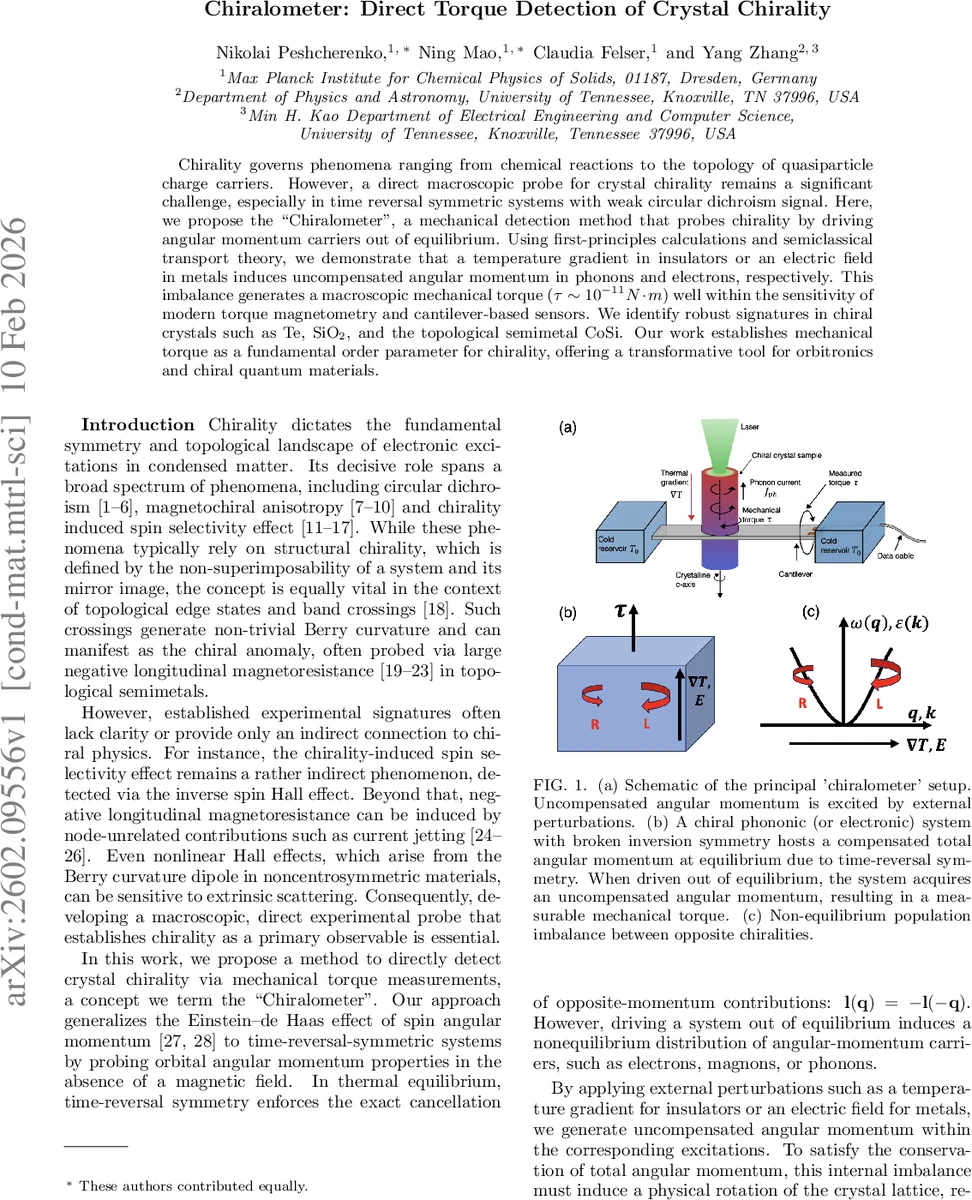
Chirality governs phenomena ranging from chemical reactions to the topology of quasiparticle charge carriers. However, a direct macroscopic probe for crystal chirality remains a significant challenge, especially in time reversal symmetric systems with weak circular dichroism signal. Here, we propose the ``Chiralometer’’, a mechanical detection method that probes chirality by driving angular momentum carriers out of equilibrium. Using first-principles calculations and semiclassical transport theory, we demonstrate that a temperature gradient in insulators or an electric field in metals induces uncompensated angular momentum in phonons and electrons, respectively. This imbalance generates a macroscopic mechanical torque ($τ\sim 10^{-11} N \cdot m$) well within the sensitivity of modern torque magnetometry and cantilever-based sensors. We identify robust signatures in chiral crystals such as Te, SiO$_2$, and the topological semimetal CoSi. Our work establishes mechanical torque as a fundamental order parameter for chirality, offering a transformative tool for orbitronics and chiral quantum materials.
💡 Research Summary
The authors introduce a novel experimental platform, the “Chiralometer,” for directly detecting crystal chirality through macroscopic mechanical torque. Traditional probes of chirality—circular dichroism, magnetochiral anisotropy, spin‑selective transport—rely on optical or spin‑based signals that are often weak, indirect, or confounded by extrinsic effects such as current jetting or nonlinear Hall contributions. The Chiralometer circumvents these limitations by exploiting the fact that, in equilibrium, time‑reversal symmetry forces the total angular momentum of all carriers (phonons, electrons, magnons) to cancel exactly: l(q)=−l(−q). When an external perturbation drives the system out of equilibrium, this cancellation is broken, leaving a net angular momentum that must be compensated by a physical rotation of the lattice, i.e., a measurable torque τ=ΔL/Δt.
Two complementary routes are explored:
- Insulating (phonon‑mediated) torque – A temperature gradient ∇T creates a non‑equilibrium phonon distribution described by the linearized Boltzmann equation, δnₛ,q=−τ_rel (vₛ(q)·∇T) ∂_T n_eq. The phonon angular momentum operator lₛ(q)=iħ eₛ(q)×eₛ*(q) yields the torque expression τ=−∑ₛ∫d³q lₛ(q)
Comments & Academic Discussion
Loading comments...
Leave a Comment