Invariance Galoisienne des zéros centraux de fonctions L
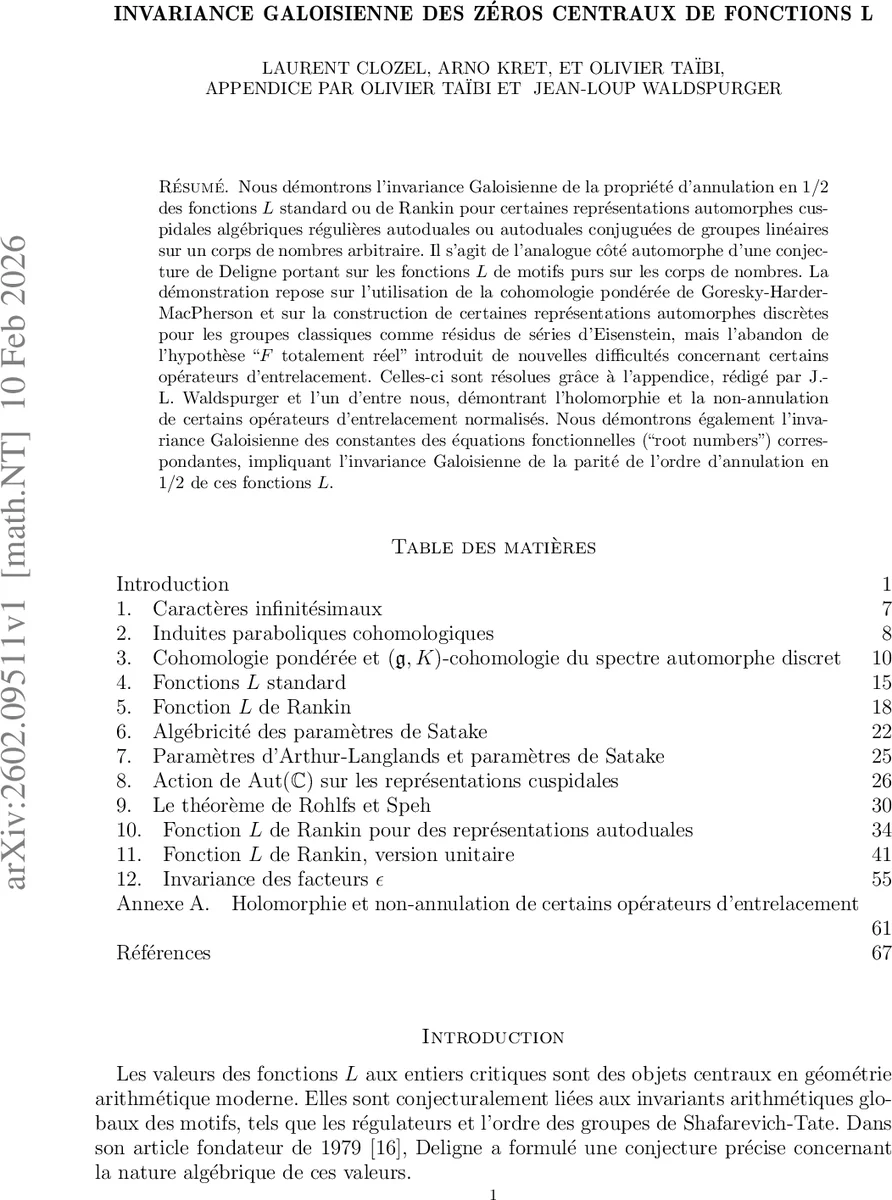
Nous démontrons l’invariance Galoisienne de la propriété d’annulation en $1/2$ des fonctions L standard ou de Rankin-Selberg pour certaines représentations automorphes cuspidales algébriques régulières autoduales ou autoduales conjuguées de groupes linéaires sur un corps de nombres arbitraire. La démonstration repose sur l’utilisation de la cohomologie pondérée de Goresky-Harder-MacPherson et sur la construction de certaines représentations automorphes discrètes pour les groupes classiques comme résidus de séries d’Eisenstein. L’abandon de l’hypothèse ``$F$ totalement réel’’ introduit de nouvelles difficultés concernant certains opérateurs d’entrelacement. Celles-ci sont résolues grâce à l’appendice, rédigé par J.-L. Waldspurger et l’un d’entre nous, démontrant l’holomorphie et la non-annulation de certains opérateurs d’entrelacement normalisés. Nous démontrons également l’invariance Galoisienne des facteurs epsilon correspondants, impliquant l’invariance Galoisienne de la parité de l’ordre d’annulation en $1/2$ de ces fonctions $L$. – We prove the invariance under the Galois group of the vanishing at $1/2$ of standard and Rankin-Selberg L-functions for certain self-dual or conjugate self-dual algebraic cuspidal automorphic representations for general linear groups over an arbitrary number field. The proof uses Goresky-Harder-MacPherson weighted cohomology and the construction of certain discrete automorphic representations for classical groups as residues of Eisenstein series. New difficulties appear concerning certain intertwining operators. These are solved in the appendix by J.-L. Waldspurger and O. Taïbi proving the holomorphy and non-vanishing of these operators. We also prove the Galois invariance of epsilon factors, implying Galois invariance of the parity of the order at $1/2$ of L-functions.
💡 Research Summary
The paper establishes that the vanishing (or order of vanishing) at the central point s = ½ of standard L‑functions and Rankin–Selberg L‑functions attached to certain regular algebraic cuspidal automorphic representations of GLₙ over an arbitrary number field F is invariant under the action of Aut(ℂ) (equivalently under the absolute Galois group). The authors work with self‑dual or conjugate‑self‑dual representations that are regular (or “super‑regular”) at the infinite places, and they impose parity conditions (symplectic versus orthogonal) on the representations.
The proof proceeds in several stages. First, the authors replace the classical intersection cohomology of Baily–Borel compactifications (available only for totally real or CM fields) by the weighted cohomology of Goresky–Harder–MacPherson, which is defined for any arithmetic locally symmetric space. This weighted cohomology carries a natural rational structure and a (g,K)‑cohomology description of the discrete automorphic spectrum.
Second, they construct Eisenstein series on suitable classical groups (e.g. Sp₂N, SO_{2N+1}) induced from a parabolic whose Levi factor contains the GL‑factor carrying the representation π. The constant term of the Eisenstein series involves normalising factors that are products of standard L‑functions such as L(s,π,∧²) or L(s,π×ρ). By analysing the poles of these normalising factors at s = ½, they relate the existence of a pole of the Eisenstein series to the non‑vanishing of L(½,π) or L(½,π×ρ).
A major technical difficulty is the control of the normalised intertwining operators M(s) outside the totally real setting. In the appendix (written by J.-L. Waldspurger and Olivier Taïbi) the authors prove holomorphy and non‑vanishing of M(s) at s = ½, and they show that any possible zero of M(s) has order at most one. This result is crucial for transferring the Galois action from the cohomology classes to the values of L‑functions.
Third, using the rational structure on weighted cohomology (established by Nair and Rai) they show that the Galois automorphism a ∈ Aut(ℂ) permutes the Hecke eigenspaces in the same way as it permutes the underlying algebraic representations. Consequently, the vanishing of L(½,π) or L(½,π×ρ) is preserved under a.
Finally, the authors treat the epsilon‑factors at s = ½. By the functional equation, the epsilon‑factor is expressed in terms of the same normalising factors, and the appendix’s analysis yields the Galois invariance ε(½,a(π)×a(ρ)) = a(ε(½,π×ρ)). From this they deduce that the parity of the order of vanishing at ½ (i.e. whether the order is even or odd) is also Galois‑invariant.
The paper thus provides a complete, unconditional proof (no totally real hypothesis) of Deligne’s conjectural Galois‑invariance for central zeros of L‑functions attached to regular algebraic self‑dual (or conjugate‑self‑dual) automorphic representations, extending previous results that required restrictive hypotheses on F. It also supplies new tools—weighted cohomology, a refined analysis of Eisenstein residues, and a robust treatment of intertwining operators—that are likely to be useful in further investigations of special values of automorphic L‑functions.
Comments & Academic Discussion
Loading comments...
Leave a Comment