A single-stage high-order compact gas-kinetic scheme in arbitrary Lagrangian-Eulerian formulation
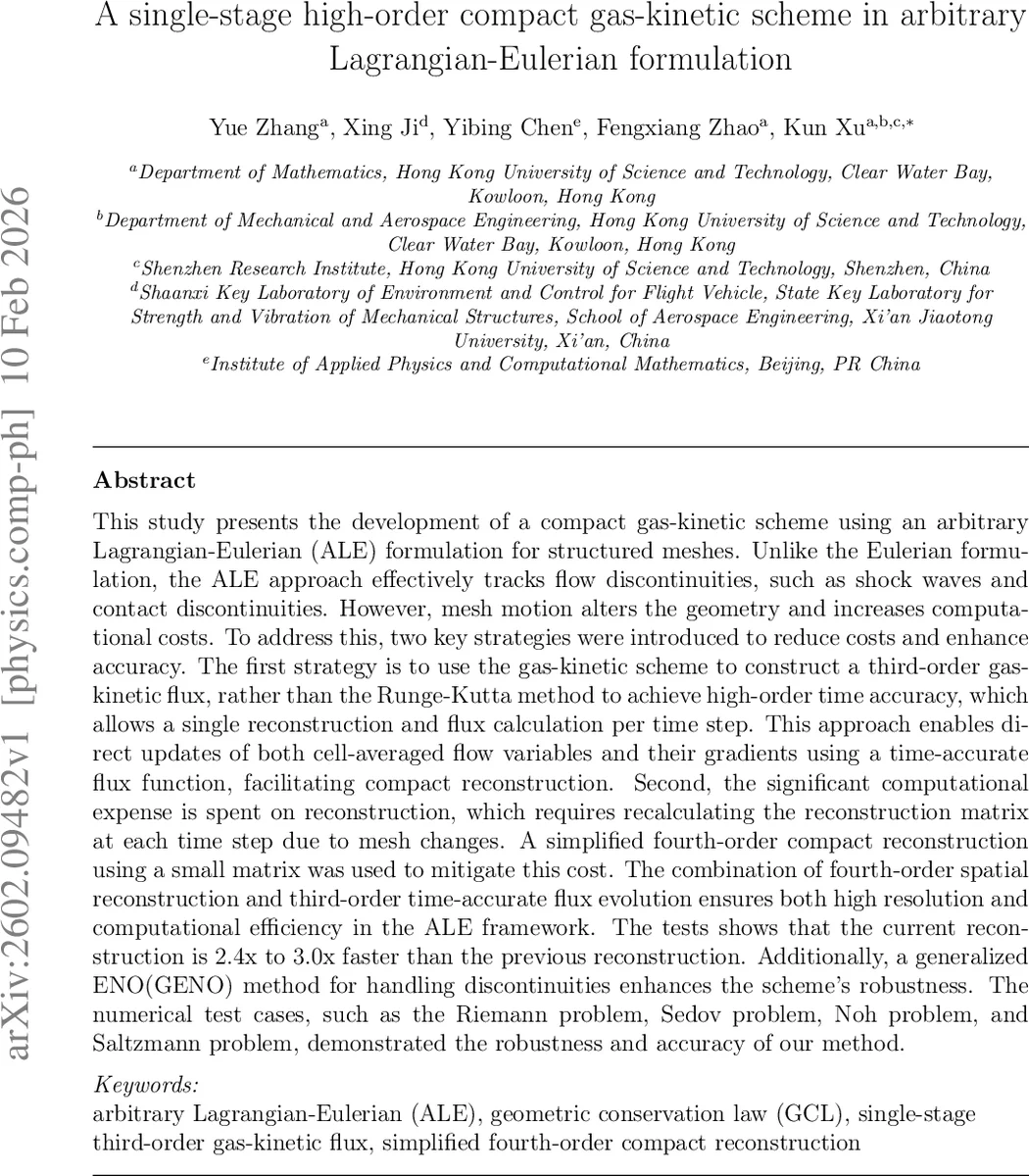
This study presents the development of a compact gas-kinetic scheme using an arbitrary Lagrangian-Eulerian (ALE) formulation for structured meshes. Unlike the Eulerian formulation, the ALE approach effectively tracks flow discontinuities, such as shock waves and contact discontinuities. However, mesh motion alters the geometry and increases computational costs. To address this, two key strategies were introduced to reduce costs and enhance accuracy. The first strategy is to use the gas-kinetic scheme to construct a third-order gas-kinetic flux, rather than the Runge-Kutta method to achieve high-order time accuracy, which allows a single reconstruction and flux calculation per time step. This approach enables direct updates of both cell-averaged flow variables and their gradients using a time-accurate flux function, facilitating compact reconstruction. Second, the significant computational expense is spent on reconstruction, which requires recalculating the reconstruction matrix at each time step due to mesh changes. A simplified fourth-order compact reconstruction using a small matrix was used to mitigate this cost. The combination of fourth-order spatial reconstruction and third-order time-accurate flux evolution ensures both high resolution and computational efficiency in the ALE framework. The tests shows that the current reconstruction is 2.4x to 3.0x faster than the previous reconstruction. Additionally, a generalized ENO(GENO) method for handling discontinuities enhances the scheme’s robustness. The numerical test cases, such as the Riemann problem, Sedov problem, Noh problem, and Saltzmann problem, demonstrated the robustness and accuracy of our method.
💡 Research Summary
This paper introduces a compact, high‑order gas‑kinetic scheme (GKS) formulated within an arbitrary Lagrangian‑Eulerian (ALE) framework for structured meshes. The authors address two major challenges inherent to ALE computations: (1) the need for high‑order temporal accuracy without incurring the cost of multi‑stage Runge‑Kutta (RK) time integration, and (2) the expensive reconstruction step that must be recomputed each time the mesh moves.
The first innovation is the use of a third‑order gas‑kinetic flux derived directly from the analytical solution of the BGK model. Because the GKS provides a time‑accurate flux function, both cell‑averaged conserved variables and their gradients can be updated simultaneously from a single flux evaluation. Consequently, only one reconstruction and one flux calculation are required per time step, eliminating the need for sub‑stage reconstructions typical of RK‑based high‑order schemes.
The second innovation concerns spatial reconstruction. In ALE, the reconstruction matrix changes with the mesh, so a conventional high‑order reconstruction would require rebuilding and inverting a large matrix at every sub‑step. The authors propose a simplified fourth‑order compact reconstruction that uses a small, fixed‑size matrix (essentially a 9‑point stencil for three‑dimensional hexahedral cells). This “compact” approach reduces the reconstruction cost by a factor of 2.4–3.0 while preserving fourth‑order spatial accuracy.
To handle discontinuities robustly, the scheme incorporates a generalized ENO (GENO) reconstruction. GENO blends a high‑order linear polynomial with a low‑order ENO stencil through a path function, automatically switching to the ENO mode near shocks or contact discontinuities. This mechanism suppresses spurious oscillations and improves the overall robustness of the method in the presence of strong gradients.
Mathematically, the ALE finite‑volume formulation is derived from the integral conservation law on a moving control volume, with the geometric conservation law (GCL) enforced via a 2 × 2 Gaussian quadrature on each face. The BGK equation is transformed to a moving reference frame using the relative particle velocity w = v − U, where U is the mesh velocity. The numerical flux is obtained by taking moments of the time‑evolved distribution function f, which itself is expressed as an integral solution involving the equilibrium state g and the initial distribution f₀. The collision time τ combines physical viscosity (μ/p) with a numerical dissipation term C₁Δt + C₂|p_L − p_R|/(p_L + p_R)Δt to capture unresolved shock structures.
The authors validate the method on several benchmark problems:
- Riemann problems (1D and 2D) demonstrate that the scheme captures shock and contact waves with sharper resolution than traditional ALE‑WENO approaches.
- Sedov blast wave shows accurate energy conservation and correct spherical shock propagation even on highly distorted meshes.
- Noh problem confirms the scheme’s ability to handle extremely strong compression without generating non‑physical oscillations.
- Saltzmann problem (a complex multi‑wave interaction) illustrates that the fourth‑order spatial and third‑order temporal accuracy are retained on moving meshes, and that the overall computational time is reduced by roughly 2.5× compared with previous ALE‑GKS implementations.
In conclusion, the paper delivers a single‑stage, high‑order ALE gas‑kinetic scheme that simultaneously achieves:
- High accuracy – fourth‑order spatial and third‑order temporal convergence.
- Computational efficiency – reconstruction cost cut by up to three times, and only one flux evaluation per time step.
- Robustness – GENO reconstruction effectively controls oscillations near discontinuities.
- Geometric fidelity – exact satisfaction of the geometric conservation law on moving hexahedral cells.
The methodology is readily extensible to three‑dimensional unstructured meshes and to multi‑physics problems such as multiphase flows or magnetohydrodynamics, making it a valuable addition to the toolbox of researchers dealing with high‑speed, highly deformable fluid‑structure interaction problems.
Comments & Academic Discussion
Loading comments...
Leave a Comment