Pseudo-isotopies of 3-manifolds with infinite fundamental groups
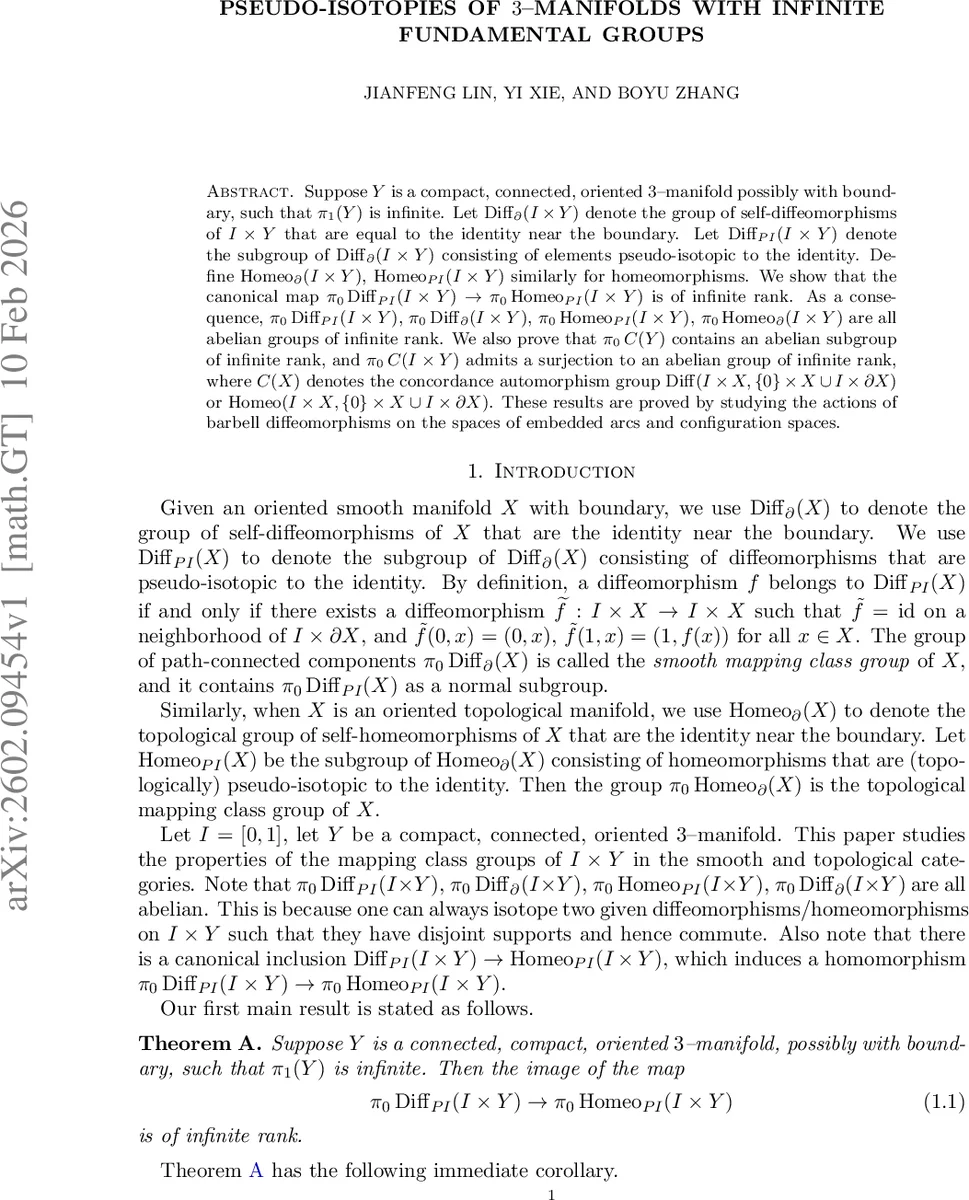
Suppose $Y$ is a compact, connected, oriented 3-manifold possibly with boundary, such that $π_1(Y)$ is infinite. Let $\operatorname{Diff}\partial(I\times Y)$ denote the group of self-diffeomorphisms of $I\times Y$ that are equal to the identity near the boundary. Let $\operatorname{Diff}{PI}(I\times Y)$ denote the subgroup of $\operatorname{Diff}\partial(I\times Y)$ consisting of elements pseudo-isotopic to the identity. Define $\operatorname{Homeo}\partial(I\times Y)$, $\operatorname{Homeo}{PI}(I\times Y)$ similarly for homeomorphisms. We show that the canonical map $π_0\operatorname{Diff}{PI}(I\times Y) \to π_0\operatorname{Homeo}{PI}(I\times Y)$ is of infinite rank. As a consequence, $π_0\operatorname{Diff}{PI}(I\times Y)$, $π_0\operatorname{Diff}{\partial}(I\times Y)$, $π_0\operatorname{Homeo}{PI}(I\times Y)$, $π_0\operatorname{Homeo}_{\partial}(I\times Y)$ are all abelian groups of infinite rank. We also prove that $π_0,C(Y)$ contains an abelian subgroup of infinite rank, and $π_0,C(I\times Y)$ admits a surjection to an abelian group of infinite rank, where $C(X)$ denotes the concordance automorphism group $\operatorname{Diff}(I\times X, {0}\times X\cup I\times \partial X)$ or $\operatorname{Homeo}(I\times X, {0}\times X\cup I\times \partial X)$. These results are proved by studying the actions of barbell diffeomorphisms on the spaces of embedded arcs and configuration spaces.
💡 Research Summary
The paper investigates the mapping‑class groups of the product manifold I × Y, where Y is a compact, connected, oriented 3‑manifold (possibly with boundary) whose fundamental group is infinite. The authors consider four natural groups: the smooth mapping‑class group π₀Diff∂(I × Y), its pseudo‑isotopy subgroup π₀Diff_PI(I × Y), and the corresponding topological groups π₀Homeo∂(I × Y) and π₀Homeo_PI(I × Y). All four are abelian because any two diffeomorphisms/homeomorphisms can be isotoped to have disjoint support and therefore commute.
The first main result (Theorem A) states that the canonical homomorphism
π₀Diff_PI(I × Y) → π₀Homeo_PI(I × Y)
has an image of infinite rank. Consequently each of the four groups above is an abelian group of infinite rank. This vastly generalises earlier special cases (e.g. Y = S¹ × D², S² × S¹, connected sums of aspherical 3‑manifolds, etc.) and also yields infinite‑rank subgroups in the mapping‑class groups of S¹ × Y.
The second main result (Theorem B) concerns concordance automorphism groups C(Y) and C(I × Y), defined as diffeomorphisms (or homeomorphisms) of I × X that are the identity on {0} × X ∪ I × ∂X. The authors prove that π₀C(Y) contains an abelian subgroup of infinite rank, and π₀C(I × Y) surjects onto an abelian group of infinite rank. These groups are the low‑dimensional analogues of the high‑dimensional pseudo‑isotopy groups that are known to be closely related to algebraic K‑theory.
Proof strategy. The authors adapt the “barbell” diffeomorphisms introduced by Budney and Gabai. A barbell diffeomorphism inserts a small knotted loop (the “bell”) together with a connecting tube (the “handle”) into I × Y. By varying the knot type and the placement of the handle one obtains an infinite family {φ₁, φ₂,…} of diffeomorphisms. The core technical work is to show that any non‑trivial integer linear combination of the φ_i’s is not isotopic to the identity in Homeo∂(I × Y).
To detect non‑triviality the authors study the action of these diffeomorphisms on the space Emb†(I, I × Y) of properly embedded arcs whose endpoints lie on the two boundary components {0} × Y and {1} × Y and whose projection to Y is a contractible loop. They compute the fundamental group π₁(Emb†) using the Dax isomorphism, which identifies it with π₂(Y). They also analyse π₂(Emb†) via a map Ψ into a direct sum of countably many copies of ℚ, constructed from configuration‑space techniques and the Bousfield–Kan spectral sequence. The map Ψ records how a diffeomorphism moves arcs in a way that creates non‑trivial 2‑cycles in a configuration space; non‑zero Ψ values obstruct isotopy to the identity.
Because Y has infinite π₁, its universal cover is non‑compact and homotopy equivalent to a wedge of 2‑spheres, which simplifies the computation of π₂(Y) and ensures the existence of many independent classes. The authors also lift diffeomorphisms to finite covers eY that are Haken; a pull‑back map on mapping‑class groups is shown to be well‑defined, allowing the obstruction to be detected on the cover where the topology is easier to control.
The paper treats several cases depending on the topology of the closed manifold (\widehat Y) obtained by filling each spherical boundary component of Y with a 3‑ball. If (\widehat Y) is irreducible and not Seifert‑fibered, the authors use homotopy classes of embedded surfaces in Emb† to obtain the obstruction. If (\widehat Y) is Seifert‑fibered, a more delicate analysis of the fiber structure is employed. When (\widehat Y) is reducible, the authors handle the special manifolds S¹ × S² and RP³ # RP³ separately, and otherwise reduce to the previous arguments via connected‑sum decompositions.
Having established that the φ_i’s are linearly independent in π₀Homeo∂(I × Y), the authors deduce the infinite‑rank image of the map in Theorem A. The stronger version of Theorem A (Theorems C and D) shows that these diffeomorphisms remain independent even in the larger group π₀Homeo(I × Y, I × ∂Y). Using the exact sequences linking Diff∂, C, and Diff_PI (and their topological analogues), the authors translate the independence result into the statements about concordance groups in Theorem B.
Overall, the paper provides the first systematic description of pseudo‑isotopy and concordance groups for a broad class of 3‑manifolds, revealing that they are far from trivial: they contain infinitely generated abelian subgroups. The techniques blend low‑dimensional geometric topology (barbell diffeomorphisms, arc and surface embeddings) with homotopy‑theoretic tools (Dax isomorphism, configuration spaces, Bousfield–Kan spectral sequence), and open the way for further investigations of mapping‑class groups in dimensions three and four.
Comments & Academic Discussion
Loading comments...
Leave a Comment