Certified Gradient-Based Contact-Rich Manipulation via Smoothing-Error Reachable Tubes
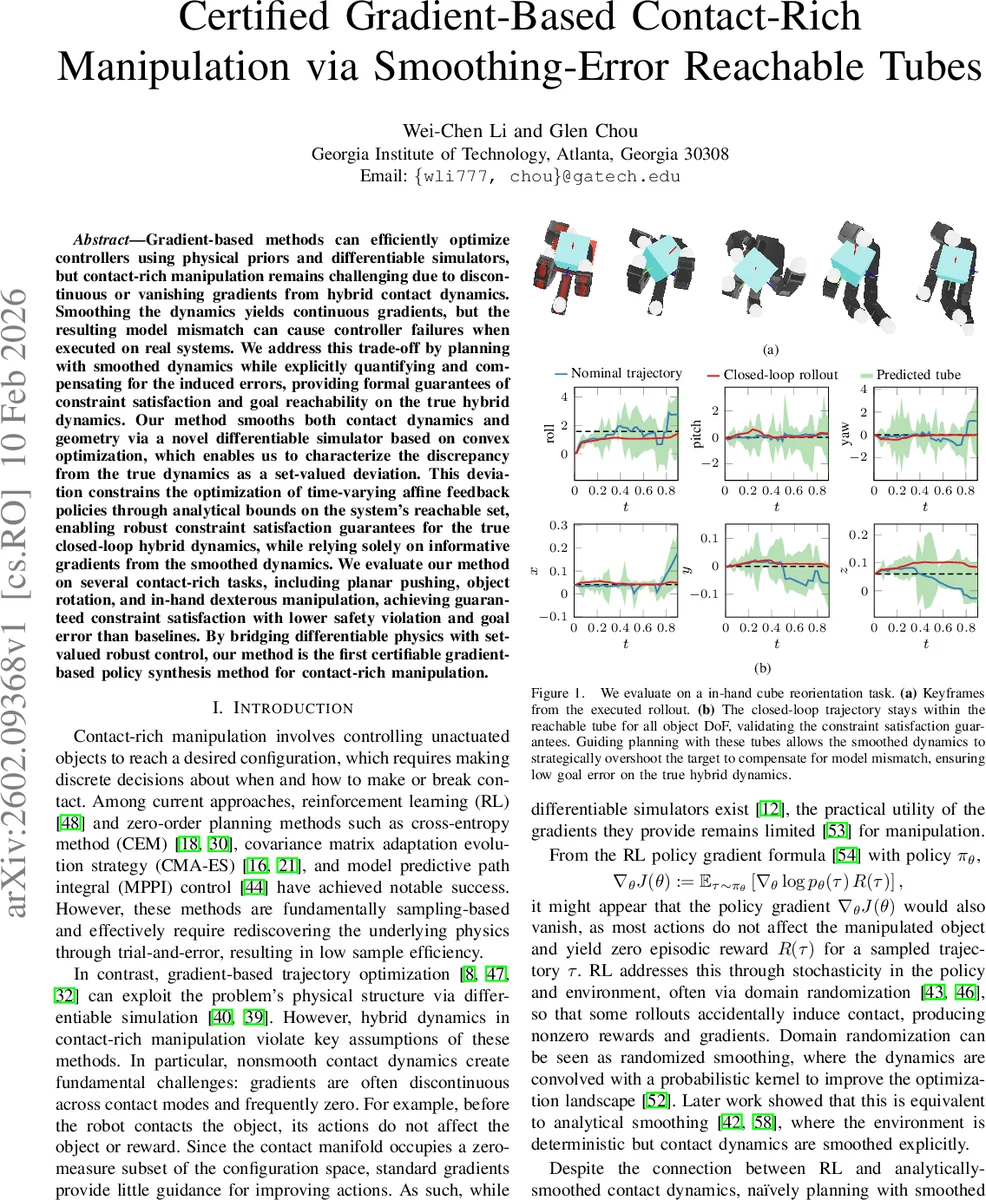
Gradient-based methods can efficiently optimize controllers using physical priors and differentiable simulators, but contact-rich manipulation remains challenging due to discontinuous or vanishing gradients from hybrid contact dynamics. Smoothing the dynamics yields continuous gradients, but the resulting model mismatch can cause controller failures when executed on real systems. We address this trade-off by planning with smoothed dynamics while explicitly quantifying and compensating for the induced errors, providing formal guarantees of constraint satisfaction and goal reachability on the true hybrid dynamics. Our method smooths both contact dynamics and geometry via a novel differentiable simulator based on convex optimization, which enables us to characterize the discrepancy from the true dynamics as a set-valued deviation. This deviation constrains the optimization of time-varying affine feedback policies through analytical bounds on the system’s reachable set, enabling robust constraint satisfaction guarantees for the true closed-loop hybrid dynamics, while relying solely on informative gradients from the smoothed dynamics. We evaluate our method on several contact-rich tasks, including planar pushing, object rotation, and in-hand dexterous manipulation, achieving guaranteed constraint satisfaction with lower safety violation and goal error than baselines. By bridging differentiable physics with set-valued robust control, our method is the first certifiable gradient-based policy synthesis method for contact-rich manipulation.
💡 Research Summary
This paper tackles a fundamental difficulty in contact‑rich robotic manipulation: the discontinuous or vanishing gradients that arise from hybrid contact dynamics. Gradient‑based trajectory optimization and differentiable simulators are attractive because they can exploit physical priors and provide efficient learning signals, but they fail when the underlying dynamics switch abruptly between contact modes. The authors propose a two‑stage solution that retains the smooth gradients needed for optimization while delivering formal guarantees with respect to the true, unsmoothed hybrid dynamics.
First, they introduce a novel differentiable simulator that smooths both contact forces and geometry using a convex‑optimization formulation. Instead of solving a linear complementarity problem (LCP) directly, the simulator embeds the contact model in a conic program and relaxes the complementarity constraints with a logarithmic barrier parameter κ. This “analytic smoothing” yields a continuously differentiable mapping fκ(x,u) from state‑action pairs to the next state, and, crucially, the simulator provides analytic sensitivities of the solution with respect to the problem data and to κ itself (∂λ/∂κ). By differentiating through the KKT conditions of the conic program, the method obtains ∂fκ/∂x and ∂fκ/∂u without back‑propagating through a large computational graph.
Second, the authors quantify the model mismatch introduced by smoothing. They prove (Theorem 1) that the true dynamics f₀(x,u) can be expressed as the smoothed dynamics plus a set‑valued error term:
f₀(x,u) = fκ(x,u) + Eκ(x,u)·w, w∈
Comments & Academic Discussion
Loading comments...
Leave a Comment