Quadratic irrational analogues of Ramanujan's series for $1/π$
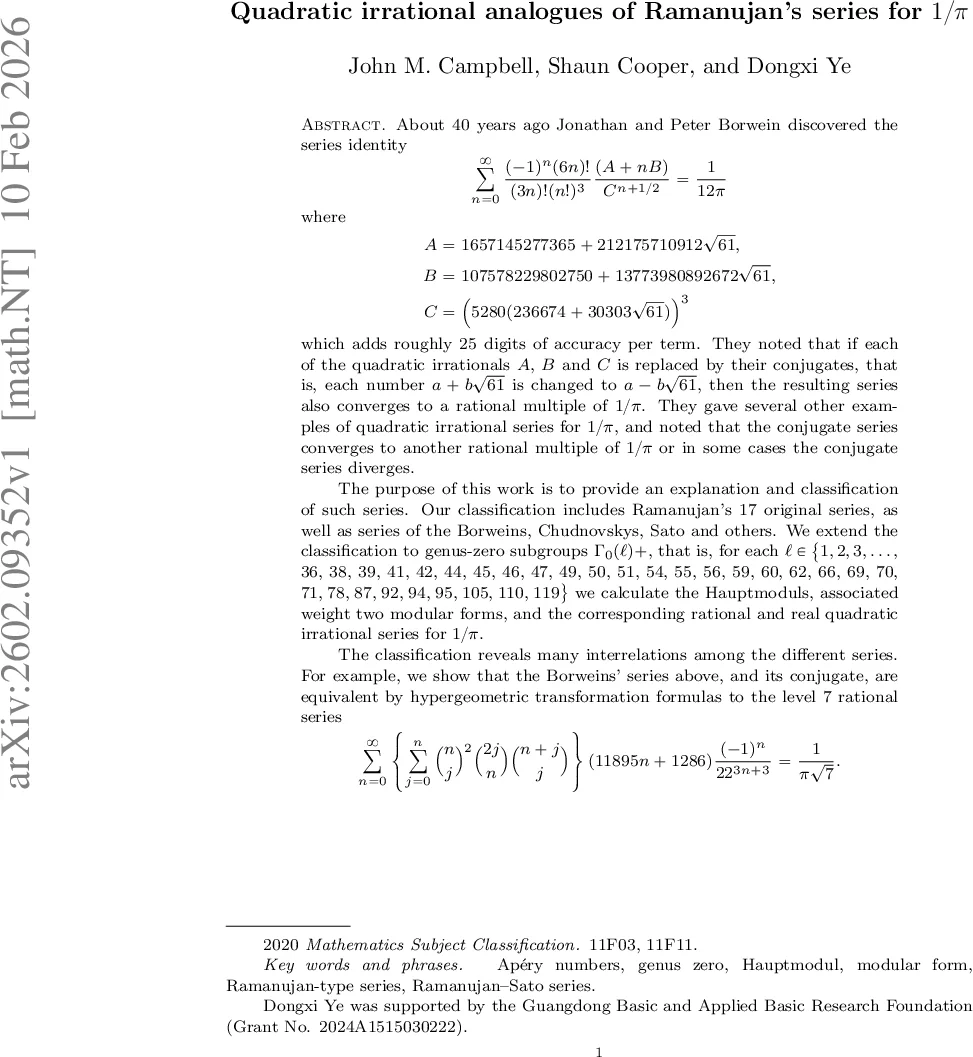
About 40 years ago Jonathan and Peter Borwein discovered the series identity $$ \sum_{n=0}^\infty \frac{(-1)^n(6n)!}{(3n)!(n!)^3} \frac{(A+nB)}{C^{n+1/2}} = \frac{1}{12π} $$ where \begin{align*} A&=1657145277365+212175710912\sqrt{61},\cr B&=107578229802750+13773980892672\sqrt{61},\cr C&=\left(5280(236674+30303\sqrt{61})\right)^3 \end{align*} which adds roughly 25 digits of accuracy per term. They noted that if each of the quadratic irrationals $A$, $B$ and $C$ is replaced by their conjugates, that is, each number $a+b\sqrt{61}$ is changed to $a-b\sqrt{61}$, then the resulting series also converges to a rational multiple of $1/π$. They gave several other examples of quadratic irrational series for $1/π$, and noted that the conjugate series converges to another rational multiple of $1/π$ or in some cases the conjugate series diverges. The purpose of this work is to provide an explanation and classification of such series. Our classification includes Ramanujan’s 17 original series, as well as series of the Borweins, Chudnovskys, Sato and others. We extend the classification to genus-zero subgroups $Γ_0(\ell)+$, that is, for each $\ell \in \big{1,2,3,\ldots,36,38,39,41,42,44,45,46,47,49,50,51,54,55,56,59,60,62,66,69,70, 71,78,87,92,94,95,105,110,119\big}$ we calculate the Hauptmoduls, associated weight two modular forms, and the corresponding rational and real quadratic irrational series for $1/π$. The classification reveals many interrelations among the different series. For example, we show that the Borweins’ series above, and its conjugate, are equivalent by hypergeometric transformation formulas to the level~7 rational series $$ \sum_{n=0}^\infty \left{\sum_{j=0}^n {n \choose j}^2{2j \choose n} {n+j \choose j}\right} (11895n+1286) \frac{(-1)^n}{22^{3n+3}} = \frac{1}{π\sqrt{7}}. $$
💡 Research Summary
The paper provides a comprehensive classification of Ramanujan‑type series for 1/π that involve quadratic irrational parameters. Starting from Ramanujan’s original 17 series, the authors incorporate later examples by the Borweins, Chudnovskys, Sato and others, and explain why the “conjugate” series (obtained by sending √d → –√d) often converges to another rational multiple of 1/π, while in some cases it diverges.
The theoretical backbone consists of four theorems. Theorem 2.1 shows that whenever a Hauptmodul X for a Fuchsian group Γ (a normal extension of some Γ₀(ℓ)⁺) exists, there is an associated weight‑2 modular form Z whose logarithmic derivative can be expressed as a rational function of X involving two polynomials G(X) and H(X). Theorem 2.2 proves that the coefficients Tₙ in the X‑expansion Z = Σ Tₙ Xⁿ satisfy a linear recurrence of order k₁+1, where k₁ = deg G. Theorem 2.3 gives the converse: given G and H one can reconstruct the q‑expansions of X and Z, so the modular data completely determine the series. Theorem 2.4 combines these results: for any genus‑zero level ℓ and any integer N, one defines a second modular function Y related to X by an algebraic equation f(X,Y)=0, computes λ = X²·(dX/dY)/(dY/dX)·G(Y)/G(X), and obtains the universal formula
\
Comments & Academic Discussion
Loading comments...
Leave a Comment