Total positivity in twisted flag varieties
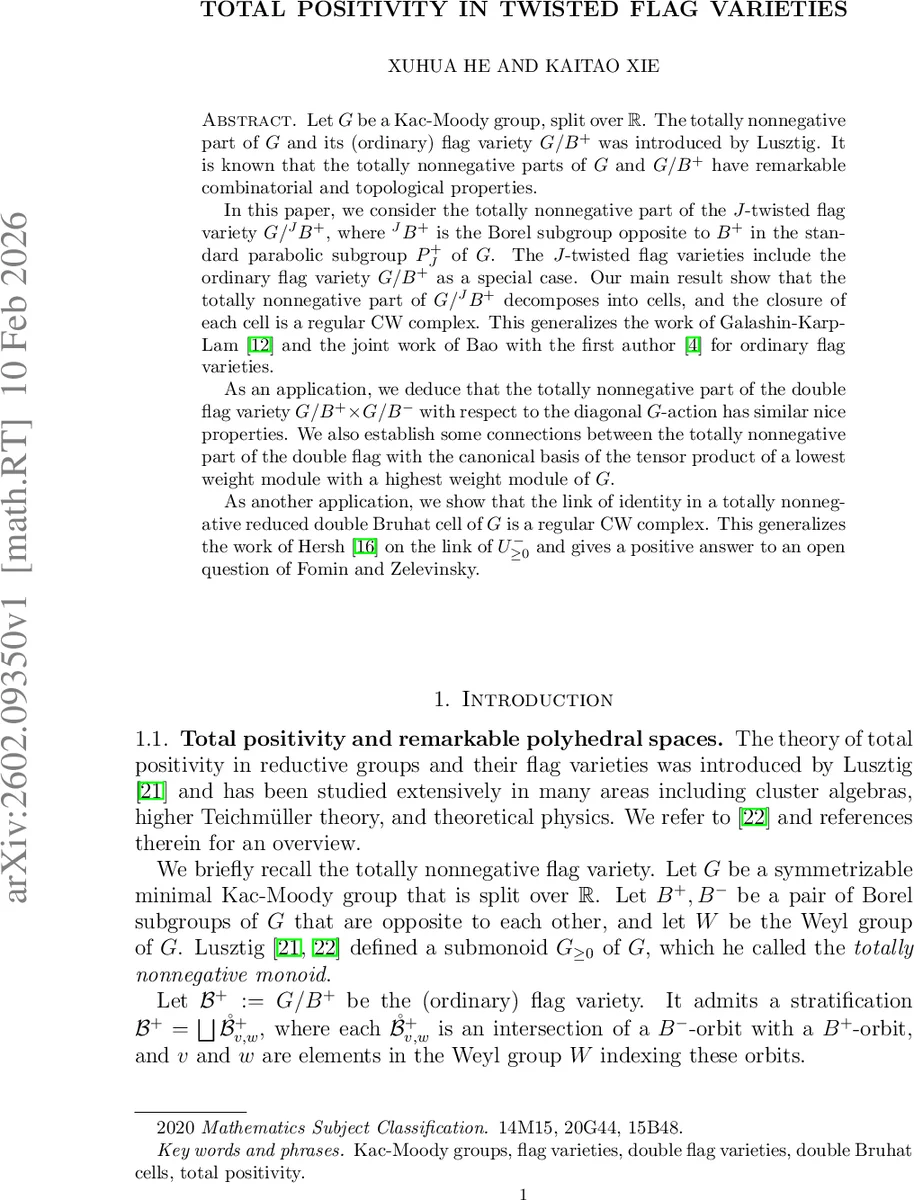
Let $G$ be a Kac-Moody group, split over $\mathbb R$. The totally nonnegative part of $G$ and its (ordinary) flag variety $G/B^+$ was introduced by Lusztig. It is known that the totally nonnegative parts of $G$ and $G/B^+$ have remarkable combinatorial and topological properties. In this paper, we consider the totally nonnegative part of the $J$-twisted flag variety $G/{}^J B^+$, where ${}^J B^+$ is the Borel subgroup opposite to $B^+$ in the standard parabolic subgroup $P_J^+$ of $G$. The $J$-twisted flag varieties include the ordinary flag variety $G/B^+$ as a special case. Our main result show that the totally nonnegative part of $G/{}^J B^+$ decomposes into cells, and the closure of each cell is a regular CW complex. This generalizes the work of Galashin-Karp-Lam \cite{GKL22} and the joint work of Bao with the first author \cite{BH24} for ordinary flag varieties. As an application, we deduce that the totally nonnegative part of the double flag variety $G/B^+ \times G/B^-$ with respect to the diagonal $G$-action has similar nice properties. We also establish some connections between the totally nonnegative part of the double flag with the canonical basis of the tensor product of a lowest weight module with a highest weight module of $G$. As another application, we show that the link of identity in a totally nonnegative reduced double Bruhat cell of $G$ is a regular CW complex. This generalizes the work of Hersh \cite{Her14} on the link of $U_{\geq0}^-$ and gives a positive answer to an open question of Fomin and Zelevinsky.
💡 Research Summary
The paper studies total positivity for Kac‑Moody groups G split over ℝ, extending Lusztig’s theory beyond the ordinary flag variety to a broader class called J‑twisted flag varieties. For a subset J of the simple‑root index set I, the authors consider the standard parabolic subgroup P⁺_J and its opposite Borel subgroup ^J B⁺ inside P⁺_J. The J‑twisted flag variety is defined as B_J = G / ^J B⁺; when J = ∅ it coincides with the ordinary flag G/B⁺, while for non‑finite J it is genuinely different and lacks the usual representation‑theoretic description via highest‑weight modules.
The main result (Theorem 1.3) proves that the totally non‑negative part B_{J,≥0} (the Hausdorff closure of G_{≥0}·^J B⁺/ ^J B⁺) decomposes into semi‑algebraic cells indexed by pairs (v,w)∈W×W, and that the closure of each cell is a regular CW complex (hence homeomorphic to a closed ball). This generalizes earlier work of Galashin‑Karp‑Lam for finite‑type groups and Bao‑He for ordinary Kac‑Moody flag varieties.
To handle the lack of a canonical basis description for twisted flags, the authors develop a new inductive strategy. They first extend the “product structure” method—originally used for ordinary flags—to the twisted setting. Then they construct explicit candidate parametrizing sets for the cells. Starting with the restricted family where v∈W_J and w∈W_J, they verify that these candidates are indeed the totally positive cells and satisfy the required containment in certain “big cells”. Using the product structure, they propagate the result to larger families (v∈W, w∈W_J) and finally to arbitrary (v,w). At each step the product structure allows them to reduce closure relations to smaller cases, establishing both parametrization and regularity simultaneously.
With Theorem 1.3 in hand, the authors turn to the double flag variety G/B⁺ × G/B⁻ equipped with the diagonal G‑action. They embed this space into a larger Kac‑Moody group \tilde G and a twisted flag \tilde B_{\tilde J} of \tilde G, constructing a subvariety \tilde Z⊂\tilde B_{\tilde J} that forms a fiber bundle over G/B⁺ × G/B⁻. The bundle projection respects both the stratifications and total positivity. Applying the twisted‑flag result yields Theorem 1.4: the totally non‑negative double flag variety (G/B⁺ × G/B⁻)_{≥0} is also a remarkable polyhedral space with a regular CW decomposition.
An immediate corollary (Theorem 1.5) concerns reduced double Bruhat cells L_{w,u}=G_{w,u}/T, where G_{w,u}=B⁺\dot w B⁺∩B⁻\dot u B⁻. The link of the identity element in the totally non‑negative part of L_{w,u} is a regular CW complex, in fact homeomorphic to a closed ball. This extends Hersh’s result on the link of the totally non‑negative unipotent monoid U⁻_{≥0} and answers positively a question of Fomin and Zelevinsky (Conjecture 10.2(1) in
Comments & Academic Discussion
Loading comments...
Leave a Comment