On integrals of non-autonomous dynamical systems in finite characteristic
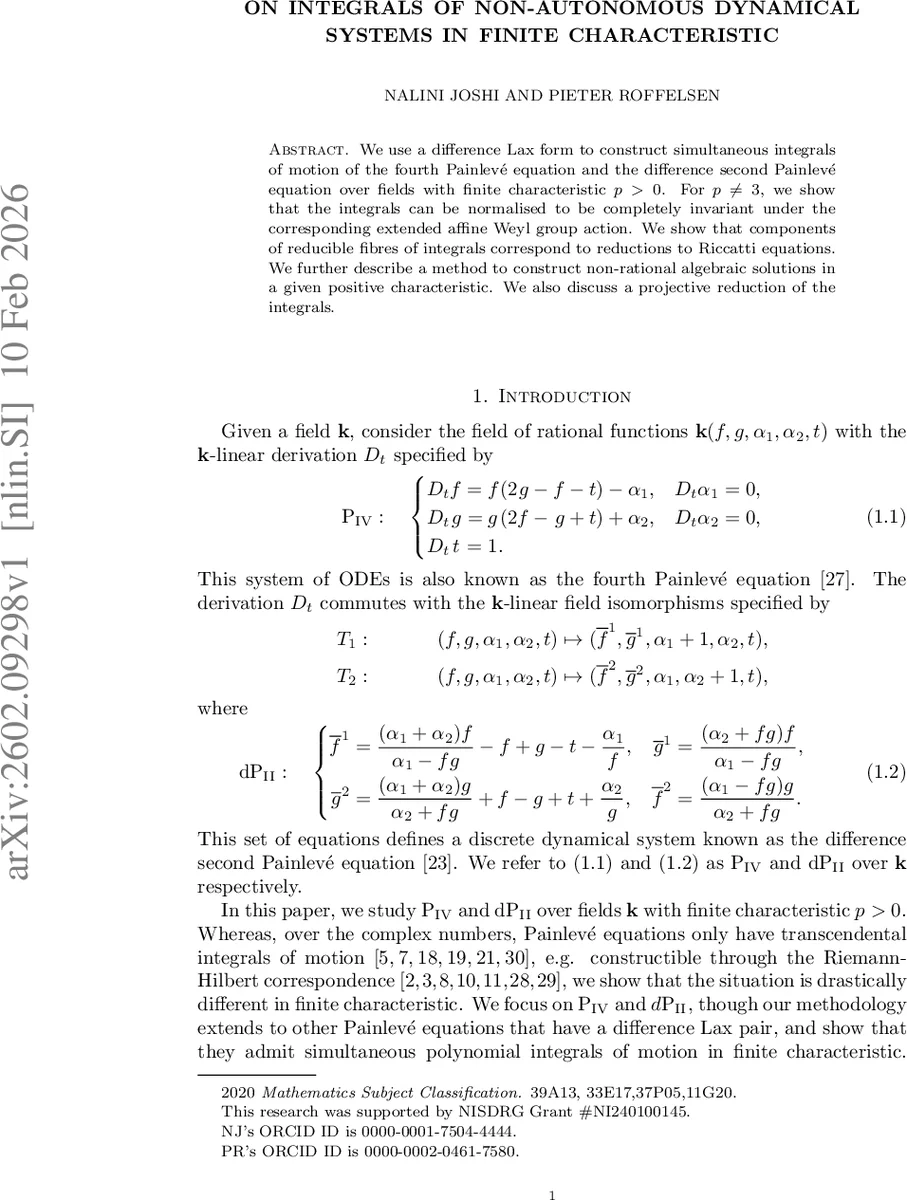
We use a difference Lax form to construct simultaneous integrals of motion of the fourth Painlevé equation and the difference second Painlevé equation over fields with finite characteristic $p>0$. For $p\neq 3$, we show that the integrals can be normalised to be completely invariant under the corresponding extended affine Weyl group action. We show that components of reducible fibres of integrals correspond to reductions to Riccatti equations. We further describe a method to construct non-rational algebraic solutions in a given positive characteristic. We also discuss a projective reduction of the integrals.
💡 Research Summary
The paper investigates simultaneous integrals of motion for the fourth Painlevé equation (P IV) and the difference second Painlevé equation (dP II) when the underlying field has positive characteristic $p>0$. The authors start from a difference Lax pair introduced by Nakazono, whose spectral part is a $2\times2$ matrix polynomial $A(z)$ depending on the dynamical variables $f,g$, the parameters $\alpha_1,\alpha_2$, the independent variable $t$, and a scaling parameter $w$. By forming the product $M_p(z)=A(z+p-1)\cdots A(z)$ and taking its trace $\chi_p(z)=\operatorname{Tr}M_p(z)$, they obtain a polynomial in $z$ that is $1$‑periodic and invariant under the time‑derivation $D_t$. Consequently every coefficient of $\chi_p(z)$ is a common integral of P IV and dP II. The constant term $I_p:=\chi_p(0)$ is shown to be a polynomial in $f,g,\alpha_1,\alpha_2,t$ of total degree $3p$, with leading term $-(f^{2}g)^p$.
The existence and degree of $I_p$ are proved by a careful asymptotic analysis. First, a scaling $w\mapsto b w f$ isolates the dominant $f$‑dependence, revealing that $A(z)$ behaves like $f^{2}g,U$ where $U$ satisfies $U^2=-U$ and $\operatorname{Tr}U=0$. This yields the leading term in $f$. To control the total degree, the authors introduce a homogeneous scaling $f=c_1\lambda$, $g=c_2\lambda$ and expand $A(z)$ as a series in $\lambda^{-1}$. They define auxiliary matrices $U_0,U_1,U_2,\dots$ and establish a collection of trace identities (e.g. $\operatorname{Tr}U_0=0$, $\operatorname{Tr}U_0U_1=0$, $U_2U_0=0$, $U_0U_1=-c_1c_2U_1U_0$, etc.). By combinatorial bookkeeping of the products appearing in $\operatorname{Tr}M_p(z)$ they show that all contributions of order higher than $\lambda^{-3p}$ vanish, which forces the total degree to be exactly $3p$.
Next, the paper examines the symmetry under the extended affine Weyl group $\widetilde W(A^{(1)}_2)$, generated by $s_0,s_1,s_2,\pi$ with the usual Coxeter relations. The action on the variables is given explicitly in Table 1 and corresponds precisely to the Schlesinger transformations $B^{(j)}(z)$ of the Lax pair. For $p\neq3$ the authors introduce a corrected integral $eI_p$ (formula 2.2) which adds a simple $t$‑dependent term to $I_p$. They prove that $eI_p$ is invariant under every element of $\widetilde W(A^{(1)}_2)$, i.e. $w(eI_p)=eI_p$ for all $w\in\widetilde W$. The case $p=3$ remains open; the authors compute the action on $I_3$ but cannot achieve full invariance.
The geometric side of the study focuses on the fibers defined by $I_p=0$. Computational evidence (cited from earlier work) suggests that generic fibers are elliptic curves satisfying an analogue of the Hasse bound over finite fields. The authors prove that whenever a fiber is reducible, the corresponding parameters force P IV to reduce to a Riccati equation; this provides a precise link between reducible fibers and special solutions. They conjecture (Conjecture 4.4) that all reducible fibers arise in this way. Moreover, singular points on the fibers give rise to non‑rational algebraic solutions of P IV and dP II, which have no counterpart in characteristic zero.
Finally, the authors show that under a projective reduction (essentially sending $t\to\infty$ or fixing a suitable invariant divisor) the difference second Painlevé system dP II collapses to the difference first Painlevé equation dP I. In this limit the integral $I_p$ descends to the known integral of motion for dP I, confirming that the construction is compatible with the known hierarchy of Painlevé equations.
In summary, the paper provides a novel algebraic construction of simultaneous integrals for P IV and dP II in finite characteristic, establishes their Weyl‑group invariance (up to a simple correction), relates the geometry of their level sets to Riccati reductions and algebraic solutions, and demonstrates compatibility with the Painlevé hierarchy via projective reduction. These results open a new avenue for arithmetic and geometric investigations of Painlevé equations over finite fields.
Comments & Academic Discussion
Loading comments...
Leave a Comment