Platform Design, Earnings Transparency and Minimum Wage Policies: Evidence from A Natural Experiment on Lyft
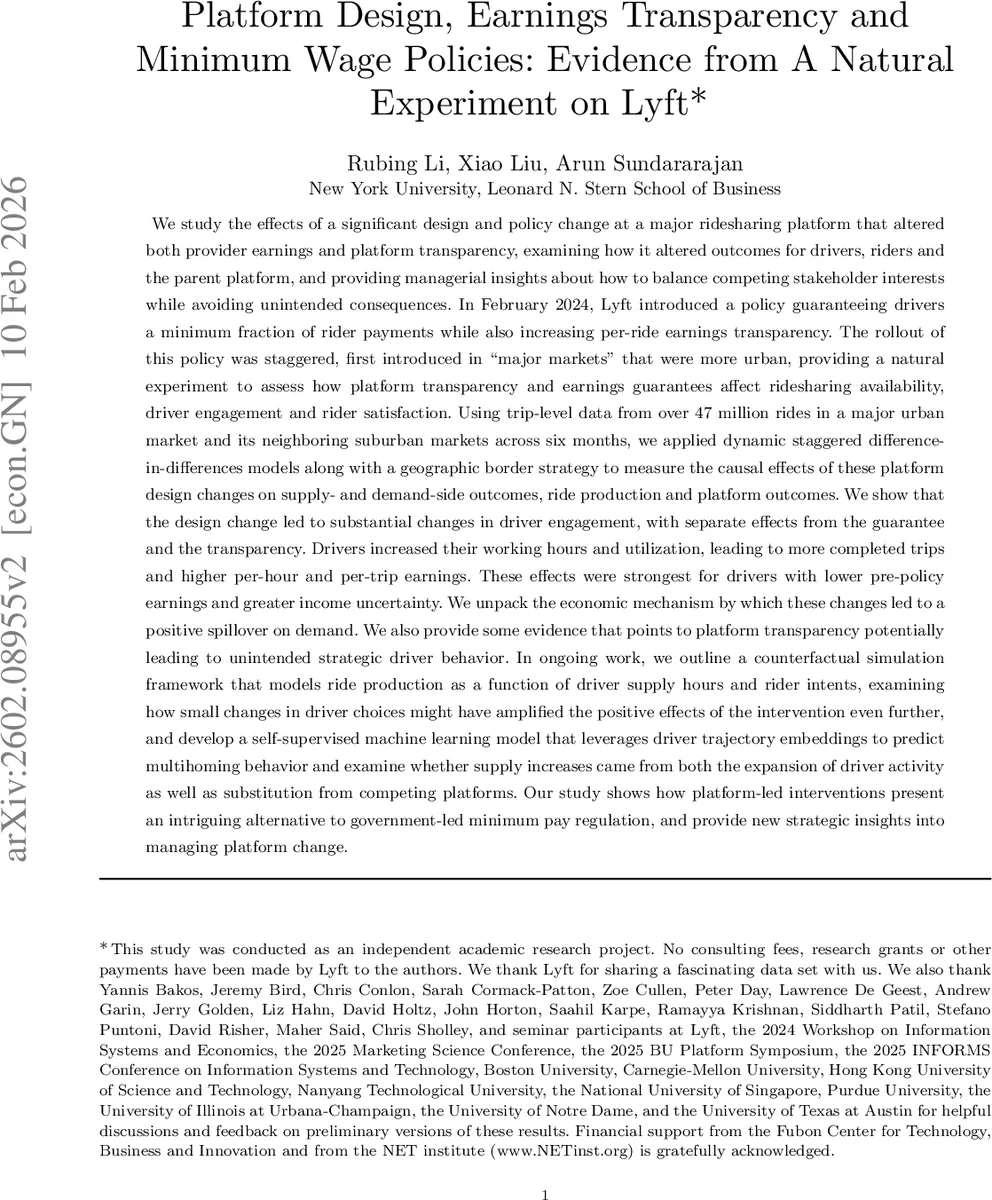
We study the effects of a significant design and policy change at a major ridesharing platform that altered both provider earnings and platform transparency, examining how it affected outcomes for drivers, riders, and the platform, and providing managerial insights on balancing competing stakeholder interests while avoiding unintended consequences. In February 2024, Lyft introduced a policy guaranteeing drivers a minimum fraction of rider payments while increasing per-ride earnings transparency. The staggered rollout, first in major markets, created a natural experiment to examine how earnings guarantees and transparency affect ride availability and driver engagement. Using trip-level data from over 47 million rides across a major market and adjacent markets over six months, we apply dynamic staggered difference-in-differences models combined with a geographic border strategy to estimate causal effects on supply, demand, ride production, and platform performance. We find that the policy led to substantial increases in driver engagement, with distinct effects from the guarantee and transparency. Drivers increased working hours and utilization, resulting in more completed trips and higher per-hour and per-trip earnings, with stronger effects among drivers with lower pre-policy earnings and greater income uncertainty. Increased supply also generated positive spillovers on demand. We also find evidence that greater transparency may induce strategic driver behavior. In ongoing work, we develop a counterfactual simulation framework linking driver supply and rider intents to ride production, illustrating how small changes in driver choices could further amplify policy effects. Our study shows how platform-led interventions present an intriguing alternative to government-led minimum pay regulation and provide new strategic insights into managing platform change.
💡 Research Summary
**
This paper exploits Lyft’s February 2024 rollout of two platform design changes—a weekly earnings guarantee that drivers receive at least 70 % of rider payments after external fees, and increased per‑ride earnings transparency—as a natural experiment to assess their causal impact on drivers, riders, and the platform itself. Using trip‑level data covering more than 47 million rides in a major urban market (LAX) and two adjacent suburban markets (OCX and SBD) over a six‑month window, the authors apply a suite of econometric strategies: dynamic staggered difference‑in‑differences (DiD) with inverse‑propensity weighting, a geographic border‑pair design to control for spatial spillovers, and a two‑year matched control to address seasonality.
The guarantee component substantially raises driver engagement. Estimated weekly driving hours increase between 8.6 % and 33.3 %, with the strongest effects for drivers who previously earned a lower share of rider payments and who exhibit higher income‑uncertainty tolerance. Full‑time drivers respond more vigorously than part‑time drivers (about 26 % larger hour gains). The transparency component, while improving information symmetry, also triggers strategic behavior: drivers adjust start locations and shift times to concentrate in high‑earning zones, indicating that greater visibility can produce both trust‑building benefits and unintended tactical responses.
Supply growth translates into demand expansion. The authors document higher app‑open rates and higher conversion of ride requests into completed trips after the policy, especially in a small set of “high‑demand” neighborhoods. By estimating a ride‑production function that treats driver hours as supply and app‑opens/rider requests as demand, they find increasing returns to scale and an overall rise in production efficiency post‑intervention. A machine‑learning model of multi‑homing behavior suggests that drivers who also work on competing platforms exhibit even larger supply responses, supporting a household‑production view that the additional hours are more likely substituted from other gig work than from leisure.
The paper further explores counterfactual scenarios using a novel simulation framework that nudges driver start locations and times. Small spatial nudges generate larger gains in ride production than comparable temporal nudges, implying that modest behavioral interventions could amplify the policy’s impact.
From a policy perspective, the findings demonstrate that a platform‑led earnings floor can replicate many welfare gains associated with government‑mandated minimum‑wage rules while preserving market‑driven pricing and avoiding the efficiency losses that can accompany statutory wage floors. However, the transparency element underscores the need for careful design of information disclosures to mitigate strategic gaming.
Overall, the study provides robust evidence that Lyft’s earnings guarantee and transparency reforms produced a “win‑win‑win” outcome: drivers earned more and worked more, riders experienced higher availability and conversion, and the platform’s overall efficiency improved. This suggests that well‑designed platform interventions can serve as viable alternatives to external regulation in two‑sided markets, especially when they are data‑driven and calibrated to heterogeneous driver characteristics. Future work is outlined on refining nudges, addressing geographic inequality in demand spillovers, and deepening the analysis of multi‑platform labor dynamics.
Comments & Academic Discussion
Loading comments...
Leave a Comment