karl. - A Research Vehicle for Automated and Connected Driving
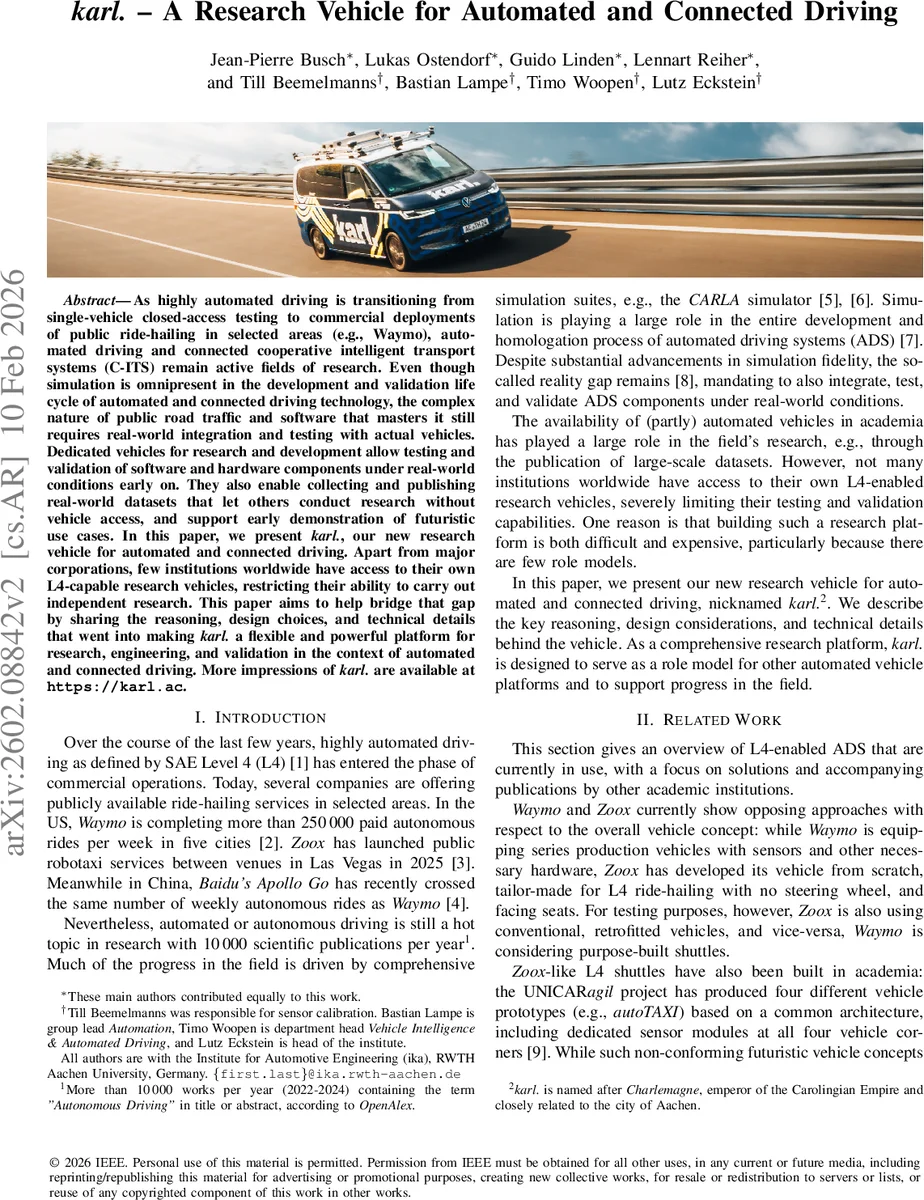
As highly automated driving is transitioning from single-vehicle closed-access testing to commercial deployments of public ride-hailing in selected areas (e.g., Waymo), automated driving and connected cooperative intelligent transport systems (C-ITS) remain active fields of research. Even though simulation is omnipresent in the development and validation life cycle of automated and connected driving technology, the complex nature of public road traffic and software that masters it still requires real-world integration and testing with actual vehicles. Dedicated vehicles for research and development allow testing and validation of software and hardware components under real-world conditions early on. They also enable collecting and publishing real-world datasets that let others conduct research without vehicle access, and support early demonstration of futuristic use cases. In this paper, we present karl., our new research vehicle for automated and connected driving. Apart from major corporations, few institutions worldwide have access to their own L4-capable research vehicles, restricting their ability to carry out independent research. This paper aims to help bridge that gap by sharing the reasoning, design choices, and technical details that went into making karl. a flexible and powerful platform for research, engineering, and validation in the context of automated and connected driving. More impressions of karl. are available at https://karl.ac.
💡 Research Summary
The paper presents “karl.”, a purpose‑built research vehicle designed to enable autonomous and connected driving research at SAE Level 4 (L4) within academic environments. Recognizing that most public‑road autonomous driving research relies on a handful of commercial fleets (e.g., Waymo, Zoox) and that few universities possess their own L4‑capable platforms, the authors describe the motivation, design decisions, and technical implementation of karl.
Base vehicle selection – karl is built on a Volkswagen T7 Multivan 1.4 TSI e‑Hybrid long‑wheelbase. The choice was driven by the vehicle’s spacious interior (allowing extensive hardware integration and a developer workstation), a plug‑in hybrid powertrain (providing zero‑emission electric operation for short trips while retaining range for longer missions), and the presence of OEM driver‑assistance functions (adaptive cruise control, parking assist) that can be repurposed for low‑level actuation via CAN‑tap.
Physical modifications – Minimal structural changes were made: routing of power and data cables beneath interior trim, a CAN‑tap for actuator commands, and a cosmetic exterior wrap. The bulk of the integration is modular, relying on two custom racks.
Cabin rack – Constructed from 40 mm aluminum profiles, the rack houses two 19‑inch 12U columns that contain the power distribution unit, a high‑performance computer (HPC), two Ethernet switches, a 5G router, V2X communication hardware, and auxiliary devices. The rack supplies both AC (up to 3 kW) and DC power (up to 2.16 kW) and provides 24 individually fused, software‑controllable outputs via a Weidmüller UC20‑WL2000‑AC module and a secondary UR20‑FBC‑MOD‑TCP‑ECO downstream stage.
Sensor rack – Mounted on the roof, the sensor rack is also built from 40 mm aluminum and supports a flexible layout that does not intrude on the vehicle chassis. It carries eight StereoLabs ZED X stereo cameras (three front with 4 mm lenses for higher resolution, five side/rear with 2 mm lenses for wide FOV), four Ouster OS1 rotating lidars positioned at each corner and tilted downward, a front‑facing Aeva Aeries II FMCW solid‑state lidar (providing both range and per‑point radial velocity), and a suite of five 4D imaging radars (Altos V2 front, Smartmicro DRVEGRD169 side, DRVEGRD152 rear). The sensor suite achieves full 360° coverage with minimal blind spots and supports high‑rate data streams (cameras up to 60 fps at 1920 × 1200, lidars up to 20 Hz, radars at 15 Hz).
Calibration and localization – Extrinsic calibration of all sensors is performed with the open‑source ros2‑calib tool, while intrinsic camera parameters are supplied by the manufacturer. For precise positioning, a compact SBG Systems Ekinox Micro RTK/GNSS‑INS unit is installed in the cabin rack, paired with two Talysman VSP6037L GNSS antennas on the sensor rack, delivering centimeter‑level accuracy and sub‑0.05° heading precision even in urban canyons.
External communication – Connectivity is provided by an Ericsson Cradlepoint R1900 automotive‑grade 5G router and a dedicated V2X module, enabling real‑time GNSS corrections, remote operation, live digital twins, over‑the‑air updates, and functional off‑loading.
Software stack – The vehicle runs a ROS 2‑based software architecture. Sensor drivers, data pipelines, perception, planning, and control modules are integrated with the HPC. Two NVIDIA Jetson AGX Orin boards handle four camera streams each, while additional compute in the rooftop box can preprocess lidar data. A developer workstation consisting of dual 21‑inch touch monitors, a table, and an Elgato StreamDeck+ provides real‑time visualization and interaction during experiments.
Comparison with existing platforms – The authors compare karl with other academic research vehicles (UNICAR, OPAL‑3L, EDGAR, CoCar, RoboCar, etc.), highlighting that karl offers a richer sensor suite, higher power capacity, and a more modular hardware layout while still using a commercially available base vehicle.
Contributions and future work – karl serves as a role model for other institutions, facilitating the collection and open release of real‑world datasets, enabling early demonstration of connected‑vehicle use cases, and lowering the barrier to entry for L4 research. Remaining challenges include managing the added vehicle mass and energy consumption, ensuring safety certification for public‑road testing, and further streamlining sensor synchronization and latency handling.
In summary, the paper documents the end‑to‑end engineering of a versatile, L4‑capable research platform that bridges the gap between simulation‑heavy development and real‑world validation, thereby advancing autonomous and connected driving research in academia.
Comments & Academic Discussion
Loading comments...
Leave a Comment