The Fractional-Logarithmic Laplacian:Fundamental Properties and Eigenvalues
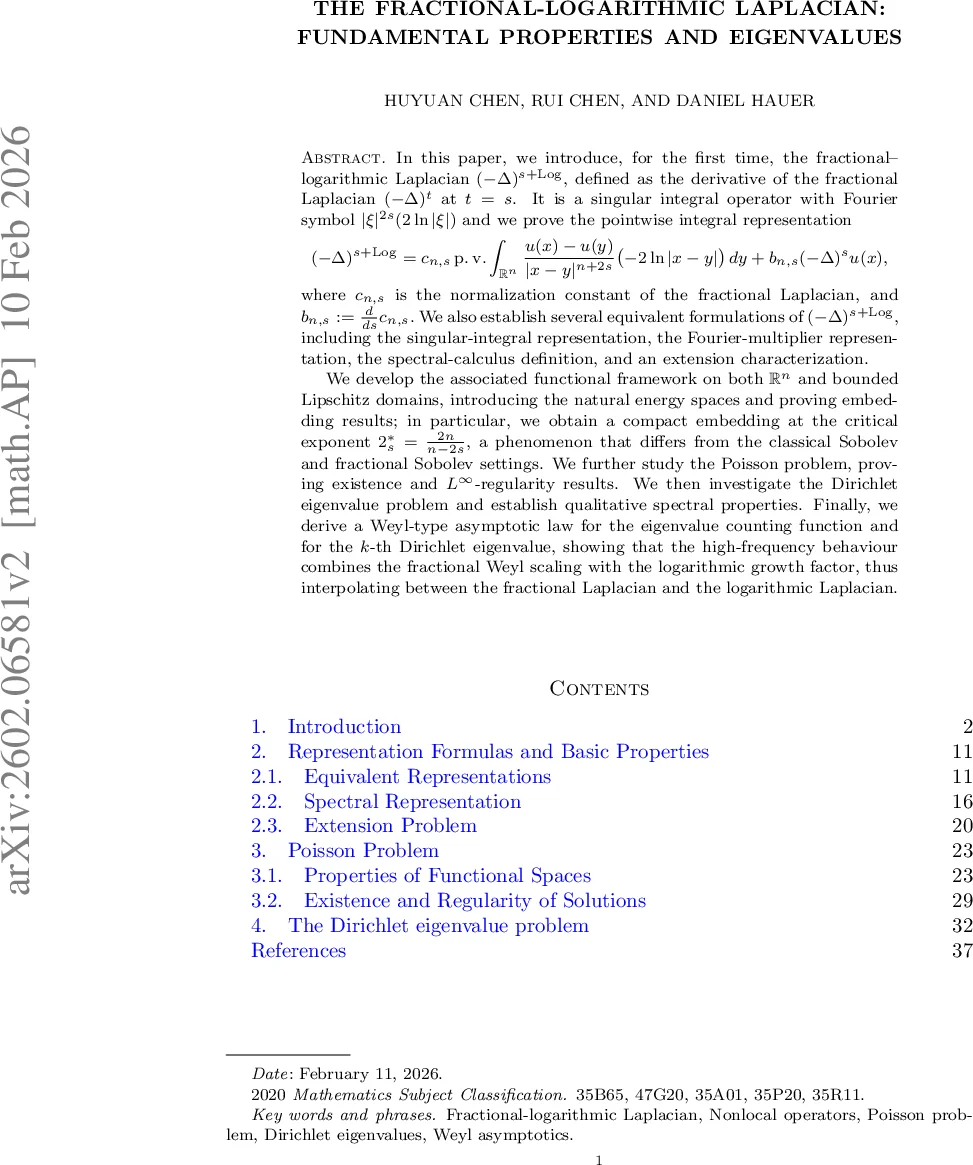
In this paper, we introduce, for the first time, the fractional–logarithmic Laplacian ( (-Δ)^{s+\log} ), defined as the derivative of the fractional Laplacian ( (-Δ)^t ) at ( t=s ). It is a singular integral operator with Fourier symbol ( |ξ|^{2s}(2\ln|ξ|) ), and we prove the pointwise integral representation [ (-Δ)^{s+\log}u(x) = c_{n,s},\mathrm{PV}!\int_{\mathbb{R}^n} \frac{u(x)-u(y)}{|x-y|^{n+2s}}\bigl(-2\ln|x-y|\bigr),dy + b_{n,s}(-Δ)^s u(x), ] where ( c_{n,s} ) is the normalization constant of the fractional Laplacian and ( b_{n,s}:=\frac{d}{ds}c_{n,s}.) We also establish several equivalent formulations of ( (-Δ)^{s+\log} ), including the singular-integral representation, the Fourier-multiplier representation, the spectral-calculus definition, and an extension characterization. We develop the associated functional framework on both ( \mathbb{R}^n ) and bounded Lipschitz domains, introducing the natural energy spaces and proving embedding results. In particular, we obtain a compact embedding at the critical exponent ( 2_s^*=\frac{2n}{n-2s},) a phenomenon that differs from the classical Sobolev and fractional Sobolev settings. We further study the Poisson problem, proving existence and ( L^\infty )-regularity results. We then investigate the Dirichlet eigenvalue problem and establish qualitative spectral properties. Finally, we derive a Weyl-type asymptotic law for the eigenvalue counting function and for the ( k )-th Dirichlet eigenvalue, showing that the high-frequency behavior combines the fractional Weyl scaling with a logarithmic growth factor, thereby interpolating between the fractional Laplacian and the logarithmic Laplacian.
💡 Research Summary
The paper introduces, for the first time, a novel non‑local operator called the fractional‑logarithmic Laplacian, denoted ( (-\Delta)^{s+\log} ). It is defined as the derivative with respect to the order of the classical fractional Laplacian ( (-\Delta)^t ) evaluated at a fixed exponent ( t=s\in(0,1) ): \
Comments & Academic Discussion
Loading comments...
Leave a Comment