Analysis of Hessian Scaling for Local and Global Costs in Variational Quantum Algorithm
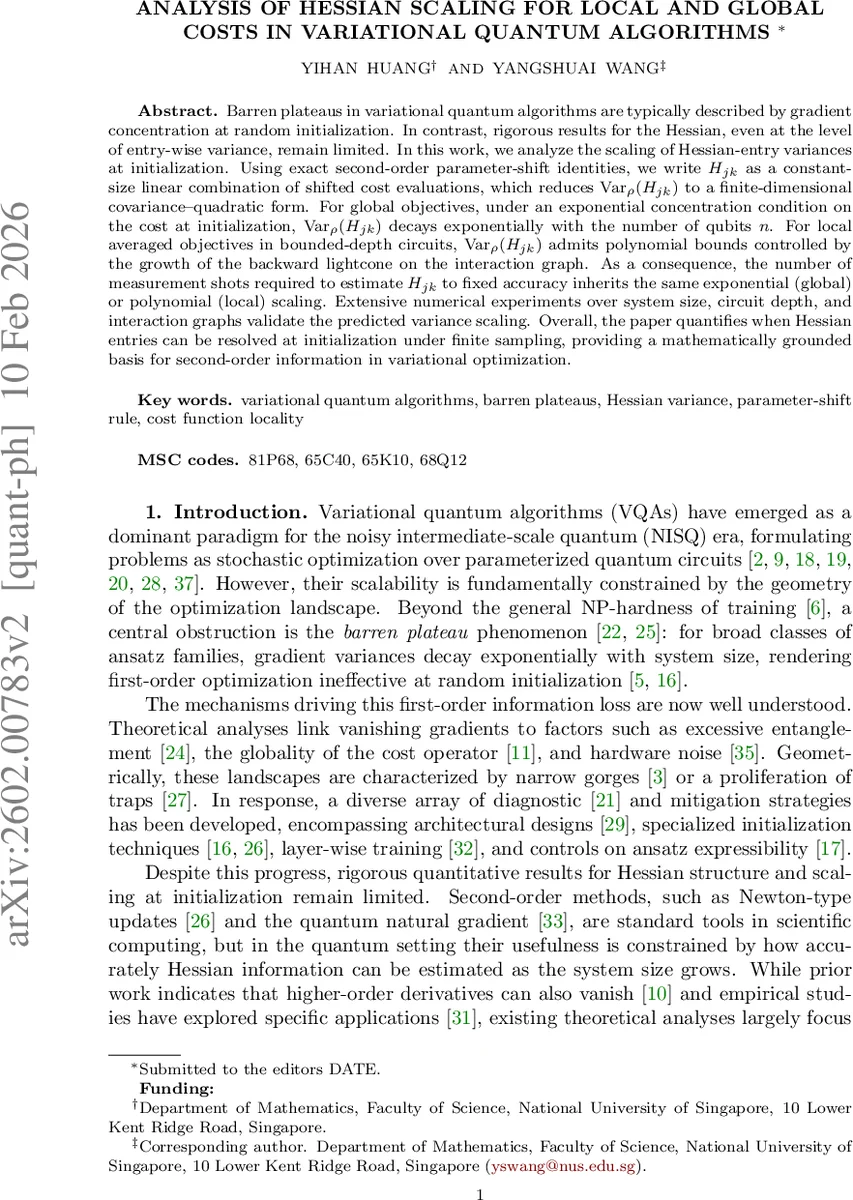
Barren plateaus in variational quantum algorithms are typically described by gradient concentration at random initialization. In contrast, rigorous results for the Hessian, even at the level of entry-wise variance, remain limited. In this work, we analyze the scaling of Hessian-entry variances at initialization. Using exact second-order parameter-shift identities, we write $H_{jk}$ as a constant-size linear combination of shifted cost evaluations, which reduces ${\rm Var}ρ(H{jk})$ to a finite-dimensional covariance–quadratic form. For global objectives, under an exponential concentration condition on the cost at initialization, ${\rm Var}ρ(H{jk})$ decays exponentially with the number of qubits $n$. For local averaged objectives in bounded-depth circuits, ${\rm Var}ρ(H{jk})$ admits polynomial bounds controlled by the growth of the backward lightcone on the interaction graph. As a consequence, the number of measurement shots required to estimate $H_{jk}$ to fixed accuracy inherits the same exponential (global) or polynomial (local) scaling. Extensive numerical experiments over system size, circuit depth, and interaction graphs validate the predicted variance scaling. Overall, the paper quantifies when Hessian entries can be resolved at initialization under finite sampling, providing a mathematically grounded basis for second-order information in variational optimization.
💡 Research Summary
This paper addresses a fundamental gap in the theory of variational quantum algorithms (VQAs): while the phenomenon of barren plateaus—exponential decay of gradient variance at random initialization—is now well understood, the behavior of second‑order information, namely the Hessian, has received far less rigorous treatment. The authors develop a comprehensive analytical framework for the scaling of Hessian‑entry variances at initialization and translate these results into concrete sampling‑cost estimates for practical Hessian estimation.
The technical core rests on exact second‑order parameter‑shift identities. By applying the parameter‑shift rule twice, each Hessian element (H_{jk}) is expressed as a constant‑size linear combination of shifted cost function evaluations (C(\theta\oplus s)) with shifts (s) drawn from a set of at most four configurations. This representation reduces the variance of a Hessian entry to a finite‑dimensional quadratic form in the covariances of the shifted costs: \
Comments & Academic Discussion
Loading comments...
Leave a Comment