MadAgents
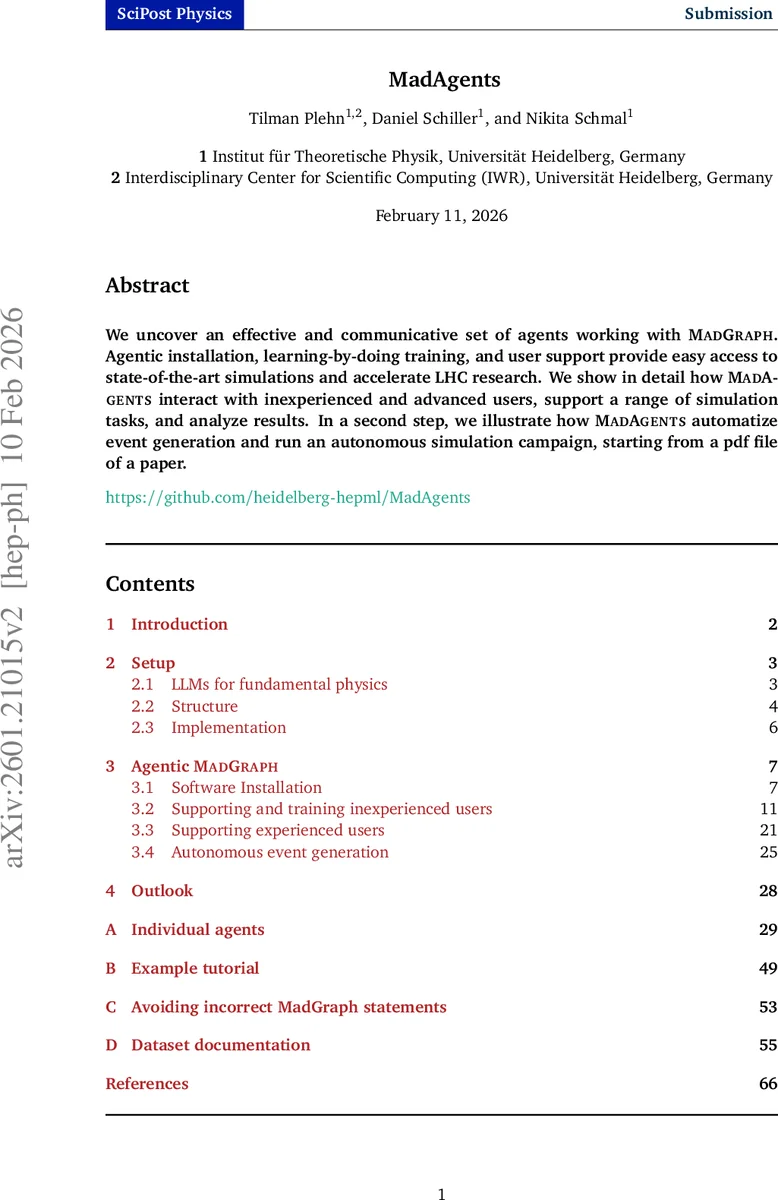
We uncover an effective and communicative set of agents working with MadGraph. Agentic installation, learning-by-doing training, and user support provide easy access to state-of-the-art simulations and accelerate LHC research. We show in detail how MadAgents interact with inexperienced and advanced users, support a range of simulation tasks, and analyze results. In a second step, we illustrate how MadAgents automatize event generation and run an autonomous simulation campaign, starting from a pdf file of a paper.
💡 Research Summary
The paper “MadAgents” introduces a novel agent‑based framework that integrates large language models (LLMs) with the MadGraph event‑generation ecosystem to streamline installation, training, and advanced usage for both novice and expert high‑energy physics (HEP) researchers. The authors argue that while modern LHC analyses rely heavily on precise simulations from tools such as MadGraph, Pythia, Delphes, and HERWIG, the complexity of installing, configuring, and operating these packages creates a substantial barrier, especially for newcomers.
MadAgents addresses this barrier by building a multi‑agent system on top of the LangGraph orchestration library. The architecture consists of a central Orchestrator that interprets user requests, delegates tasks to specialized Planner, Plan‑Updater, and Reviewer agents, and coordinates a suite of Worker agents: MG‑Operator (MadGraph‑specific commands), Script‑Operator (general Bash/Python scripting), CLI‑Operator (interactive shell control), Plotter (automatic figure generation), PDF‑Reader (extracting information from research papers), and Researcher (web‑based literature mining). Each worker operates with a limited context, receiving concise instructions from the Orchestrator, executing tool calls, and reporting results back for validation.
Installation is fully automated within an Apptainer container. The system can download and compile MadGraph, Pythia8, Delphes, and even ROOT from source, placing them under /opt. Dependency resolution, build‑log parsing, and environment configuration are performed by the LLM using chain‑of‑thought reasoning, with the Plan‑Updater revising plans when errors arise and the Reviewer ensuring that each step meets physical and technical criteria.
For novice users, MadAgents provides “learning‑by‑doing” tutorials. When a user asks for a MadGraph tutorial, the PDF‑Reader fetches existing documentation, the Orchestrator creates a step‑by‑step plan, and the MG‑Operator executes commands while the Script‑Operator offers corrective scripts in real time. Errors such as syntax mistakes or missing cards are automatically detected and fixed, allowing students to acquire hands‑on experience without deep prior knowledge.
Expert users benefit from advanced capabilities such as on‑shell next‑to‑leading order (NLO) top‑pair production, scale variations, PDF uncertainty propagation, and custom parameter scans. The Orchestrator decomposes complex requests into multi‑step workflows, the Planner generates a detailed execution plan, and the Reviewer continuously checks for physical consistency (e.g., gauge invariance, convergence of integrals). Results are stored in a shared /output directory, and the Plotter produces publication‑quality histograms and kinematic distributions following LaTeX‑compatible styling.
The most innovative demonstration is the autonomous simulation campaign driven solely by a PDF of a published paper. The PDF‑Reader extracts the model definition, parameter values, collider setup, and analysis cuts; the Researcher supplements missing information by querying arXiv and HEPData. The Orchestrator then orchestrates a full MadGraph‑Pythia‑Delphes pipeline: generating matrix‑element code, showering, detector simulation, and finally plotting. The entire workflow runs without further human interaction, reproducing the figures and event samples reported in the original article, thereby showcasing a powerful tool for reproducibility and rapid prototyping.
Technically, the agents rely on GPT‑5.1 for most tasks, with a lightweight GPT‑5‑mini model handling rapid plan updates. To mitigate the non‑deterministic nature of LLM outputs, a Summarizer agent periodically condenses long conversation histories, and the system is designed to request human feedback when confidence is low. All code, container images, and documentation are publicly released on GitHub, encouraging community contributions and extensions.
In conclusion, MadAgents dramatically lowers the entry barrier to state‑of‑the‑art HEP simulations, accelerates routine analysis, and opens the door to fully autonomous research pipelines. Future work will expand the framework to other generators (Sherpa, Herwig), integrate sophisticated parameter‑optimization agents, and explore collaborative multi‑agent environments for large‑scale LHC collaborations.
Comments & Academic Discussion
Loading comments...
Leave a Comment