Collective excitations in chiral spin liquid: chiral roton and long-wavelength nematic mode
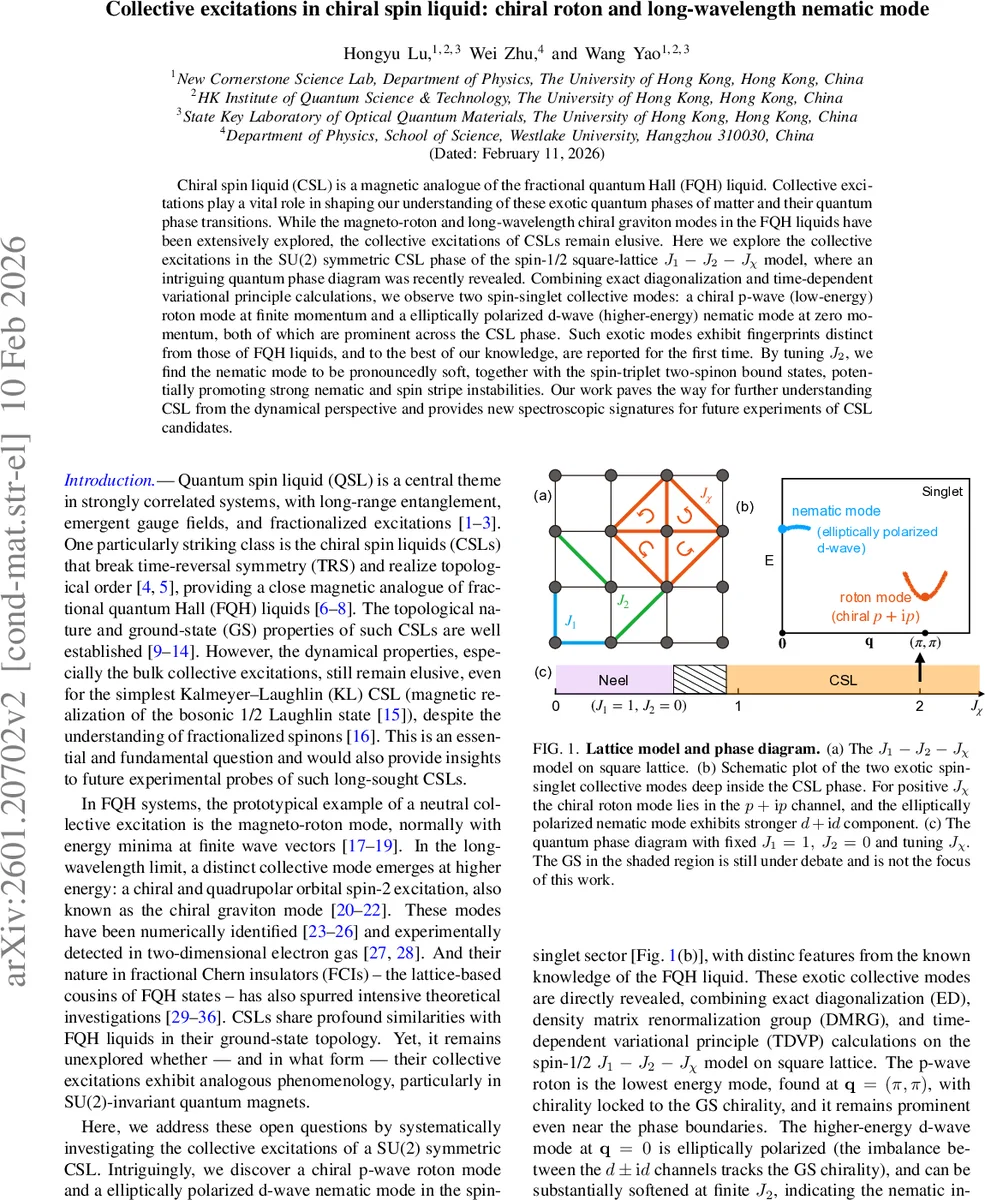
Chiral spin liquid (CSL) is a magnetic analogue of the fractional quantum Hall (FQH) liquid. Collective excitations play a vital role in shaping our understanding of these exotic quantum phases of matter and their quantum phase transitions. While the magneto-roton and long-wavelength chiral graviton modes in the FQH liquids have been extensively explored, the collective excitations of CSLs remain elusive. Here we explore the collective excitations in the SU(2) symmetric CSL phase of the spin-1/2 square-lattice $J_1-J_2-J_χ$ model, where an intriguing quantum phase diagram was recently revealed. Combining exact diagonalization and time-dependent variational principle calculations, we observe two spin-singlet collective modes: a chiral p-wave (low-energy) roton mode at finite momentum and a elliptically polarized d-wave (higher-energy) nematic mode at zero momentum, both of which are prominent across the CSL phase. Such exotic modes exhibit fingerprints distinct from those of FQH liquids, and to the best of our knowledge, are reported for the first time. By tuning $J_2$, we find the nematic mode to be pronouncedly soft, together with the spin-triplet two-spinon bound states, potentially promoting strong nematic and spin stripe instabilities. Our work paves the way for further understanding CSL from the dynamical perspective and provides new spectroscopic signatures for future experiments of CSL candidates.
💡 Research Summary
The manuscript investigates the collective excitations of a chiral spin liquid (CSL) realized in the spin‑½ J₁‑J₂‑Jχ Heisenberg model on the square lattice. While the ground‑state topology of CSLs—fractionalization, long‑range entanglement, and broken time‑reversal symmetry—has been extensively studied, their dynamical properties have remained largely unexplored. By combining exact diagonalization (ED) on 6 × 6 tori, density‑matrix renormalization group (DMRG) calculations, and time‑dependent variational principle (TDVP) simulations on long cylinders (4 × 32), the authors compute dynamical structure factors (DSFs) for several local operators: the spin component Sᶻ, nearest‑neighbor bond operators Bₓ and B_y, and a rank‑2 quadrupolar (d‑wave) operator D_{x²‑y²}=Bₓ−B_y.
Two distinct spin‑singlet collective modes are uncovered. The first is a low‑energy chiral p‑wave “roton” mode that appears at the Brillouin‑zone corner q = (π,π) with an energy ω≈1.76 J₁. Its spectral weight is maximized for the complex bond combination P₊ = Bₓ + i B_y, while the orthogonal combination P₋ = Bₓ − i B_y shows essentially no response. Overlap calculations using a single‑mode approximation (SMA) reveal that the excited state created by P₊ on the ground state has an overlap > 0.99 with the exact eigenstate, confirming that the mode is a chiral p‑wave excitation whose chirality is locked to the sign of the scalar chiral coupling Jχ. This is in stark contrast to the magneto‑roton mode of fractional quantum Hall (FQH) liquids, which does not carry an independent chirality quantum number despite the ground state’s broken time‑reversal symmetry.
The second mode is a higher‑energy d‑wave “nematic” excitation located at zero momentum (q = 0). In the DSF of D_{x²‑y²} a pronounced peak is observed, indicating a collective quadrupolar fluctuation. The mode is elliptically polarized: the spectral weight in the d + i d channel is roughly twice that in the d − i d channel, showing an imbalance between the two chiral components. Importantly, when the next‑nearest‑neighbor Heisenberg coupling J₂ is increased (e.g., J₂ = 0.6, Jχ = 0.5), the nematic mode softens dramatically, its energy dropping close to that of the lowest triplet excitation and its spectral weight becoming sharply concentrated. Overlap matrices confirm that the nematic mode is well described by a single‑mode ansatz built from D_{x²‑y²}, with overlaps ≈ 0.8–0.9, while no clear chirality selection is seen for this mode.
In the spin‑triplet sector, the authors identify finite‑momentum bound states (two‑spinon bound states) that appear as relatively sharp peaks in the spin‑Sᶻ DSF at (π,0) and (0,π). These bound states are interpreted as spin‑stripe fluctuations and have energies comparable to the softened nematic mode, suggesting a possible intertwined instability between nematic order and spin‑stripe order.
The paper situates these findings within the broader context of topological phases. While CSLs share many ground‑state features with bosonic Laughlin states (e.g., Kalmeyer–Laughlin CSL), the dynamical signatures are qualitatively different: (i) the roton mode carries a definite chirality, (ii) the long‑wavelength collective mode is a d‑wave quadrupolar excitation rather than the quadrupolar “graviton” of FQH systems, and (iii) the presence of low‑energy triplet bound states points to competing magnetic orders. The authors argue that these distinctive dynamical fingerprints provide concrete spectroscopic targets for experiments such as inelastic neutron scattering, Raman spectroscopy, or THz pump‑probe measurements on candidate materials (e.g., kagome or square‑lattice magnets with sizable scalar chiral interactions).
Overall, the work delivers the first comprehensive dynamical characterization of a chiral spin liquid, revealing a chiral p‑wave roton and an elliptically polarized d‑wave nematic mode, and highlights how tuning microscopic parameters can drive the system toward nematic or spin‑stripe instabilities. These insights deepen our understanding of how topological order manifests in the excitation spectrum of quantum magnets and open new avenues for probing CSLs experimentally.
Comments & Academic Discussion
Loading comments...
Leave a Comment