Qhronology: A Python package for studying quantum models of closed timelike curves
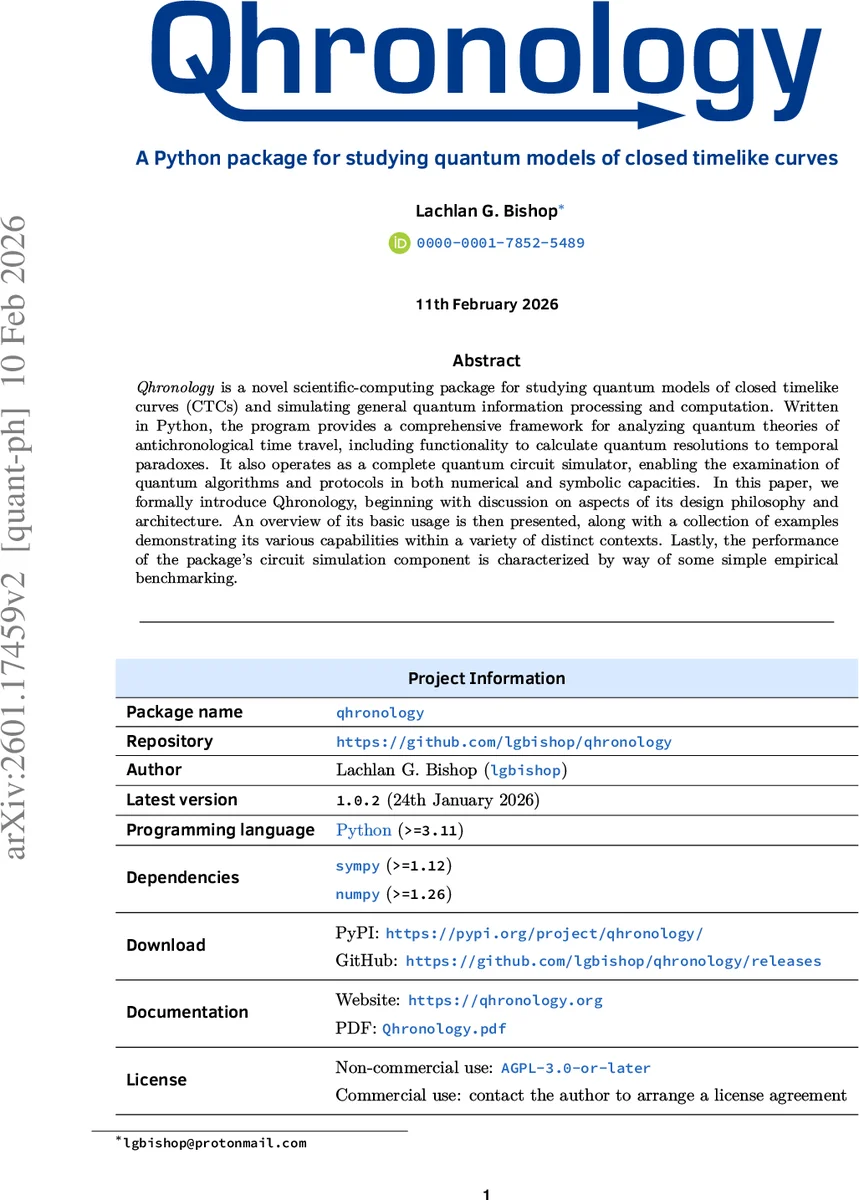
Qhronology is a novel scientific-computing package for studying quantum models of closed timelike curves (CTCs) and simulating general quantum information processing and computation. Written in Python, the program provides a comprehensive framework for analyzing quantum theories of antichronological time travel, including functionality to calculate quantum resolutions to temporal paradoxes. It also operates as a complete quantum circuit simulator, enabling the examination of quantum algorithms and protocols in both numerical and symbolic capacities. In this paper, we formally introduce Qhronology, beginning with discussion on aspects of its design philosophy and architecture. An overview of its basic usage is then presented, along with a collection of examples demonstrating its various capabilities within a variety of distinct contexts. Lastly, the performance of the package’s circuit simulation component is characterized by way of some simple empirical benchmarking.
💡 Research Summary
Qhronology is a Python‑based scientific‑computing library designed to facilitate the study of quantum models of closed timelike curves (CTCs) and to serve as a general quantum circuit simulator. The package, first released in early 2026 (current version 1.0.2), depends on Python ≥ 3.11, SymPy ≥ 1.12, and NumPy ≥ 1.26, and is distributed under the AGPL‑3.0‑or‑later license (non‑commercial use is free, commercial use requires a separate agreement).
Design and Architecture
The codebase is split into three sub‑packages: quantum, mechanics, and utilities. The quantum package contains the user‑facing API, while mechanics implements the core mathematical operations (state evolution, fixed‑point solving, non‑unitary transformations). utilities houses internal helpers, a lightweight visualization engine, and the abstract QuantumObject class. QuantumObject provides shared matrix, symbolic, and drawing functionality; it is subclassed by QuantumState (mutable) and QuantumGate (immutable). This hierarchy enables a clean, extensible object‑oriented model where both states and gates share a common foundation.
Symbolic‑Numeric Integration
Qhronology leverages SymPy to create parameterized symbols that can be embedded directly into matrix representations, allowing the definition of “parameterized circuits”. NumPy is used for the heavy linear‑algebra work, but the current implementation still relies on Python‑level loops for many operations, limiting raw performance. Lazy evaluation and result caching are provided to avoid redundant calculations, though memory management remains a work‑in‑progress.
CTC Prescriptions
Two major quantum‑time‑travel prescriptions are implemented:
Deutsch‑CTC (D‑CTC) – solves the fixed‑point condition ρ_CV = Tr_CR
Comments & Academic Discussion
Loading comments...
Leave a Comment