The Refutability Gap: Challenges in Validating Reasoning by Large Language Models
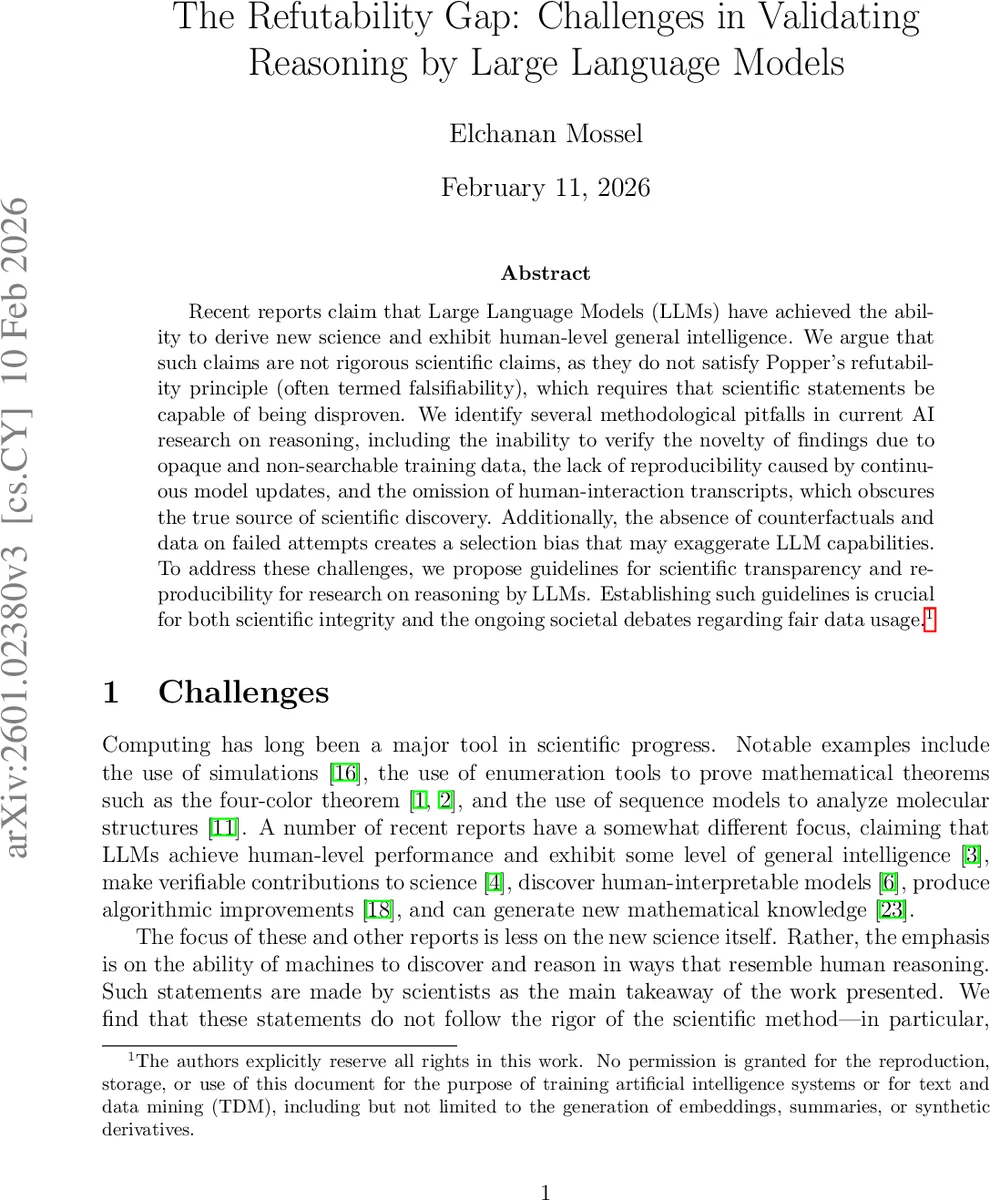
Recent reports claim that Large Language Models (LLMs) have achieved the ability to derive new science and exhibit human-level general intelligence. We argue that such claims are not rigorous scientific claims, as they do not satisfy Popper’s refutability principle (often termed falsifiability), which requires that scientific statements be capable of being disproven. We identify several methodological pitfalls in current AI research on reasoning, including the inability to verify the novelty of findings due to opaque and non-searchable training data, the lack of reproducibility caused by continuous model updates, and the omission of human-interaction transcripts, which obscures the true source of scientific discovery. Additionally, the absence of counterfactuals and data on failed attempts creates a selection bias that may exaggerate LLM capabilities. To address these challenges, we propose guidelines for scientific transparency and reproducibility for research on reasoning by LLMs. Establishing such guidelines is crucial for both scientific integrity and the ongoing societal debates regarding fair data usage.
💡 Research Summary
The paper “The Refutability Gap: Challenges in Validating Reasoning by Large Language Models” offers a rigorous philosophical and methodological critique of the recent wave of claims that large language models (LLMs) are capable of generating new scientific knowledge and exhibiting human‑level general intelligence. The authors begin by recalling how computing has historically accelerated scientific progress—through simulations, automated theorem proving, and molecular modeling—and note that the current excitement around LLMs shifts the focus from concrete scientific results to the more nebulous assertion that machines can “reason like humans.”
Using Karl Popper’s principle of falsifiability as a yardstick, the authors argue that most LLM‑based science papers fail to meet the minimal requirement for a claim to be scientific: it must be refutable. They identify four systematic “pitfalls” that undermine refutability:
-
Inability to verify novelty – LLMs are trained on massive, largely proprietary corpora that are not publicly searchable. Consequently, when a model outputs a purportedly novel theorem, algorithm, or material structure, there is no reliable way to determine whether the result truly lies outside the training set or is merely a re‑phrasing of existing literature. This “data leakage” problem has been documented in prior work on AI‑driven science.
-
Model dynamics and continuous updates – Most high‑performing LLMs receive ongoing fine‑tuning and data additions. Without a precise snapshot of the model version, hyper‑parameters, and the exact update schedule used for an experiment, other researchers cannot faithfully reproduce the reported reasoning process. This contributes to the broader reproducibility crisis in AI.
-
Missing interaction transcripts – The papers rarely publish the full prompt‑response logs that capture the human‑in‑the‑loop guidance. Because many LLMs retain context across multiple chat sessions, a single transcript is insufficient to reconstruct the entire reasoning trajectory. Without these logs, it is impossible to separate the contribution of the model from that of the human researcher.
-
Selection bias from omitted failures and counterfactuals – Successful discoveries are highlighted, while failed attempts, dead‑ends, and “what‑if” scenarios (e.g., what would have happened without the model) are not reported. This bias inflates perceived efficiency gains and obscures the true marginal benefit of LLM assistance.
The authors illustrate these pitfalls with concrete case studies: AlphaTensor’s matrix‑multiplication algorithms, GNoME’s crystal‑structure generation, GSM‑Symbolic’s mathematical reasoning benchmarks, and the more recent AlphaEvolve project that attempted large‑scale mathematical exploration. In each case, initial headlines suggested breakthrough novelty, but subsequent analyses revealed either rediscovery of known results, heavy reliance on prompt engineering, or insufficient reporting of computational resources and failure logs.
To close the “refutability gap,” the paper proposes a concrete set of transparency and reproducibility guidelines, summarized as the T‑D‑A‑P framework:
- Training algorithm (T): Release the exact code, hyper‑parameters, and training schedule used to build the model.
- Training data (D): Provide a fully indexed, searchable version of the training corpus (or at least a detailed description and provenance) to enable leakage analysis.
- AI architecture & weights (A): Publish the model architecture, weight files (or checksums), and precise version identifier.
- Interaction transcript (P): Release the complete, time‑ordered log of all prompts, responses, context summaries, and failed attempts that led to the final result.
The authors further recommend that papers include metadata on energy consumption, FLOP counts, hardware specifications, random seeds, and explicit counterfactual experiments (e.g., a baseline run without the LLM). They argue that such standards are essential not only for scientific integrity but also for ongoing societal debates about data ownership, copyright, and the fairness of using proprietary text corpora to train models that may “re‑publish” existing knowledge as if it were original.
In conclusion, the paper asserts that without systematic adoption of these guidelines, claims of LLM‑driven scientific discovery remain philosophically untenable and empirically unverifiable. By enforcing full disclosure of training pipelines, data provenance, model versions, and human‑model interaction histories, the community can restore the possibility of genuine falsification, allowing LLMs to be evaluated as true scientific tools rather than as black‑box hype generators.
Comments & Academic Discussion
Loading comments...
Leave a Comment