Picard rank and Ulrich line bundles on bidouble planes
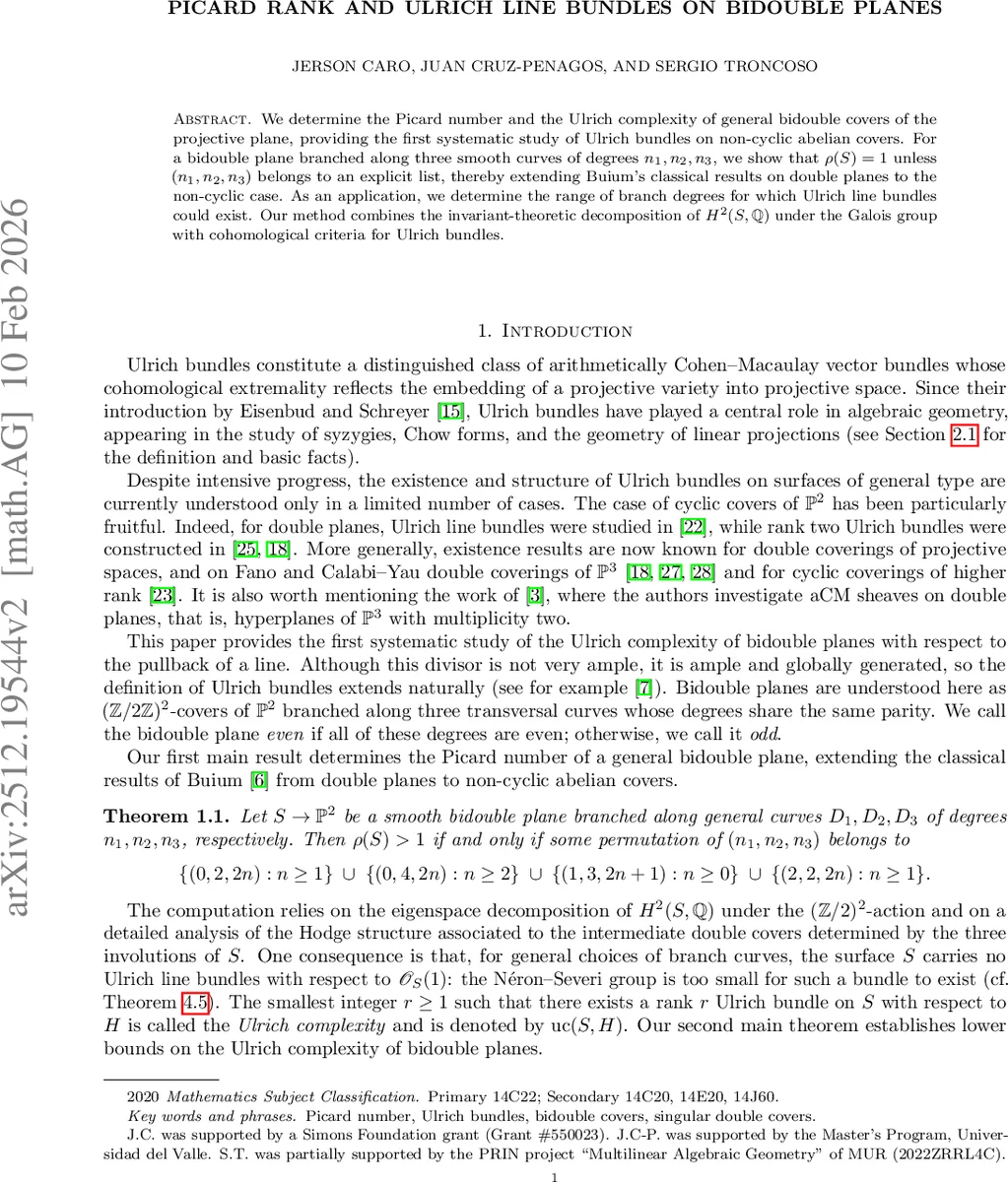
We determine the Picard number and the Ulrich complexity of general bidouble covers of the projective plane, providing the first systematic study of Ulrich bundles on non-cyclic abelian covers. For a bidouble plane branched along three smooth curves of degrees $n_1,n_2,n_3$, we show that $ρ(S)=1$ unless $(n_1,n_2,n_3)$ belongs to an explicit list, thereby extending Buium’s classical results on double planes to the non-cyclic case. As an application, we determine the range of branch degrees for which Ulrich line bundles could exist. Our method combines the invariant-theoretic decomposition of $H^2(S,\mathbb{Q})$ under the Galois group with cohomological criteria for Ulrich bundles.
💡 Research Summary
The paper “Picard rank and Ulrich line bundles on bidouble planes” by Caro, Cruz‑Penagos and Troncoso investigates two fundamental invariants of smooth bidouble covers of the projective plane: the Picard number ρ(S) and the Ulrich complexity uc(S, H), where H = 𝒪_S(1) is the pull‑back of a line from ℙ². A bidouble plane is a Galois cover with group (ℤ/2)², branched along three smooth curves D₁, D₂, D₃ of degrees n₁, n₂, n₃ that share the same parity. The authors call the surface “even’’ when all n_i are even and “odd’’ otherwise.
The first main result (Theorem 1.1) determines precisely when the Picard number exceeds one. By analysing the eigenspace decomposition of H²(S,ℚ) under the (ℤ/2)²‑action and the geometry of the three intermediate double covers Y₁, Y₂, Y₃, they prove that for a general choice of branch curves ρ(S)=1 except when a permutation of (n₁,n₂,n₃) belongs to the explicit list
\
Comments & Academic Discussion
Loading comments...
Leave a Comment