Asymptotic Inference for Rank Correlations
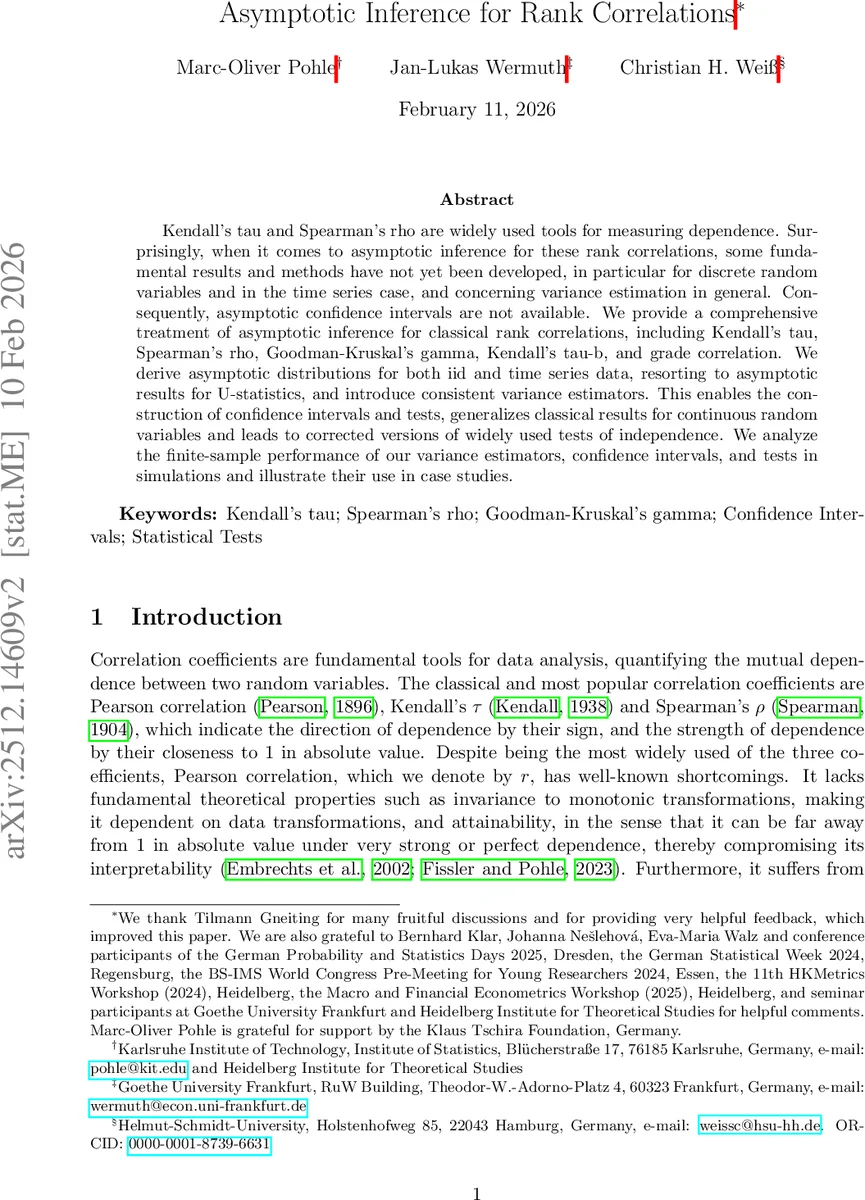
Kendall’s tau and Spearman’s rho are widely used tools for measuring dependence. Surprisingly, when it comes to asymptotic inference for these rank correlations, some fundamental results and methods have not yet been developed, in particular for discrete random variables and in the time series case, and concerning variance estimation in general. Consequently, asymptotic confidence intervals are not available. We provide a comprehensive treatment of asymptotic inference for classical rank correlations, including Kendall’s tau, Spearman’s rho, Goodman-Kruskal’s gamma, Kendall’s tau-b, and grade correlation. We derive asymptotic distributions for both iid and time series data, resorting to asymptotic results for U-statistics, and introduce consistent variance estimators. This enables the construction of confidence intervals and tests, generalizes classical results for continuous random variables and leads to corrected versions of widely used tests of independence. We analyze the finite-sample performance of our variance estimators, confidence intervals, and tests in simulations and illustrate their use in case studies.
💡 Research Summary
This paper delivers a comprehensive treatment of asymptotic inference for the classical rank‑based correlation measures—Kendall’s τ, Spearman’s ρ, Goodman‑Kruskal’s γ, and the tie‑adjusted versions τ_b and ρ_b. The authors begin by revisiting the population definitions of these coefficients through the lens of mid‑distribution functions and sign functions, which allows a unified formulation that works for both continuous and discrete margins. They emphasize that in the discrete case the single‑ and double‑tie probabilities (ζ and ζ₂) play a crucial role in the limiting variances, a fact that has been largely ignored in the existing literature.
Using the theory of U‑statistics, the paper shows that the empirical versions of τ and γ are exact second‑order U‑statistics, while the empirical ρ and its variants are asymptotically equivalent to such U‑statistics. For independent and identically distributed (iid) samples, the authors extend Hoeffding’s classic results to derive explicit asymptotic normal distributions for all five coefficients, providing closed‑form variance formulas that incorporate the tie probabilities. They then propose consistent estimators for these asymptotic variances based on the same U‑statistic structure, proving consistency and offering practical algorithms for implementation.
The analysis is further broadened to weakly dependent time‑series observations. By leveraging recent invariance principles for U‑statistics of order two under mixing conditions, the authors establish that the same asymptotic normality holds for τ_b, ρ_b, and γ when the data exhibit weak dependence (e.g., α‑mixing, β‑mixing). A multivariate central limit theorem for vectors of U‑statistics is also proved, which yields the joint asymptotic covariance matrix of the rank correlations and enables simultaneous inference.
A thorough simulation study evaluates the finite‑sample performance of the proposed variance estimators, confidence intervals, and independence tests across a wide range of data‑generating processes: continuous (Gaussian, t‑distribution), discrete (Bernoulli, multinomial), and various time‑series models (AR(1), MA, GARCH). The results demonstrate that the new estimators are essentially unbiased, achieve nominal coverage rates, and outperform the commonly used approximations (e.g., Fieller’s method) especially in the presence of ties or serial dependence.
Two empirical applications illustrate the practical relevance of the methodology. The first analyzes daily financial return ranks, constructing confidence intervals for τ and ρ and performing a corrected independence test that is more conservative than the traditional test based on continuous‑variable asymptotics. The second examines ordinal survey responses, revealing significant dependence captured by γ and τ_b but not by ρ_b, thereby highlighting the importance of choosing the appropriate rank measure.
The paper concludes by summarizing its contributions: (i) a unified asymptotic theory for rank correlations covering continuous, discrete, and mixed data; (ii) consistent variance estimators that make confidence intervals and hypothesis tests feasible; (iii) extensions to weakly dependent time series; and (iv) an open‑source R package (“R Cor”) that implements all proposed procedures. Future research directions include high‑dimensional extensions, non‑linear dependence structures, and robust versions of the estimators.
Comments & Academic Discussion
Loading comments...
Leave a Comment