Local vertices, quadratic propagators and double-copy structure of one-loop integrands from forward limits
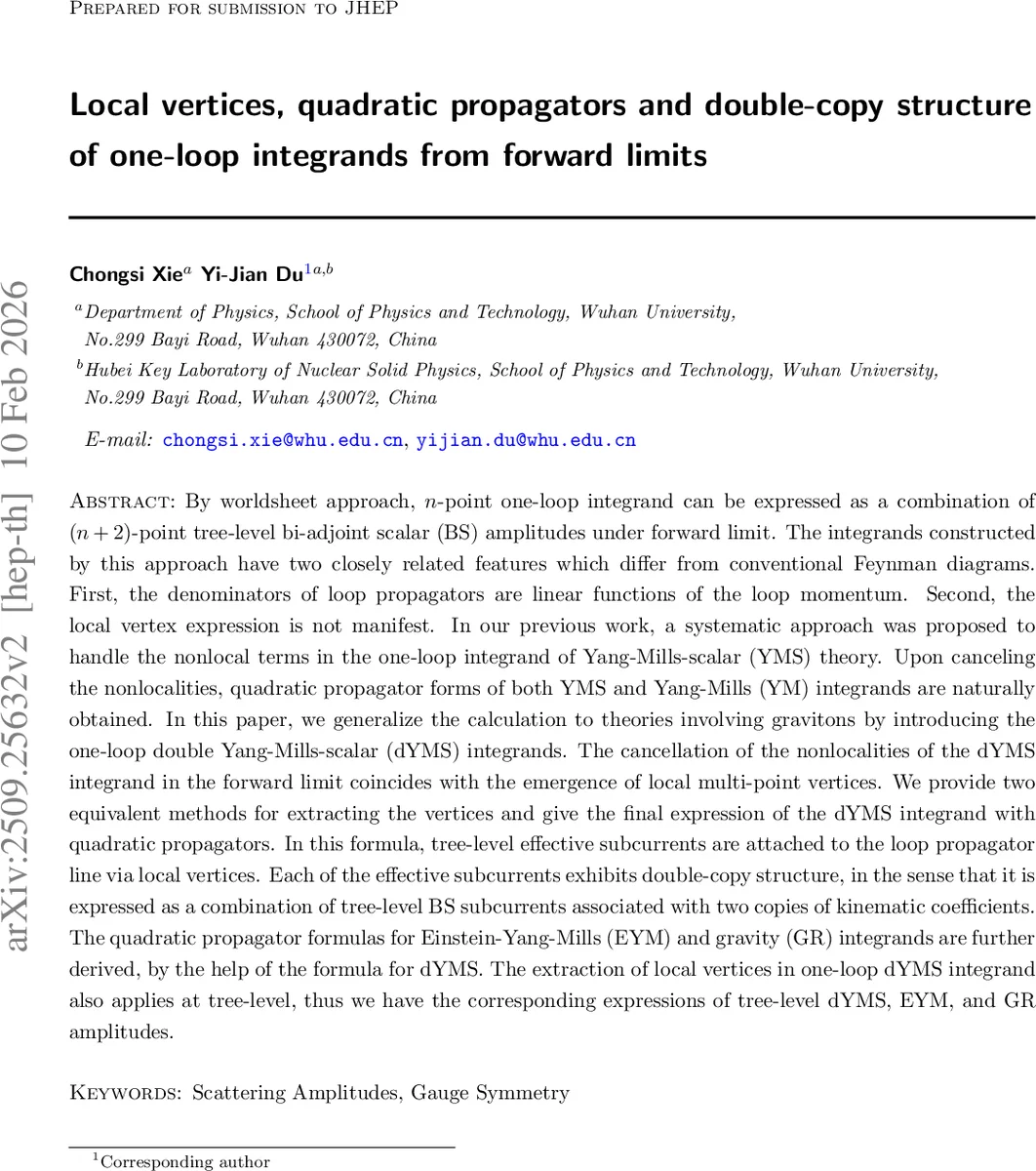
By worldsheet approach, $n$-point one-loop integrand can be expressed as a combination of $(n+2)$-point tree-level bi-adjoint scalar (BS) amplitudes under forward limit. The integrands constructed by this approach have two closely related features which differ from conventional Feynman diagrams. First, the denominators of loop propagators are linear functions of the loop momentum. Second, the local vertex expression is not manifest. In our previous work, a systematic approach was proposed to handle the nonlocal terms in the one-loop integrand of Yang-Mills-scalar (YMS) theory. Upon canceling the nonlocalities, quadratic propagator forms of both YMS and Yang-Mills (YM) integrands are naturally obtained. In this paper, we generalize the calculation to theories involving gravitons by introducing the one-loop double Yang-Mills-scalar (dYMS) integrands. The cancellation of the nonlocalities of the dYMS integrand in the forward limit coincides with the emergence of local multi-point vertices. We provide two equivalent methods for extracting the vertices and give the final expression of the dYMS integrand with quadratic propagators. In this formula, tree-level effective subcurrents are attached to the loop propagator line via local vertices. Each of the effective subcurrents exhibits double-copy structure, in the sense that it is expressed as a combination of tree-level BS subcurrents associated with two copies of kinematic coefficients. The quadratic propagator formulas for Einstein-Yang-Mills (EYM) and gravity (GR) integrands are further derived, by the help of the formula for dYMS. The extraction of local vertices in one-loop dYMS integrand also applies at tree-level, thus we have the corresponding expressions of tree-level dYMS, EYM, and GR amplitudes.
💡 Research Summary
The paper investigates the structure of one‑loop scattering integrands obtained from the world‑sheet (CHY/ambitwistor) approach, where an n‑point one‑loop amplitude is generated by taking the forward limit of an (n + 2)‑point tree‑level bi‑adjoint scalar (BS) amplitude. In this construction the loop propagators appear with linear denominators of the form l·K, unlike the quadratic denominators (l + K)² familiar from conventional Feynman diagrams. Moreover, the locality of the integrand—i.e. the presence of manifest local vertices—is not obvious.
Building on the authors’ earlier work on Yang‑Mills‑scalar (YMS) theory, they first recall how non‑local terms in the YMS one‑loop integrand can be systematically cancelled, resulting in a representation with quadratic propagators and manifest local vertices. The present work extends this method to theories that contain gravitons by introducing the double‑Yang‑Mills‑scalar (dYMS) integrand. The dYMS integrand consists of two copies of the YMS half‑integrand, one copy carrying the kinematic data of a Yang‑Mills sector and the other copy carrying a second, independent copy. This double‑copy structure is the key to treating Einstein‑Yang‑Mills (EYM) and pure gravity (GR) at one loop.
The authors classify dYMS partial integrands according to the number |W| of external states that carry two polarization vectors (the “W‑set”). For each |W| = 0, 1, 2, 3 they develop a systematic “localisation” procedure:
- Graphic rule and off‑shell BCJ relations – Using refined graphic rules for BS Berends‑Giele currents and off‑shell BCJ identities, they identify all non‑local contributions that arise after the forward limit.
- Cancellation of non‑localities – By exploiting the BCJ relations they reorganise the terms so that every non‑local piece cancels against another, leaving only local expressions.
- Extraction of multi‑point vertices – The cancellation process naturally generates new multi‑point vertices (e.g. 2x‑1w, 2x‑1y‑1z‑1w, etc.). The authors provide explicit examples for low‑point cases (X = {x₁}, Y = {y₁,y₂}, Z = {z₁,z₂}, …) and then give general formulas for arbitrary multiplicities.
- Quadratic propagator form – After localisation, the partial integrand can be written as a product of quadratic propagators 1/(l + K)² attached to a line of effective tree‑level currents. The full integrand follows from a partial‑fraction identity.
A central result is that each effective current attached to the loop line can be expressed as a double‑copy: it is a linear combination of BS Berends‑Giele currents multiplied by two copies of kinematic coefficients. On‑shell, these currents reproduce the familiar tree‑level double‑copy representation of gravity amplitudes, and off‑shell they provide the building blocks for BCJ numerators with quadratic propagators.
By substituting one copy of the dYMS current with a pure Yang‑Mills current and the other with a graviton current, the authors obtain explicit one‑loop integrands for EYM and GR. These integrands feature:
- Quadratic propagators for every internal line,
- Local multi‑point vertices whose structure is completely determined by the cancellation procedure,
- Tree‑level effective currents with double‑copy form, guaranteeing that the resulting numerators satisfy BCJ relations.
The paper also shows that the localisation technique works at tree level: the same extraction of local vertices yields compact tree‑level dYMS, EYM, and GR amplitudes expressed in terms of BS currents and double‑copy kinematic factors.
In summary, the work provides:
- A concrete algorithm to convert forward‑limit generated one‑loop integrands with linear propagators into a manifestly local form with quadratic propagators.
- A systematic classification of the new multi‑point vertices that appear for different numbers of graviton insertions.
- An explicit double‑copy structure for the effective currents, bridging BS theory, YMS, and gravity.
- Practical formulas for one‑loop EYM and GR amplitudes that are ready for use in amplitude‑based calculations and for the construction of BCJ numerators with quadratic propagators.
These results deepen our understanding of the interplay between world‑sheet formulations, BCJ duality, and the traditional Feynman diagram picture, and they open a pathway toward systematic higher‑loop constructions of double‑copy compatible integrands.
Comments & Academic Discussion
Loading comments...
Leave a Comment