Neural Gaussian Radio Fields for Channel Estimation
Accurate channel state information (CSI) is a critical bottleneck in modern wireless networks, with pilot overhead consuming 11% to 21% of transmission bandwidth and feedback delays causing severe throughput degradation under mobility. Addressing this requires rethinking how neural fields represent coherent wave phenomena. This work introduces \textit{neural Gaussian radio fields (\textcolor{stanfordred}{nGRF})}, a physics-informed framework that fundamentally reframes neural field design by replacing view-dependent rasterization with direct complex-valued aggregation in 3D space. This approach natively models wave superposition rather than visual occlusion. The architectural shift transforms the learning objective from function-fitting to source-recovery, a well-posed inverse problem grounded in electromagnetic theory. While demonstrated for wireless channel estimation, the core principle of explicit primitive-based fields with physics-constrained aggregation extends naturally to any coherent wave-based domain, including acoustic propagation, seismic imaging, and ultrasound reconstruction. Evaluations show that the inductive bias of \textcolor{stanfordred}{nGRF} achieves 10.9 dB higher prediction SNR than state-of-the-art methods with 220$\times$ faster inference (1.1 ms vs. 242 ms), 18$\times$ lower measurement density, and 180$\times$ faster training. For large-scale outdoor environments where implicit methods fail, \textcolor{stanfordred}{nGRF} achieves 28.32 dB SNR, demonstrating that structured representations supplemented by domain physics can fundamentally outperform generic deep learning architectures.
💡 Research Summary
The paper tackles the long‑standing bottleneck of acquiring accurate channel state information (CSI) in modern wireless networks by introducing a physics‑informed neural representation called neural Gaussian Radio Fields (nGRF). Traditional data‑driven CSI estimators ignore the 3‑D spatial structure of radio propagation, while recent neural field approaches either rely on implicit volumetric representations (NeRF‑style) that require costly ray‑marching for each query, or adapt 3D Gaussian splatting techniques that use alpha‑compositing designed for visual occlusion. Both paradigms are mismatched to electromagnetic wave physics, which is governed by linear superposition of complex‑valued fields rather than visibility ordering.
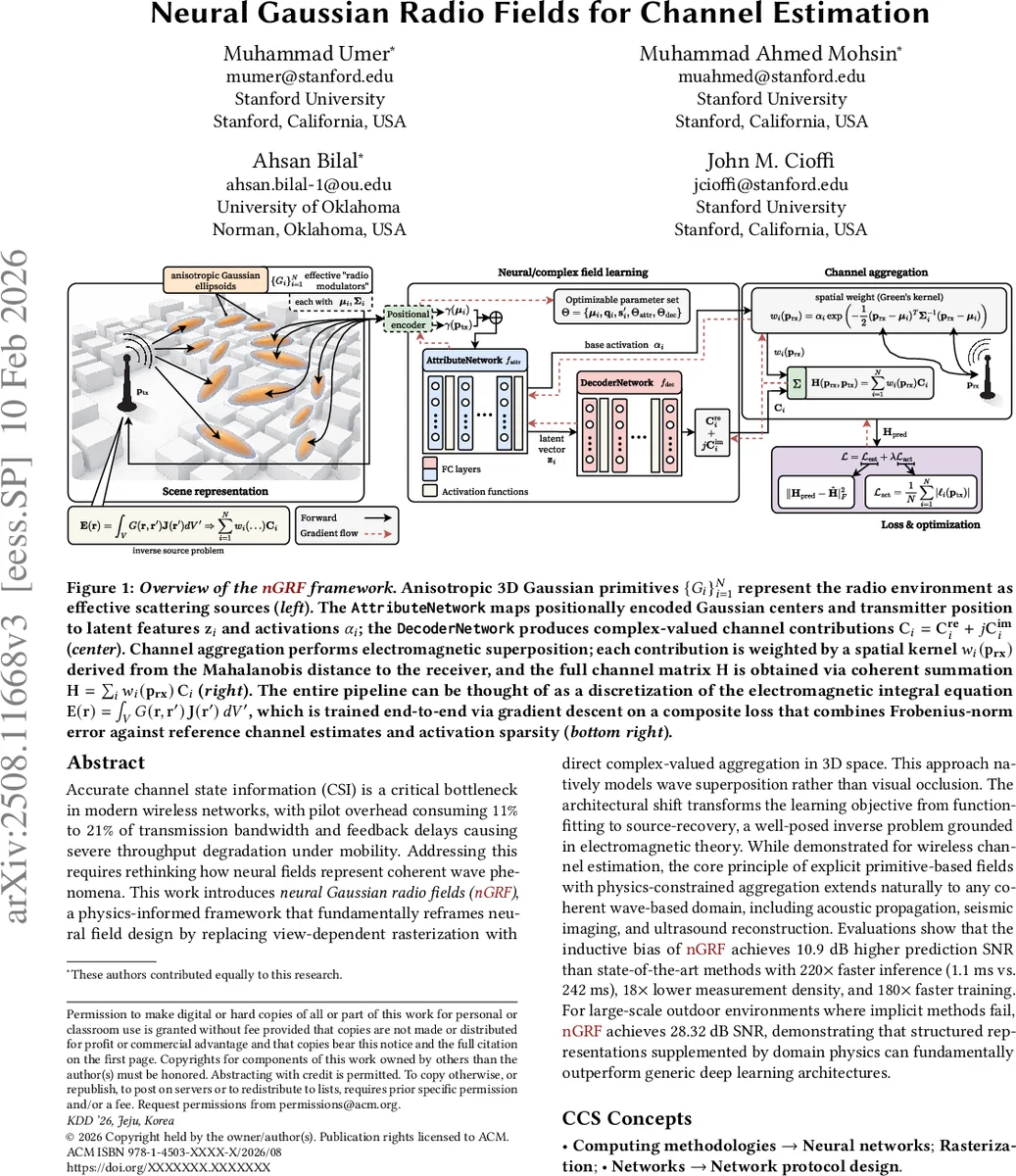
nGRF departs from these designs by modeling the radio environment as a set of N anisotropic 3‑D Gaussian primitives. Each primitive i is defined by a mean position μi, an anisotropic covariance Σi, and a complex amplitude Ai that depends on the transmitter and receiver locations. The contribution of primitive i to a receiver at position prx is computed as Ci(prx)=Ai·Gi(prx)·wi(prx), where Gi is the Gaussian spatial kernel and wi is a Mahalanobis‑distance‑based weight that encodes path loss and phase shift. The full channel matrix H is obtained by coherently summing all contributions, which directly implements the electromagnetic integral equation E(r)=∫V G(r,r′)J(r′)dV′ in a discretized form.
The architecture consists of an Attribute Network that maps positional encodings of μi and the transmitter location to latent features zi and activation scalars αi, followed by a Decoder Network that produces the complex field contributions. Training minimizes a composite loss: a Frobenius‑norm term measuring the error between predicted and reference CSI, plus a sparsity regularizer on the activations to encourage a compact set of effective sources. This shifts the learning objective from pure function fitting (H = fθ) to a well‑posed inverse problem of source recovery, leveraging the inherent regularization of the Gaussian basis and electromagnetic constraints.
Extensive experiments cover both small indoor volumes (≈10 m³) and large outdoor urban volumes (≈1000 m³). Compared with state‑of‑the‑art NeRF‑based RF‑NeRF, 3DGS‑based RF‑3DGS, and conventional deep CSI estimators, nGRF achieves an average 10.9 dB higher prediction SNR, with a peak of 28.32 dB in challenging NLOS outdoor scenarios. Inference time drops to 1.1 ms (≈220× faster), training time is reduced by a factor of 180, and the required measurement density is cut by 18×, demonstrating remarkable data efficiency. A single‑subcarrier trained model generalizes across the entire band, confirming that the network learns spatial propagation structure rather than frequency‑specific mappings.
Limitations include the need to pre‑select the number of primitives and potential inaccuracies when the environment contains highly non‑linear scattering that deviates from the assumed Green’s function approximation. The authors propose future work on adaptive primitive addition/removal, environment‑specific kernel learning, and multi‑frequency joint training to further improve robustness.
In summary, nGRF offers a novel synthesis of explicit physics‑based primitives and deep learning optimization, delivering unprecedented accuracy, speed, and efficiency for CSI estimation. Its ability to reduce pilot overhead from 11‑21 % to 0.2 % makes it a compelling candidate for real‑time deployment in 5G/6G systems, enabling more effective beamforming, massive MIMO, and dynamic spectrum management.
Comments & Academic Discussion
Loading comments...
Leave a Comment