New series involving binomial coefficients (III)
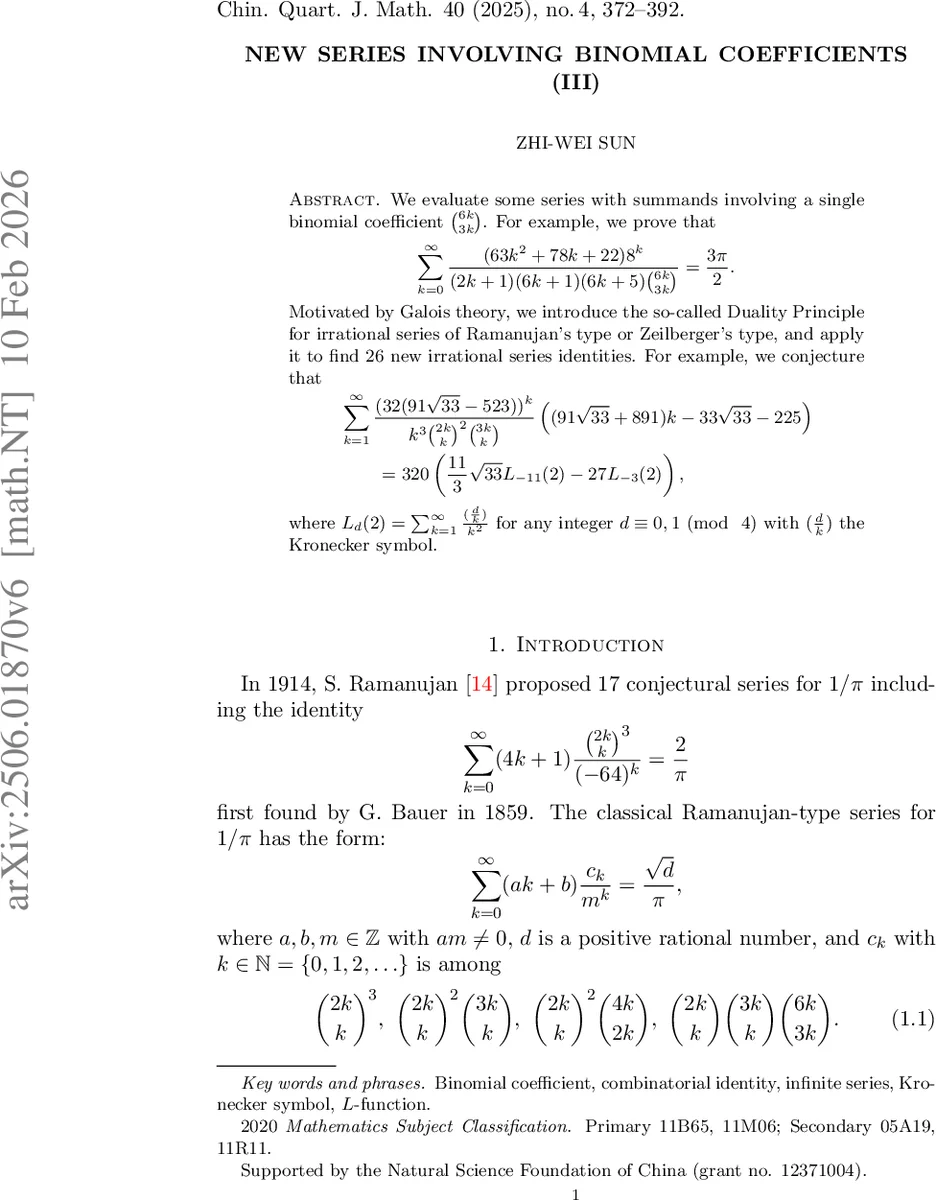
We evaluate some series with summands involving a single binomial coefficient $\binom{6k}{3k}$. For example, we prove that $$\sum_{k=0}^\infty\frac{(63k^2+78k+22)8^k}{(2k+1)(6k+1)(6k+5)\binom{6k}{3k}}=\frac{3π}2.$$ Motivated by Galois theory, we introduce the so-called Duality Principle for irrational series of Ramanujan’s type or Zeilberger’s type, and apply it to find 26 new irrational series identities. For example, we conjecture that \begin{align*}&\sum_{k=1}^\infty\frac{(32(91\sqrt{33}-523))^{k}}{k^3\binom{2k}k^2\binom{3k}k} \left((91\sqrt{33}+891)k-33\sqrt{33}-225\right) \&\qquad=320\left(\frac{11}3\sqrt{33}L_{-11}(2)-27L_{-3}(2)\right), \end{align*} where $ L_{d}(2)=\sum_{k=1}^\infty\frac{(\frac{d}k)}{k^2}$ for any integer $d\equiv0,1\pmod4$ with $(\frac{d}k)$ the Kronecker symbol.
💡 Research Summary
The paper by Zhi‑Wei Sun investigates infinite series whose terms contain a single binomial coefficient (\displaystyle\binom{6k}{3k}). The author first proves four new closed‑form identities, the most prominent being
\
Comments & Academic Discussion
Loading comments...
Leave a Comment