Cochain: Balancing Insufficient and Excessive Collaboration in LLM Agent Workflows
Large Language Models (LLMs) have demonstrated impressive performance in executing complex reasoning tasks. Chain-of-thought effectively enhances reasoning capabilities by unlocking the potential of large models, while multi-agent systems provide more comprehensive solutions by integrating the collective intelligence of multiple agents. However, both approaches face significant limitations. Single-agent with chain-of-thought, due to the inherent complexity of designing cross-domain prompts, faces collaboration challenges. Meanwhile, multi-agent systems consume substantial tokens and inevitably dilute the primary problem, which is particularly problematic in business workflow tasks. To address these challenges, we propose Cochain, a collaboration prompting framework that effectively solves the business workflow collaboration problem by combining knowledge and prompts at a reduced cost. Specifically, we construct an integrated knowledge graph that incorporates knowledge from multiple stages. Furthermore, by maintaining and retrieving a prompts tree, we can obtain prompt information relevant to other stages of the business workflow. We perform extensive evaluations of Cochain across multiple datasets, demonstrating that Cochain outperforms all baselines in both prompt engineering and multi-agent LLMs. Additionally, expert evaluation results indicate that the use of a small model in combination with Cochain outperforms GPT-4.
💡 Research Summary
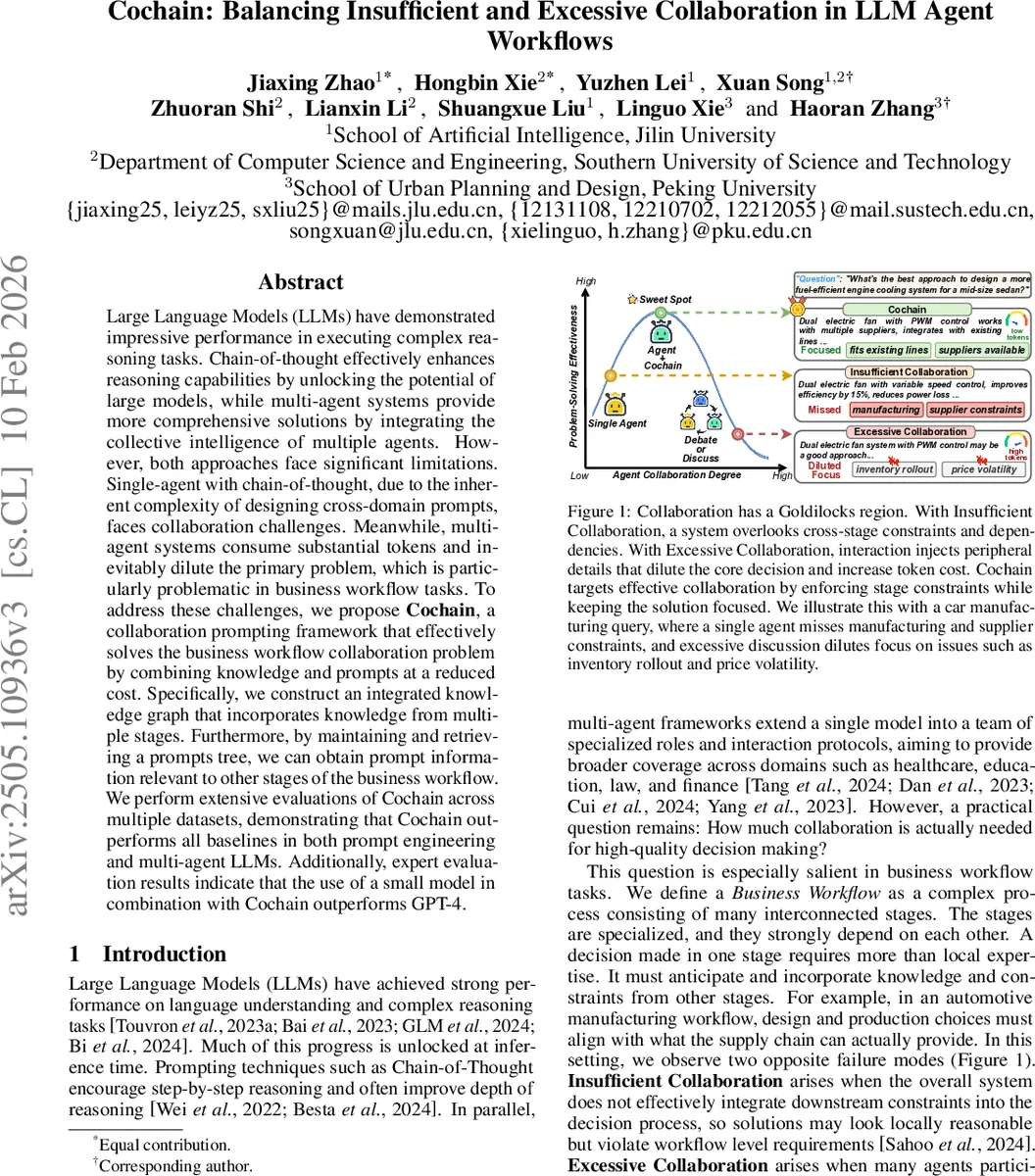
The paper “Cochain: Balancing Insufficient and Excessive Collaboration in LLM Agent Workflows” addresses a fundamental tension in the use of large language models (LLMs) for complex, multi‑stage business processes. On the one hand, single‑agent chain‑of‑thought (CoT) prompting can produce deep reasoning but often fails to incorporate cross‑stage constraints, leading to what the authors call “insufficient collaboration.” On the other hand, multi‑agent systems that rely on extensive dialogue or debate can capture a broader set of perspectives but at the cost of massive token consumption and the risk of diluting the core decision with peripheral information—an “excessive collaboration” problem. Both failure modes are illustrated with a car‑manufacturing example, where a single agent overlooks supplier constraints while a full‑blown debate introduces irrelevant inventory‑rollout details.
To resolve this, the authors propose Cochain, a collaboration‑prompting framework that replaces costly token‑intensive interactions with reusable artifacts: a Collaborative Knowledge Graph (CKG) and a Prompts Tree. The CKG fuses explicit triples extracted from workflow datasets with tacit triples elicited from stage‑specific agents via counterfactual questioning. Counterfactual inputs are generated using five templates (causal, adversarial, substitution, extreme, backward‑causal) and fed to fine‑tuned agents; the resulting variations are modeled with latent variables (θ, h) in a Bayesian formulation, allowing the system to capture hidden assumptions such as feasibility constraints or heuristic rules that are not present in the raw data. These tacit triples are then merged with the explicit graph to form a unified, multi‑hop knowledge structure that explicitly links entities across stages (e.g., “lightweight body design improves fuel economy” → “fuel economy influences supplier material choices”).
The Prompts Tree is built offline by distilling solution‑oriented prompt fragments from agent responses. Each fragment corresponds to a concrete sub‑task (e.g., “design lightweight chassis”, “select recyclable material”) and is organized hierarchically according to workflow stages. At inference time, Cochain retrieves stage‑relevant nodes from the CKG, assembles a causal chain that respects cross‑stage dependencies, and queries the Prompts Tree for a matching prompt chain. These components are concatenated into a single structured prompt that guides the backbone LLM (e.g., open‑Pangu‑1B, Qwen2‑7B) through the workflow in a focused, stage‑aware manner. Because the system reuses previously computed artifacts, token usage is dramatically reduced compared with naïve multi‑agent dialogue.
The authors evaluate Cochain on six benchmark workflows spanning automotive design, pharmaceutical development, and e‑commerce logistics. Metrics include GLEU, ROUGE‑L, and a custom PMC (Precision‑Recall‑Macro) score. Baselines comprise single‑model CoT, multi‑agent debate (short and long), CoA (Chain‑of‑Answer), MedAgents, and the commercial GPT‑4. Across all datasets, Cochain achieves the highest scores, with improvements ranging from 1.5 to 3.0 absolute points over the best baseline. Notably, when paired with a small open‑source model, Cochain outperforms GPT‑4, demonstrating that the framework’s knowledge‑reuse and prompt‑reuse mechanisms can compensate for raw model size. Expert human evaluation further confirms that Cochain’s outputs better respect cross‑stage constraints and exhibit higher consistency.
The paper also discusses limitations. Constructing the CKG requires substantial upfront data cleaning, triple extraction, and the design of domain‑specific counterfactual templates. Maintaining the graph as business processes evolve (e.g., adding new stages) will demand efficient incremental updates. Moreover, the current approach focuses on text‑based workflows; extending it to multimodal inputs (images, schematics) remains an open challenge.
In summary, Cochain introduces a novel “Goldilocks” collaboration paradigm: it delivers just enough cross‑stage intelligence to avoid missing critical constraints while avoiding the token‑heavy, noisy interactions of full multi‑agent systems. By leveraging a reusable knowledge graph and a hierarchical prompt repository, Cochain achieves state‑of‑the‑art performance on complex business workflows, even with modest LLM backbones, and offers a practical blueprint for building cost‑effective, constraint‑aware AI assistants in real‑world enterprises.
Comments & Academic Discussion
Loading comments...
Leave a Comment