Analysis of the Range Ambiguity Function of Narrowband Near-field MIMO Sensing
This paper compares the sensing performance of a narrowband near-field system across several practical antenna array geometries and SIMO/MISO and MIMO configurations. For identical transmit and receive apertures, MIMO processing is equivalent to squaring the near-field array factor, resulting in improved beamdepth and sidelobe level. Analytical derivations, supported by simulations, show that the MIMO processing improves the maximum near-field sensing range and resolution by approximately a factor of 1.4 compared to a single-aperture system. Using a quadratic approximation of the mainlobe of the array factor, an analytical improvement factor of $\sqrt{2}$ is derived, validating the numerical results. Finally, MIMO is shown to improve the poor sidelobe performance observed in the near-field by a factor of two, due to squaring of the array factor.
💡 Research Summary
The paper investigates the sensing performance of narrowband near‑field (NF) radio systems when different antenna array geometries and processing configurations (SIMO/MISO versus MIMO) are employed. Starting from a matched‑filter (MF) formulation, the authors model a collocated array with M transmitters and N receivers. The complex channel for each transmit‑receive pair is expressed as a pure phase term hₘ,ₙ(p)=e^{‑j2πf_c dₘ,ₙ(p)} where dₘ,ₙ(p) is the bistatic distance to a point p. Under the narrowband assumption (single carrier), the ambiguity function A(p′,p) reduces to a product of two sums, each representing the phase accumulation over the transmit and receive apertures respectively. When the power of the MF output is taken, the phase terms cancel and the result is the product of the squared magnitudes of the transmit and receive array factors (AFs).
In a SIMO/MISO configuration only one AF appears, so |A|² = |AF|². In the MIMO case the same physical aperture is used twice (identical, collocated transmit and receive arrays), leading to |A|² = |AF|⁴. Consequently, MIMO processing effectively squares the NF array factor, which in the near‑field depends on both angle and range, unlike the far‑field where it depends on angle only. This squaring narrows the main‑lobe, deepens the beam (beamdepth), and reduces the peak‑to‑sidelobe level (PSL).
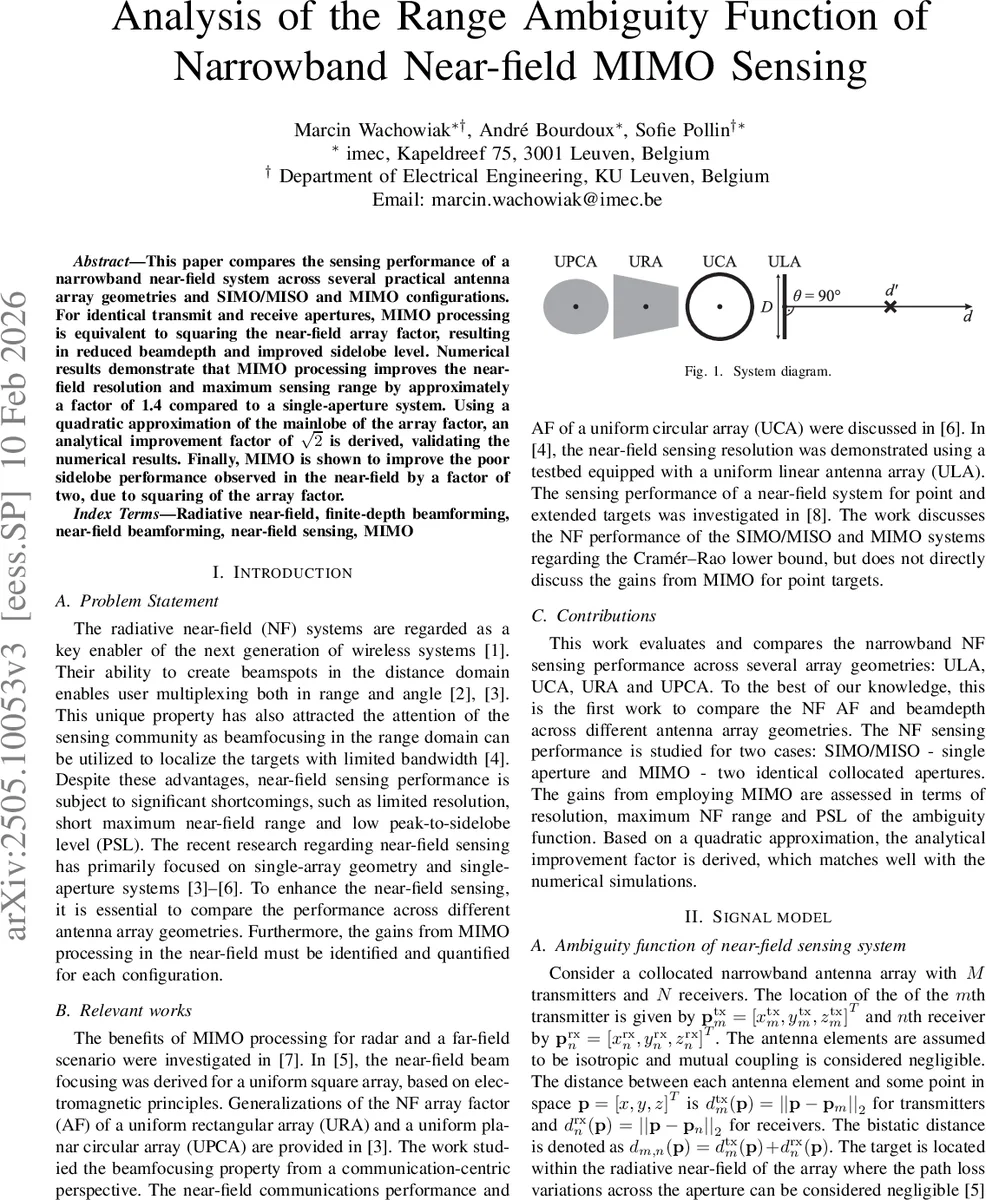
The authors then analyze four canonical array geometries: Uniform Linear Array (ULA), Uniform Circular Array (UCA), Uniform Rectangular Array (URA), and Uniform Planar Circular Array (UPCA). For each geometry the NF AF can be expressed in closed form using Fresnel integrals (ULA, URA), Bessel functions (UCA), or sinc functions (UPCA). A common argument variable x = a·d_F·Δd⁴ (or ^8, ^16 depending on geometry) is introduced, where a is a geometry‑dependent scaling factor, d_F = 2D²/λ is the Fraunhofer distance, and Δd is the vergence difference between the target distance and a reference point.
The –3 dB point of the normalized AF is obtained numerically for both SIMO/MISO and MIMO. The corresponding parameter α = x_{3dB}/a is reported in Table I. Across all geometries, α_MIMO is roughly 0.7 × α_SIMO, yielding a consistent improvement factor of about 1.4 (≈√2). Specifically, ULA shows α values 6.952 (SIMO) and 4.969 (MIMO); UCA 5.737 and 4.148; URA 9.937 and 7.068; UPCA 7.087 and 5.103.
A quadratic approximation of the main‑lobe is then employed: |AF(x)| ≈ 1 – c x² for small x, where c depends on geometry. Squaring this expression for MIMO gives |AF|⁴ ≈ 1 – 2c x², which predicts that the –3 dB argument for MIMO is √2 times smaller than for SIMO/MISO, i.e., α_SIMO/α_MIMO ≈ √2. The worst‑case error of this approximation is below 2.27 %, confirming the validity of the analytical derivation.
Because the AF is squared, the PSL is reduced by a factor of two: the peak remains unchanged while the sidelobes are halved in power, a result clearly visible in the simulated ambiguity functions (Fig. 4). The zeros of the AF are unchanged, preserving the null locations.
Simulation results illustrate beamdepth (BD) versus range for each geometry and processing mode. The BD is defined as the range interval over which the ambiguity function stays above –3 dB. For distances larger than d_F/α the beamdepth becomes unbounded, defining the maximum usable NF range. MIMO consistently expands BD across the entire NF region, confirming the 1.4‑fold improvement in both resolution and maximum range.
Among the geometries, UCA offers the best resolution due to its circular symmetry, albeit requiring roughly π times more elements than a comparable ULA. URA provides the widest beamdepth because its effective aperture is the diagonal length, reducing the effective aperture along each axis. 1‑D arrays (ULA, UCA) achieve high resolution with fewer elements but suffer from poorer sidelobe performance, whereas 2‑D arrays (URA, UPCA) improve sidelobes at the cost of a larger element count.
In summary, the paper demonstrates that, for narrowband near‑field sensing, employing a collocated MIMO architecture (identical transmit and receive apertures) yields a deterministic √2 improvement in the main‑lobe width, a 1.4‑fold increase in maximum NF range, and a two‑fold reduction in PSL, independent of the specific array geometry. These findings provide a solid theoretical and numerical foundation for the adoption of MIMO processing in future near‑field communication and sensing systems, where range resolution and sidelobe suppression are critical performance metrics.
Comments & Academic Discussion
Loading comments...
Leave a Comment