On the Almost Sure Convergence of the Stochastic Three Points Algorithm
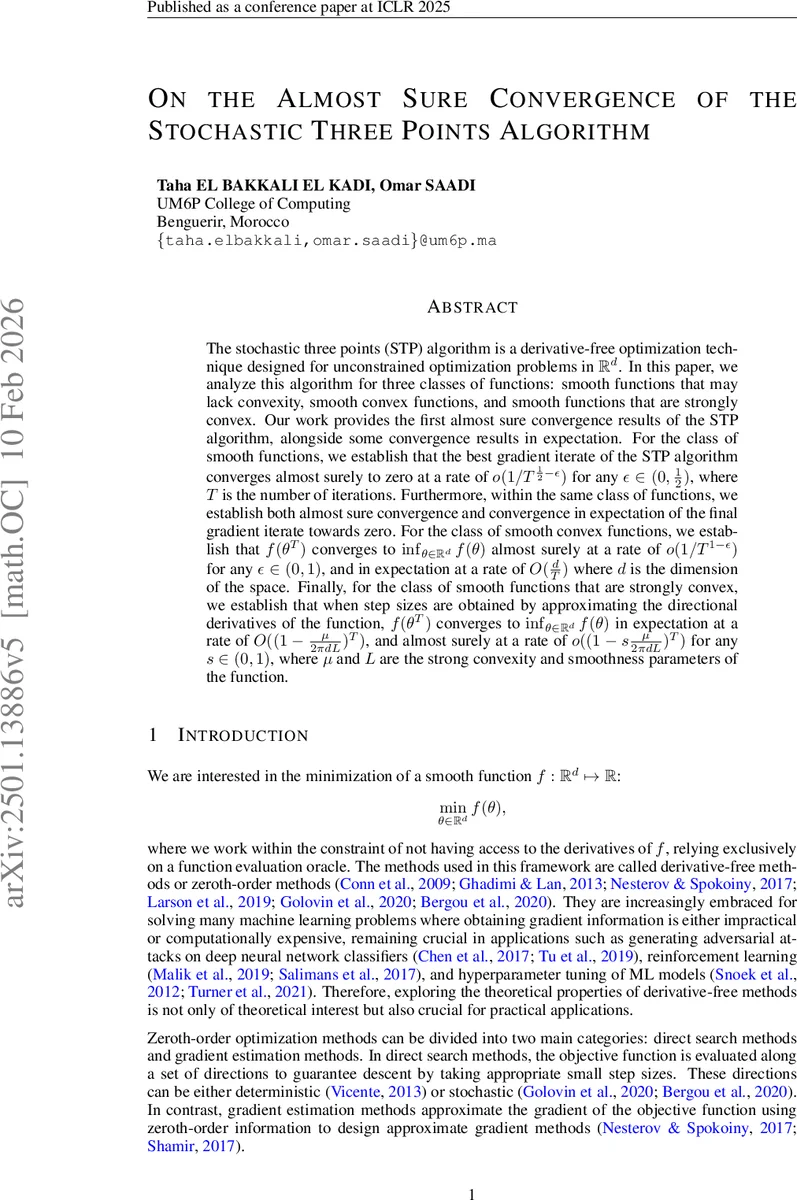
The stochastic three points (STP) algorithm is a derivative-free optimization technique designed for unconstrained optimization problems in $\mathbb{R}^d$. In this paper, we analyze this algorithm for three classes of functions: smooth functions that may lack convexity, smooth convex functions, and smooth functions that are strongly convex. Our work provides the first almost sure convergence results of the STP algorithm, alongside some convergence results in expectation. For the class of smooth functions, we establish that the best gradient iterate of the STP algorithm converges almost surely to zero at a rate of $o(1/{T^{\frac{1}{2}-ε}})$ for any $ε\in (0,\frac{1}{2})$, where $T$ is the number of iterations. Furthermore, within the same class of functions, we establish both almost sure convergence and convergence in expectation of the final gradient iterate towards zero. For the class of smooth convex functions, we establish that $f(θ^T)$ converges to $\inf_{θ\in \mathbb{R}^d} f(θ)$ almost surely at a rate of $o(1/{T^{1-ε}})$ for any $ε\in (0,1)$, and in expectation at a rate of $O(\frac{d}{T})$ where $d$ is the dimension of the space. Finally, for the class of smooth functions that are strongly convex, we establish that when step sizes are obtained by approximating the directional derivatives of the function, $f(θ^T)$ converges to $\inf_{θ\in \mathbb{R}^d} f(θ)$ in expectation at a rate of $O((1-\fracμ{2πdL})^T)$, and almost surely at a rate of $o((1-s\fracμ{2πdL})^T)$ for any $s\in (0,1)$, where $μ$ and $L$ are the strong convexity and smoothness parameters of the function.
💡 Research Summary
The paper presents the first almost‑sure convergence analysis of the Stochastic Three Points (STP) algorithm, a derivative‑free method for unconstrained optimization in ℝᵈ. The authors consider three families of objective functions—smooth non‑convex, smooth convex, and smooth strongly convex—and derive both almost‑sure and expectation‑based convergence rates for each case.
For smooth non‑convex functions, assuming L‑smoothness, a lower bound, and a random direction distribution with bounded second moment and a positive expected absolute inner product (e.g., standard normal or uniform on the unit sphere), the authors set the step‑size sequence αₜ = α t^{‑½‑ε} with ε∈(0,½). They prove that the minimum gradient norm over the first T iterates converges almost surely to zero at rate o(T^{‑½+ε}). Moreover, they show that the gradient at the final iterate θ_T also converges to zero both in expectation and almost surely, without requiring additional assumptions.
When the objective is additionally convex and possesses a bounded sublevel set, the same step‑size schedule (or a slightly slower αₜ = O(t^{‑1+β}) with β∈(0,½)) yields almost‑sure convergence of the function value gap f(θ_T)–f(θ*) to zero at rate o(T^{‑1+ε}) for any ε∈(2β,1). In expectation the gap decays as O(d/T), revealing a linear dependence on the dimension d, which matches the best known bounds for stochastic gradient methods while preserving the derivative‑free nature of STP.
For smooth μ‑strongly convex functions, the authors adopt a step‑size defined via a finite‑difference approximation of directional derivatives: αₜ = |f(θₜ+hsₜ)−f(θₜ)|/(Lh), where h is a small constant and sₜ is drawn from the same distribution as before. Under this schedule the expected function‑value gap contracts linearly:
E
Comments & Academic Discussion
Loading comments...
Leave a Comment