Benchmarking Pedestrian Dynamics Models for Common Scenarios: An Evaluation of Force-Based Models
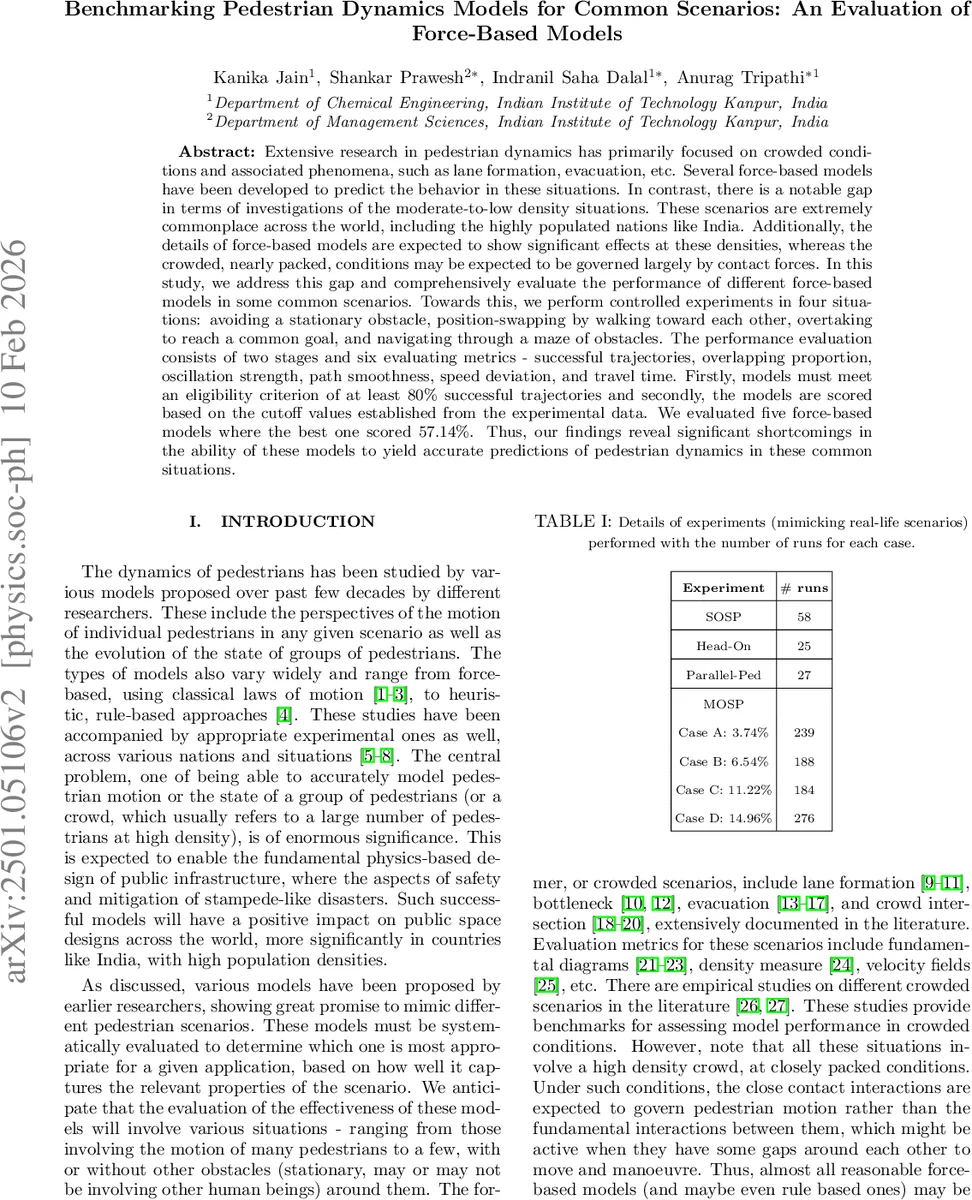
Extensive research in pedestrian dynamics has primarily focused on crowded conditions and associated phenomena, such as lane formation, evacuation, etc. Several force-based models have been developed to predict the behavior in these situations. In contrast, there is a notable gap in terms of investigations of the moderate-to-low density situations. These scenarios are extremely commonplace across the world, including the highly populated nations like India. Additionally, the details of force-based models are expected to show significant effects at these densities, whereas the crowded, nearly packed, conditions may be expected to be governed largely by contact forces. In this study, we address this gap and comprehensively evaluate the performance of different force-based models in some common scenarios. Towards this, we perform controlled experiments in four situations: avoiding a stationary obstacle, position-swapping by walking toward each other, overtaking to reach a common goal, and navigating through a maze of obstacles. The performance evaluation consists of two stages and six evaluating parameters - successful trajectories, overlapping proportion, oscillation strength, path smoothness, speed deviation, and travel time. Firstly, models must meet an eligibility criterion of at least 80% successful trajectories and secondly, the models are scored based on the cutoff values established from the experimental data. We evaluated five force-based models where the best one scored 57.14%. Thus, our findings reveal significant shortcomings in the ability of these models to yield accurate predictions of pedestrian dynamics in these common situations.
💡 Research Summary
The paper addresses a notable gap in pedestrian dynamics research: the lack of systematic evaluation of force‑based models under low‑to‑moderate density conditions that dominate everyday life. While most prior work concentrates on crowded scenarios—lane formation, bottlenecks, evacuations—the authors argue that the fine‑grained interaction forces (personal space, anticipatory avoidance, etc.) become decisive when pedestrians are not in constant contact. To quantify model performance in such regimes, they design four controlled experiments that mimic common real‑world situations: (1) a single pedestrian navigating around a stationary, human‑sized obstacle (SOSP), (2) two pedestrians walking head‑on and swapping positions, (3) a faster pedestrian overtaking a slower one toward a shared goal (Parallel‑Ped), and (4) a single pedestrian traversing a maze of multiple obstacles (MOSP) with four obstacle‑area fractions (3.74 %, 6.54 %, 11.22 %, 14.96 %). The experimental arena is a 10 m × 3.5 m rectangle; measurements are confined to the central 6 m segment to avoid entry/exit effects. Data were collected from Indian volunteers (the authors’ institution) and are publicly released on GitHub, ensuring reproducibility.
Six quantitative metrics are defined to evaluate any pedestrian simulation: (i) Successful trajectories – a run is deemed unsuccessful if travel time exceeds twice the maximum observed in the corresponding experiment, if overlap between any two circles (pedestrians or obstacles) exceeds 50 % at any instant, or if more than half the body leaves the defined boundary; (ii) Overlap proportion – normalized area of geometric overlap; (iii) Oscillation strength – cumulative backward motion relative to the desired velocity; (iv) Path smoothness – maximum absolute change in heading angle between successive displacement vectors; (v) Speed deviation – average absolute difference between instantaneous speed and the prescribed desired speed; and (vi) Travel time – total time spent in the measurement region, with the same 2×‑time cutoff used for success. All metrics are averaged over all runs for each scenario; the experimental baselines show zero failures, negligible overlap and oscillation, path‑angle changes between 0–2°, speed deviations up to 23 %, and travel times ranging from roughly 4 s to 5 s.
Using these baselines, the authors benchmark five widely cited force‑based models: Universal Power Law (UPL), Social Force Model – circular (SFMc), Social Force Model – elliptical (SFMe), Centrifugal Force Model – circular (CFMc), and Centrifugal Force Model – elliptical (CFMe). Each model receives identical initial positions, goals, and desired speeds, and is simulated under the same experimental conditions. Evaluation proceeds in two stages: first, a binary eligibility check requiring at least 80 % successful trajectories; second, a finer scoring based on how closely each metric matches the experimentally derived cutoff values. The final composite scores, expressed as a percentage of the maximum possible, reveal that even the best‑performing model (CFMe) attains only 57.14 % of the ideal score. The other models perform worse, with SFMc suffering from high oscillation despite low overlap, and UPL showing moderate performance across all metrics but no clear advantage.
The results expose a fundamental limitation of current force‑based formulations: they capture contact‑driven dynamics well in dense crowds but fail to reproduce the subtler, distance‑based interactions that dominate at lower densities. Moreover, the experiments involve Indian participants, whose cultural norms around personal space and walking behavior differ from the Western or East Asian datasets that originally informed many models. Consequently, the authors argue that existing models cannot be assumed universally applicable.
In the discussion, the paper proposes three avenues for future work. First, augmenting force‑based frameworks with explicit personal‑space, visual‑field, and anticipatory avoidance mechanisms to form hybrid models. Second, leveraging data‑driven techniques—such as machine learning or Bayesian calibration—to fine‑tune model parameters against diverse empirical datasets. Third, expanding the experimental database to include participants from multiple countries, age groups, and physical characteristics, thereby creating a truly global benchmark. By releasing both the raw experimental trajectories and the evaluation code, the authors aim to establish a standard testing platform that can guide the development of more accurate pedestrian simulation tools for everyday, low‑density environments.
Comments & Academic Discussion
Loading comments...
Leave a Comment