Semiclassical model of magnons in double-layered antiferromagnets
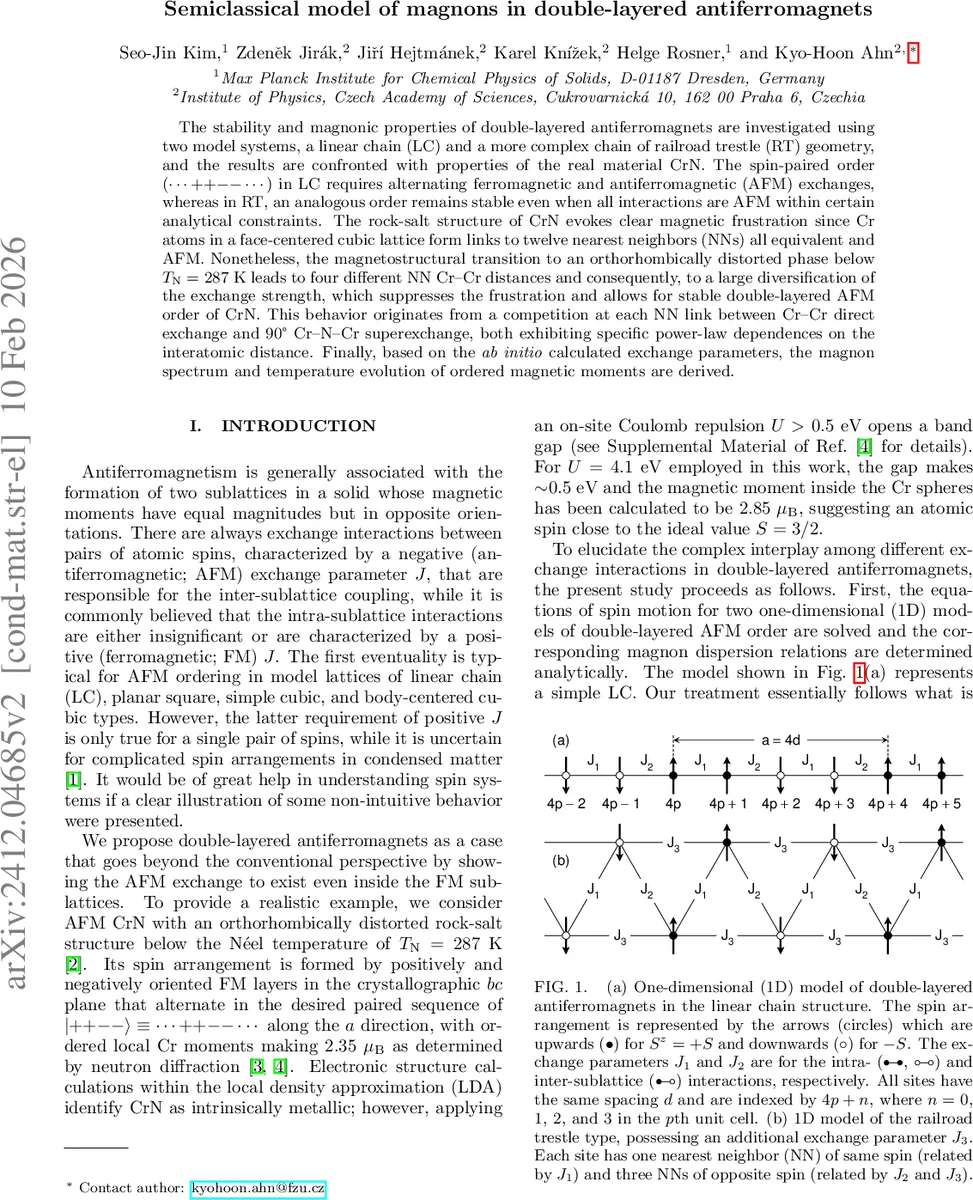
The stability and magnonic properties of double-layered antiferromagnets are investigated using two model systems, a linear chain (LC) and a more complex chain of railroad trestle (RT) geometry, and the results are confronted with properties of the real material CrN. The spin-paired order ($\cdots{+}{+}{-}{-}\cdots$) in LC requires alternating ferromagnetic and antiferromagnetic (AFM) exchanges, whereas in RT, an analogous order remains stable even when all interactions are AFM within certain analytical constraints. The rock-salt structure of CrN evokes clear magnetic frustration since Cr atoms in a face-centered cubic lattice form links to twelve nearest neighbors (NNs) all equivalent and AFM. Nonetheless, the magnetostructural transition to an orthorhombically distorted phase below $T_\text{N} = 287~\text{K}$ leads to four different NN Cr-Cr distances and consequently, to a large diversification of the exchange strength, which suppresses the frustration and allows for stable double-layered AFM order of CrN. This behavior originates from a competition at each NN link between Cr-Cr direct exchange and 90$^\circ$ Cr-N-Cr superexchange, both exhibiting specific power-law dependences on the interatomic distance. Finally, based on the $\textit{ab initio}$ calculated exchange parameters, the magnon spectrum and temperature evolution of ordered magnetic moments are derived.
💡 Research Summary
The paper presents a comprehensive semiclassical study of magnons in double‑layered antiferromagnets (AFMs), using two one‑dimensional model systems—a simple linear chain (LC) and a more intricate railroad‑trestle (RT) geometry—and then applies the insights to real CrN, a material that exhibits a double‑layered AFM order below its Néel temperature (T_N = 287 K).
In the LC model the magnetic unit cell contains four spins arranged as …++––…, with intra‑sublattice exchange J₁ (ferromagnetic) and inter‑sublattice exchange J₂ (antiferromagnetic). By linearizing the Heisenberg equations of motion for small transverse components (S_x, S_y ≪ S) and assuming plane‑wave solutions, the authors derive a fourth‑order secular equation. Its solution yields two doubly degenerate acoustic and optical magnon branches (four bands in total). The stability condition for the ++–– ground state is γ = J₁/J₂ < 0; i.e., J₁ must be positive and J₂ negative. The magnon gap at the Brillouin‑zone (BZ) boundary is √2 ω₀ for γ = −1 and vanishes as γ → 0⁻.
The RT model adds a third exchange parameter J₃, allowing three distinct nearest‑neighbor couplings: J₁ (same‑spin nearest neighbor), J₂ and J₃ (different‑spin neighbors). Solving the analogous linearized equations gives ω(k) = ω₀′
Comments & Academic Discussion
Loading comments...
Leave a Comment