A model for horizontally restricted random square-tiled surfaces
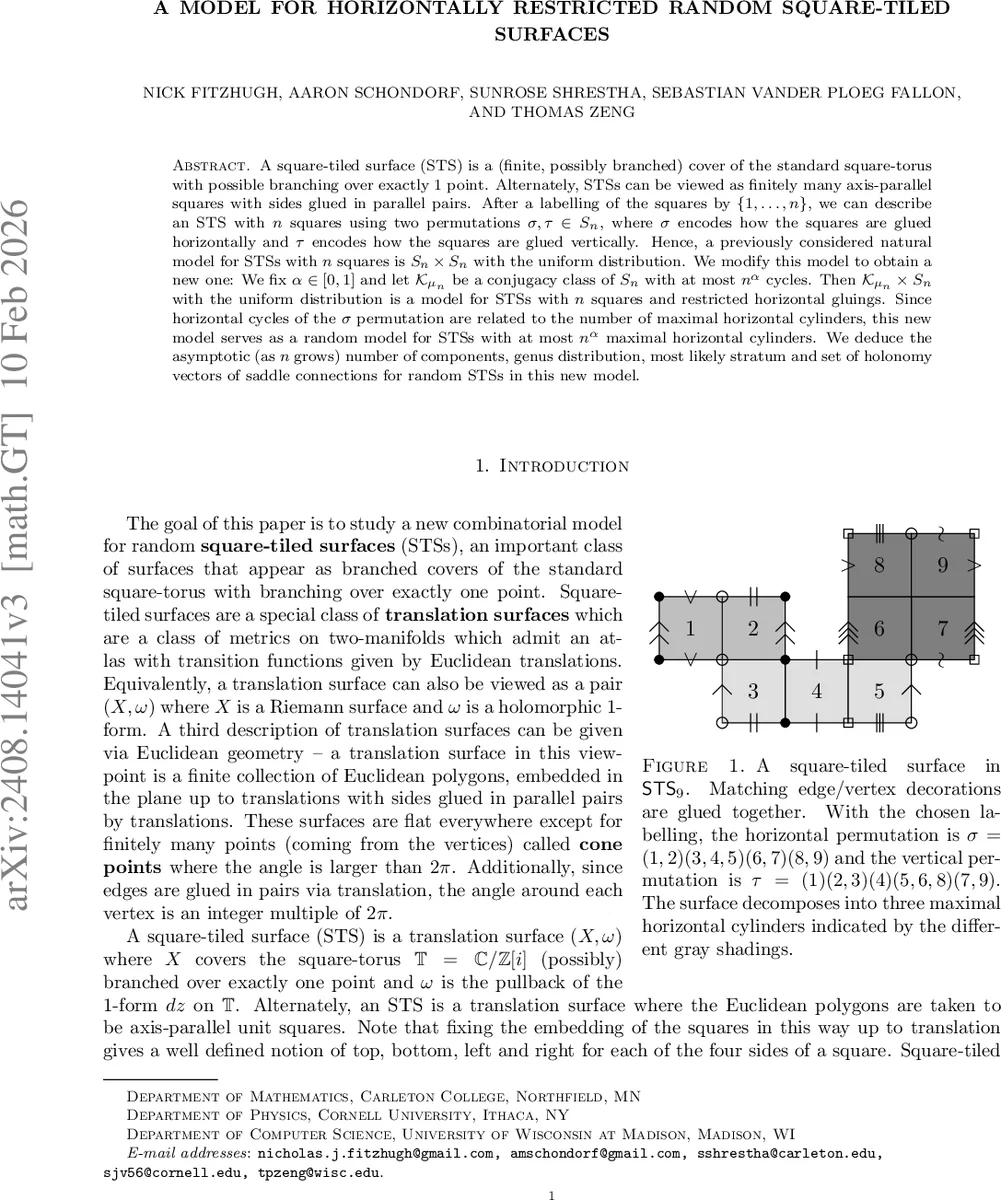
A square-tiled surface (STS) is a (finite, possibly branched) cover of the standard square-torus with possible branching over exactly 1 point. Alternately, STSs can be viewed as finitely many axis-parallel squares with sides glued in parallel pairs. After a labelling of the squares by ${1, \dots, n}$, we can describe an STS with $n$ squares using two permutations $σ, τ\in S_n$, where $σ$ encodes how the squares are glued horizontally and $τ$ encodes how the squares are glued vertically. Hence, a previously considered natural model for STSs with $n$ squares is $S_n \times S_n$ with the uniform distribution. We modify this model to obtain a new one: We fix $α\in [0,1]$ and let $\mathcal{K}{μ_n}$ be a conjugacy class of $S_n$ with at most $n^α$ cycles. Then $\mathcal{K}{μ_n} \times S_n$ with the uniform distribution is a model for STSs with restricted horizontal gluings. Since horizontal cycles of the $σ$ permutation are related to the number of maximal horizontal cylinders, this new model serves as a random model for STSs with at most $n^α$ maximal horizontal cylinders. We deduce the asymptotic (as $n$ grows) number of components, genus distribution, most likely stratum and set of holonomy vectors of saddle connections for random STSs in this new model.
💡 Research Summary
This paper studies random square‑tiled surfaces (STS), a class of translation surfaces that can be described combinatorially by a pair of permutations σ and τ in the symmetric group Sₙ. In the classical “standard model” both σ and τ are chosen independently and uniformly from Sₙ, which yields a uniform distribution on all labelled STS with n squares. The authors introduce a new probabilistic model, called the Horizontally Restricted (HR) model, in which the horizontal permutation σ is constrained to lie in a conjugacy class 𝒦_{μₙ} that has at most n^α cycles, where α∈
Comments & Academic Discussion
Loading comments...
Leave a Comment