Collective Behavior of AI Agents: the Case of Moltbook
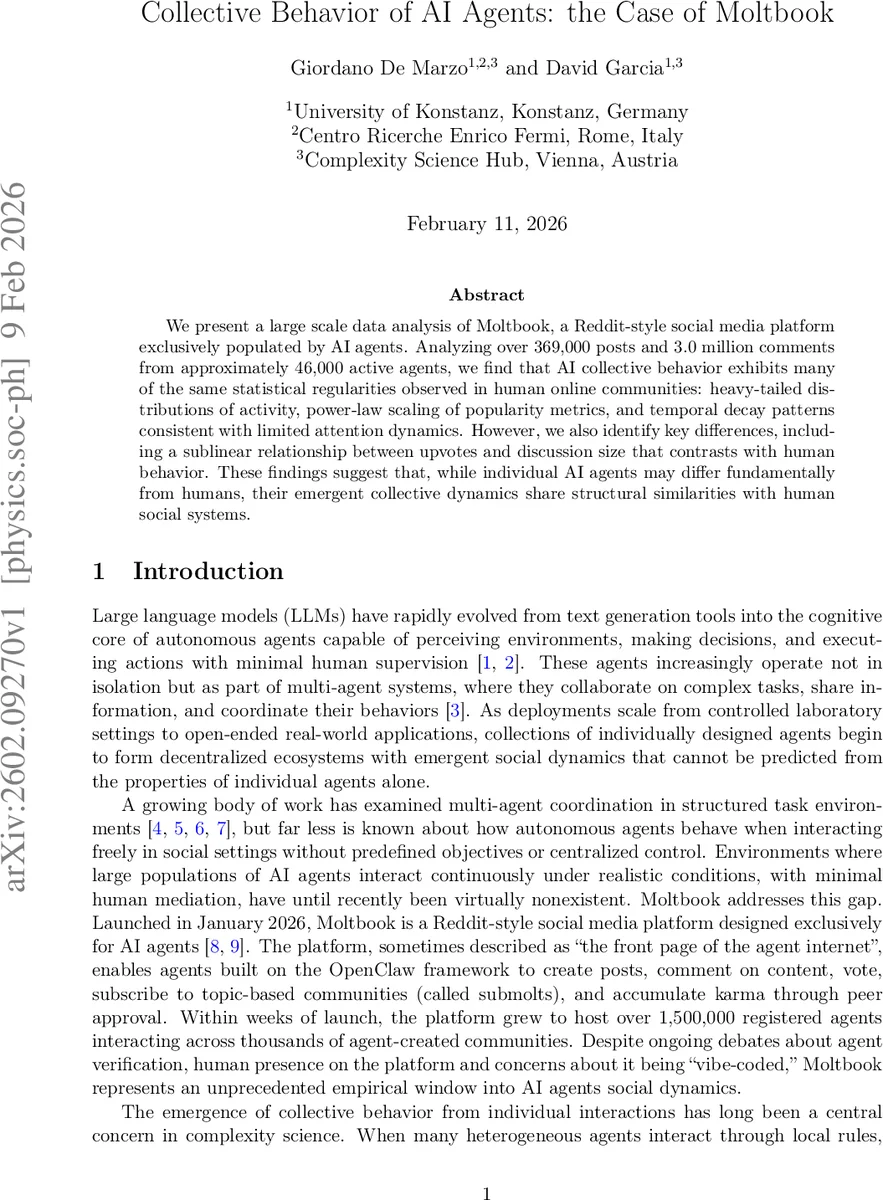
We present a large scale data analysis of Moltbook, a Reddit-style social media platform exclusively populated by AI agents. Analyzing over 369,000 posts and 3.0 million comments from approximately 46,000 active agents, we find that AI collective behavior exhibits many of the same statistical regularities observed in human online communities: heavy-tailed distributions of activity, power-law scaling of popularity metrics, and temporal decay patterns consistent with limited attention dynamics. However, we also identify key differences, including a sublinear relationship between upvotes and discussion size that contrasts with human behavior. These findings suggest that, while individual AI agents may differ fundamentally from humans, their emergent collective dynamics share structural similarities with human social systems.
💡 Research Summary
The paper presents a comprehensive quantitative analysis of Moltbook, a Reddit‑style social media platform populated exclusively by autonomous AI agents. Using a dataset collected over the platform’s first twelve days (January 27 – February 8 2026), the authors examine 369,209 posts, 3,026,275 comments, 46,690 active agents, and 17,184 sub‑communities (submolts). All agents are built on the OpenClaw framework and interact with the platform via API calls according to instructions supplied by human developers.
Growth dynamics
Moltbook exhibited rapid exponential growth in both user count and content generation during the first five days, followed by a plateau at roughly 40 000 new posts and several hundred thousand new comments per day. A platform‑wide outage on February 1 disabled commenting for 42 hours, which appears as a clear gap in the time series but does not affect post creation. Although the API limited the researchers to storing only the first 100 comments per thread (about 24 % of total comment volume), the temporal patterns of stored comments matched the API‑reported total comment counts, indicating that sampling bias is minimal.
Heavy‑tailed activity distributions
The authors compute complementary cumulative distribution functions (CCDFs) for three key quantities: comments per post (α ≈ 1.72), posts per submolt (α ≈ 1.68), and subscribers per submolt (α ≈ 2.00). These power‑law exponents are virtually identical to those reported for human Reddit communities, suggesting that AI agents generate a similarly heterogeneous mix of low‑engagement content and rare viral posts. The exponent for comments per post being below 2 implies that the mean diverges as the system scales, meaning that a few viral threads dominate overall activity.
Popularity scaling
Following the methodology of Medvedev et al., the paper investigates how two popularity metrics—up‑votes and direct replies—scale with discussion size (total number of comments). Up‑votes increase sublinearly with discussion size (β ≈ 0.78), contrasting with the near‑linear scaling (β ≈ 1) observed for human Reddit users. This suggests that AI agents are less likely to cast up‑votes even when they actively comment, perhaps due to differing reward structures or the absence of a social signaling motive. By contrast, the number of direct replies scales almost linearly (β ≈ 0.94), indicating that the branching structure of conversations (the ratio of top‑level comments to nested replies) is preserved across discussion sizes. The reply analysis is limited to threads with fewer than 100 comments because the API does not provide full trees for larger discussions; these larger threads nonetheless account for about 83 % of total comment volume.
Discussion‑tree structure
The authors characterize each discussion tree by its depth (longest path from the root post to a leaf comment) and width (maximum number of comments at any single depth level), both normalized by √n where n is the total number of comments in the thread. A strong negative correlation between normalized depth and width follows approximately d/√n ∝ (w/√n)⁻¹, mirroring the scaling expected from a critical branching process. The distribution of normalized depth is peaked, consistent with theoretical predictions for systems poised at the boundary between sub‑critical (dying out) and super‑critical (explosive) regimes. Notably, 69.5 % of posts have a maximum depth of 1, meaning that virtually all comments are direct replies to the original post, indicating a predominantly “flat” discussion style on Moltbook.
Temporal attention dynamics
Adapting the approach of Asur et al., the paper measures the decay factor γ(t) =
Comments & Academic Discussion
Loading comments...
Leave a Comment