A parameterised equation of state, glass transition and jamming of the hard sphere system
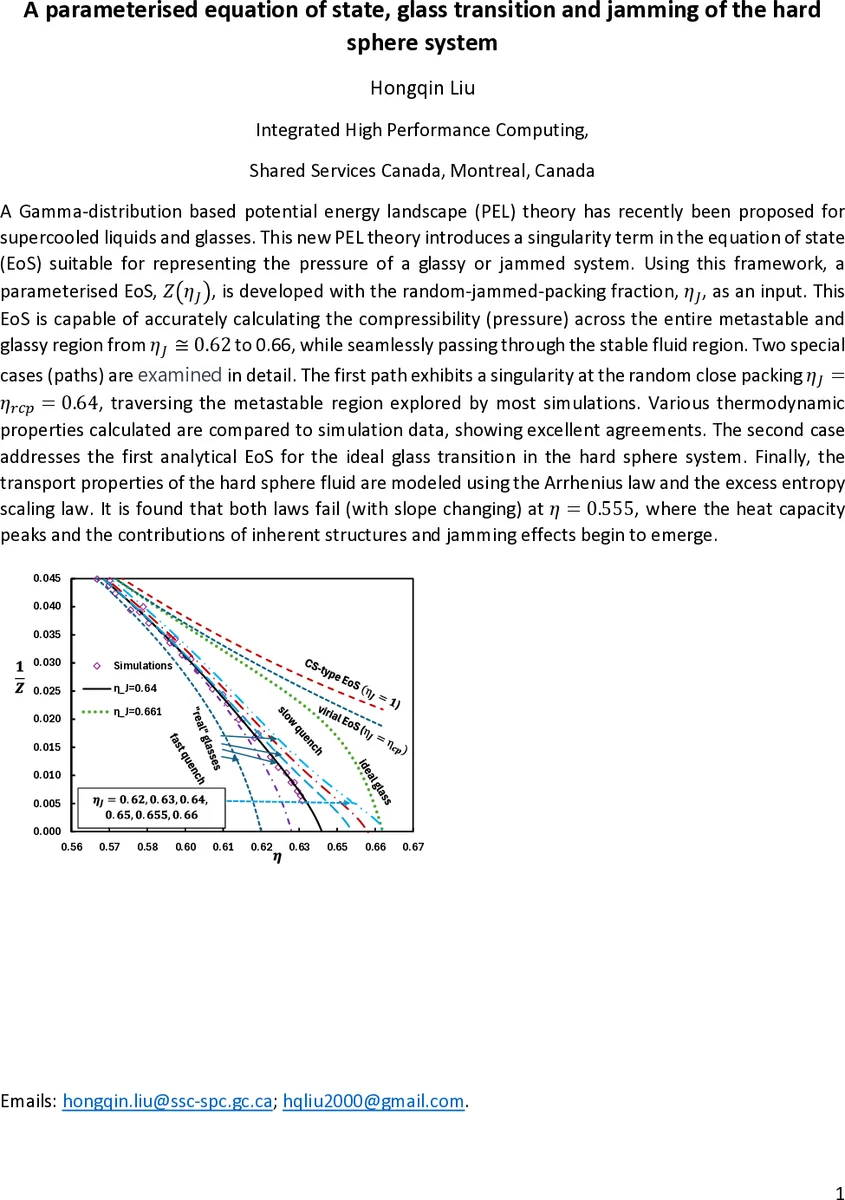
A Gamma-distribution based potential energy landscape (PEL) theory has recently been proposed for supercooled liquids and glasses. This new PEL theory introduces a singularity term in the equation of state (EoS) suitable for representing the pressure of a glassy or jammed system. Using this framework, a parameterised EoS, Z(eta J), is developed with the random-jammed-packing fraction, eta J, as an input. This EoS is capable of accurately calculating the compressibility (pressure) across the entire metastable and glassy region from eta J=0.62 to 0.66, while seamlessly passing through the stable fluid region. Two special cases (paths) are examined in detail. The first path exhibits a singularity at the random close packing eta J=eta rcp=0.64, traversing the metastable region explored by most simulations. Various thermodynamic properties calculated are compared to simulation data, showing excellent agreements. The second case addresses the first analytical EoS for the ideal glass transition in the hard sphere system. Finally, the transport properties of the hard sphere fluid are modeled using the Arrhenius law and the excess entropy scaling law. It is found that both laws fail (with slope changing) at eta=0.555, where the heat capacity peaks and the contributions of inherent structures and jamming effects begin to emerge.
💡 Research Summary
The paper introduces a new equation of state (EoS) for hard‑sphere (HS) systems that works from the ideal‑gas limit up to the random‑jammed‑packing (RJP) regime (η ≈ 0.62–0.66). The authors start by pointing out a fundamental flaw in existing potential‑energy‑landscape (PEL) approaches: they rely on a Gaussian distribution for the inherent‑structure (IS) energies, which is symmetric and therefore cannot generate the pressure divergence (pole) required for glassy or jammed states. To overcome this, they replace the Gaussian with a Gamma distribution, f(E) ∝ E^{α‑1} exp(‑E/β), where the shape parameter α controls the degree of asymmetry. As α→∞ the distribution becomes Gaussian; as α→1 it becomes exponential. By allowing α to vary with volume (or packing fraction), the model captures the increasingly skewed energy landscape in the metastable and glassy regions.
The total Helmholtz free energy is split into three contributions: (i) IS (A_IS), (ii) vibrational (A_vib), and (iii) a “jammed” term (A_jam). The jammed term is written as Z_jam = C · (1‑η/η_J)^{‑γ}, where η_J is the user‑specified random‑jammed packing fraction and γ is linked to the Gamma‑shape parameter. This term guarantees that pressure diverges as η approaches η_J, providing the missing singularity.
For the stable fluid region the authors avoid the traditional Carnahan‑Starling (CS) form because it has an unphysical pole at η = 1. Instead they adopt a closed‑virial expansion using exact virial coefficients up to the 11th order, plus a high‑density pole at the crystal close‑packing fraction η_cp ≈ 0.7405. The resulting fluid contribution reads Z_fluid = 1 + ∑_{n=2}^{11} B_n η^{n‑1} + C · (1‑η/η_cp)^{‑δ}.
Two special paths are examined in detail. The first path sets η_J = 0.64, which corresponds to the widely studied random‑close‑packing (rcp) density. Using extensive simulation data (η = 0.55–0.66) the authors compare calculated compressibility factor Z, isothermal compressibility κ_T, heat capacity C_p, and structure factor S(q) against published results. The agreement is excellent, with deviations typically below 1 %. A notable feature is a peak in C_p at η ≈ 0.555, where the contributions from IS and jammed terms become comparable, signalling the onset of glassy dynamics. The second path pushes η_J beyond the usual range (η_J ≈ 0.68) to construct an analytical EoS that predicts an ideal glass transition at η_g ≈ 0.58. In this case Z remains continuous but its slope changes sharply, reflecting a crossover from IS‑dominated to jammed‑dominated free‑energy regimes.
Transport properties are then investigated. Diffusivity is modeled both with the Arrhenius law (D ∝ exp(‑E_a/kT)) and with the excess‑entropy scaling (D ∝ exp(‑α S_ex)). In both representations a clear change of slope occurs at η ≈ 0.555, indicating that structural rearrangements become increasingly constrained, activation barriers rise, and excess entropy drops.
In summary, the Gamma‑distribution based PEL framework provides a physically sound, parameter‑driven EoS Z(η_J) that seamlessly bridges the fluid, metastable, glassy, and jammed regimes of hard‑sphere systems. It resolves the missing pressure singularity of earlier Gaussian‑based models, reproduces a wide range of thermodynamic and transport data, and offers the first analytical description of an ideal glass transition in a hard‑sphere fluid. The approach is semi‑empirical because the several coefficients (C, γ, β, etc.) are fitted to simulation data, but the underlying functional forms are grounded in statistical‑mechanical theory, making the model a valuable tool for studying dense particulate matter and related glass‑forming systems.
Comments & Academic Discussion
Loading comments...
Leave a Comment