Unraveling the mysteries of Jets in peculiar NLSy1 galaxies through multi-wavelength variability
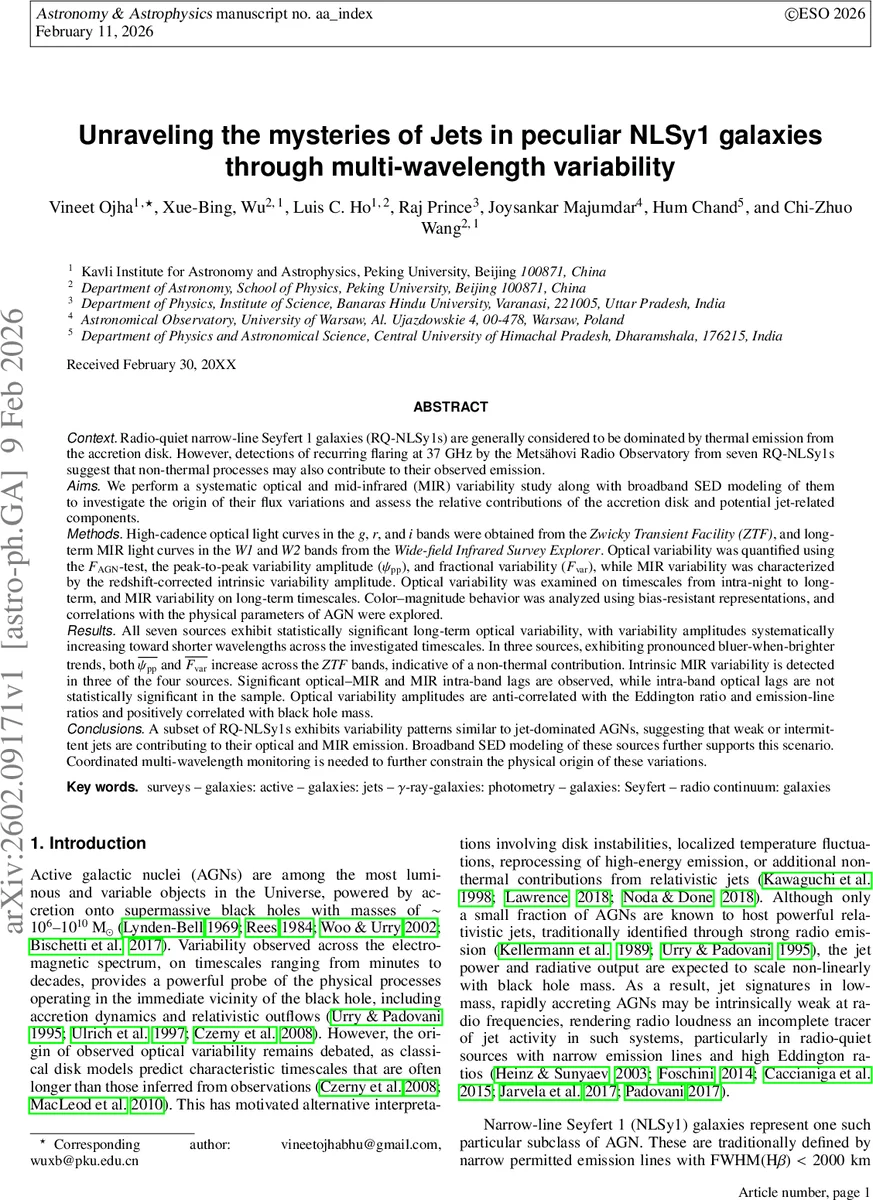
Radio-quiet narrow-line Seyfert 1 galaxies (RQ-NLSy1s) are generally considered to be dominated by thermal emission from the accretion disk. However, recurring 37 GHz radio flares detected from seven RQ-NLSy1s by the Metsahovi Radio Observatory suggest that non-thermal processes may also contribute to their emission. We present a systematic optical and mid-infrared (MIR) variability study combined with broadband SED modeling to investigate the origin of their flux variations and assess the relative contributions of accretion disk and possible jet-related components. High-cadence optical light curves in the g, r, and i bands were obtained from ZTF, while long-term MIR light curves in the W1 and W2 bands were taken from WISE. Optical variability was quantified using the FAGN-test, peak-to-peak variability amplitude, and fractional variability, while MIR variability was characterized using redshift-corrected intrinsic variability amplitudes. Optical variability was examined from intra-night to long-term timescales, and MIR variability on long-term timescales. All RQ-NLSy1s show statistically significant long-term optical variability, with amplitudes increasing toward shorter wavelengths. Three sources exhibit bluer-when-brighter trends and increasing variability amplitudes across the optical bands, indicating a non-thermal contribution. Intrinsic MIR variability is detected in three of the four sources. Significant optical-MIR and MIR intra-band lags are observed, while optical intra-band lags are insignificant. Optical variability amplitudes are anti-correlated with the Eddington ratio and positively correlated with black hole mass. These results suggest that a subset of RQ-NLSy1s hosts weak or intermittent jets contributing to their optical and MIR emission, supported by SED modeling. Coordinated multi-wavelength monitoring is required to better constrain the origin of these variations.
💡 Research Summary
This paper investigates a set of seven radio‑quiet narrow‑line Seyfert 1 (NLSy1) galaxies that have shown recurrent, high‑amplitude flares at 37 GHz, a behavior normally associated with powerful relativistic jets. The authors combine high‑cadence optical photometry from the Zwicky Transient Facility (ZTF) in the g, r, and i bands with long‑term mid‑infrared (MIR) monitoring from the Wide‑field Infrared Survey Explorer (WISE) in the W1 (3.4 µm) and W2 (4.6 µm) bands. After applying strict quality cuts (ZTF catflags = 0, magnitude errors < 10 %, 3σ outlier removal; WISE χ² < 5, PSF ≤ 2, artifact rejection), the authors retain reliable light curves spanning up to ~2200 days in the optical and 2010‑2024 in the MIR.
Variability is quantified using three complementary metrics: the FAGN‑test (to assess statistical significance), the peak‑to‑peak amplitude (ψ_pp), and the fractional variability (F_var). MIR variability is expressed as a redshift‑corrected intrinsic amplitude. The authors also examine colour‑magnitude relations using bias‑resistant regression to identify bluer‑when‑brighter (BWB) trends, and they explore correlations between variability amplitudes and fundamental AGN parameters (black‑hole mass, Eddington ratio, emission‑line ratios).
Key findings include:
- All seven sources display statistically significant long‑term optical variability, with amplitudes increasing toward shorter wavelengths.
- Three objects (J1029+5556, J1232+4957, J1509+6137) exhibit clear BWB behaviour and larger ψ_pp and F_var in the g‑band than in r or i, indicative of a non‑thermal, jet‑related contribution.
- Intrinsic MIR variability is detected in three of the four sources for which reliable WISE data exist.
- Cross‑correlation analysis reveals significant optical‑to‑MIR lags of 30–150 days (optical leading), consistent with dust reverberation, while MIR intra‑band (W1‑W2) lags are short (few days) or negligible, suggesting a common origin for the two MIR bands. Optical intra‑band lags (g‑r, r‑i) are not statistically significant.
- Variability amplitudes anti‑correlate with the Eddington ratio and positively correlate with black‑hole mass, supporting the idea that high accretion rates stabilize the disk while more massive black holes permit larger amplitude fluctuations.
To test the physical interpretation, the authors construct broadband spectral energy distributions (SEDs) for each source using a one‑zone leptonic jet model (synchrotron, synchrotron‑self‑Compton, external Compton) combined with a standard Shakura‑Sunyaev accretion‑disk component and a dusty‑torus blackbody. For the three BWB sources, the jet contributes roughly 10–30 % of the optical flux and a non‑negligible fraction of the MIR emission, whereas the remaining four objects are dominated by thermal disk and torus emission, though a weak baseline jet cannot be ruled out.
The study concludes that a subset of radio‑quiet NLSy1 galaxies host weak or intermittent relativistic jets that leave measurable imprints on optical and MIR variability, even though their radio loudness is low and large‑scale jet structures are absent in VLBI images. The authors argue that traditional radio‑based classifications underestimate jet activity in low‑mass, high‑Eddington AGN, and they advocate for coordinated, multi‑wavelength monitoring (including high‑resolution radio interferometry and simultaneous X‑ray/γ‑ray observations) to further elucidate the interplay between accretion disks, jets, and circumnuclear dust in these enigmatic sources.
Comments & Academic Discussion
Loading comments...
Leave a Comment