CoMMa: Contribution-Aware Medical Multi-Agents From A Game-Theoretic Perspective
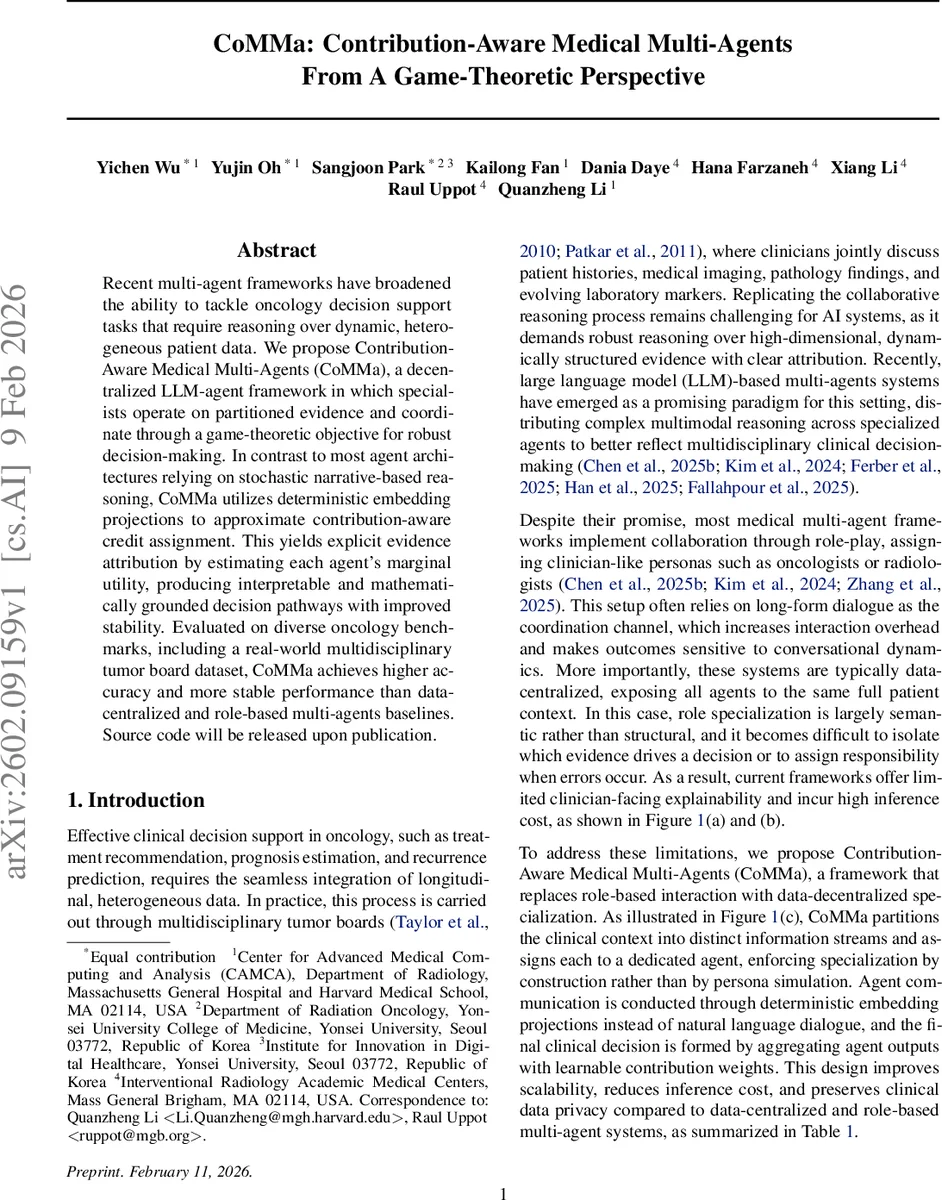
Recent multi-agent frameworks have broadened the ability to tackle oncology decision support tasks that require reasoning over dynamic, heterogeneous patient data. We propose Contribution-Aware Medical Multi-Agents (CoMMa), a decentralized LLM-agent framework in which specialists operate on partitioned evidence and coordinate through a game-theoretic objective for robust decision-making. In contrast to most agent architectures relying on stochastic narrative-based reasoning, CoMMa utilizes deterministic embedding projections to approximate contribution-aware credit assignment. This yields explicit evidence attribution by estimating each agent’s marginal utility, producing interpretable and mathematically grounded decision pathways with improved stability. Evaluated on diverse oncology benchmarks, including a real-world multidisciplinary tumor board dataset, CoMMa achieves higher accuracy and more stable performance than data-centralized and role-based multi-agents baselines.
💡 Research Summary
The paper introduces CoMMa (Contribution‑Aware Medical Multi‑Agents), a novel decentralized multi‑agent framework designed for oncology decision support. Unlike existing role‑based multi‑agent systems that rely on long‑form natural‑language dialogue and share the full patient record among all agents, CoMMa partitions the clinical context into distinct information streams (e.g., imaging reports, pathology, labs) and assigns each stream to a dedicated specialist agent. This data‑decentralized specialization forces agents to operate on disjoint evidence, making it possible to attribute decisions to specific modalities.
Each agent receives its text input, encodes it with a frozen large language model (LLM), extracts the
The core of CoMMa is a game‑theoretic contribution learning mechanism. Agent‑wise logits (h_i) are combined using a learnable agent‑decision matrix (W\in\mathbb{R}^{N\times C}), where (W_{i,k}) represents the contribution of agent (i) to class (k). The matrix is normalized so that each column sums to one, giving an interpretable per‑class weight distribution. A global anchor (the most comprehensive modality) is also processed and mixed with the aggregated agent representation to preserve a patient‑level context.
To align (W) with a principled notion of credit, the authors formulate the collaboration as a cooperative coalitional game. The total loss consists of three terms: (1) standard binary cross‑entropy (BCE) for multi‑label classification, (2) a policy‑gradient loss (L_{pg}) that up‑weights (W_{i,k}) when the marginal reduction in BCE caused by adding agent (i) is positive, and (3) a Shapley regularization loss (L_{shap}) that penalizes divergence between (W) and an estimated Shapley value matrix (\Phi). The Shapley values are approximated via Monte‑Carlo sampling over random coalitions, providing an estimate of each agent’s marginal utility across output dimensions.
Experiments were conducted on several public oncology benchmarks and a real‑world multidisciplinary tumor board dataset comprising hundreds of patients with multimodal records. CoMMa consistently outperformed a centralized single‑agent baseline and a role‑based multi‑agent baseline that uses dialogue‑driven coordination. Gains of 2–4 % in AUROC and a noticeable reduction in prediction variance were reported. Moreover, the learned (W) matrix could be visualized, revealing which data streams (e.g., radiology reports vs. pathology) drove specific treatment recommendations, thereby offering clinically meaningful explainability absent in prior systems.
The authors acknowledge limitations: reliance on a frozen LLM may propagate its biases and limit incorporation of the latest medical knowledge; Monte‑Carlo estimation of Shapley values can be noisy if the number of sampled coalitions is small; the approach assumes each modality has sufficient training data, which may not hold for rare tests; and the current pipeline only handles textual embeddings, leaving raw imaging or time‑series signals for future work.
In summary, CoMMa advances medical multi‑agent AI by (i) replacing stochastic language‑based coordination with deterministic embedding exchange, (ii) embedding a Shapley‑based credit assignment mechanism that yields transparent, per‑modality contribution scores, and (iii) demonstrating superior accuracy and stability on complex oncology tasks. Future research directions include extending the framework to non‑textual modalities, improving Shapley approximation efficiency, and integrating the system into live clinical workflows for prospective validation.
Comments & Academic Discussion
Loading comments...
Leave a Comment