Quantum State Characterization of Gravitational Waves via Graviton Counting Statistics
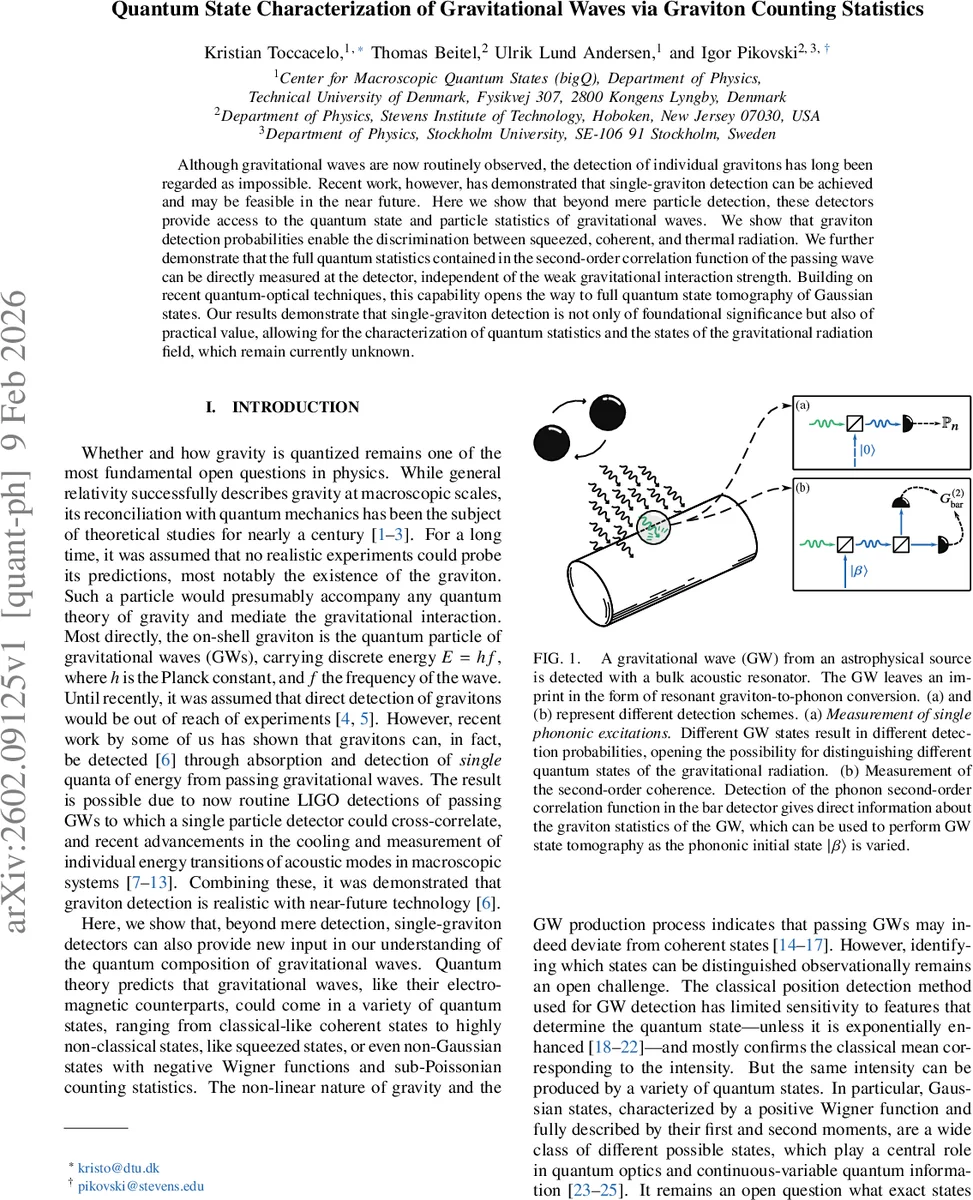
Although gravitational waves are now routinely observed, the detection of individual gravitons has long been regarded as impossible. Recent work, however, has demonstrated that single-graviton detection can be achieved and may be feasible in the near future. Here we show that beyond mere particle detection, these detectors provide access to the quantum state and particle statistics of gravitational waves. We show that graviton detection probabilities enable the discrimination between squeezed, coherent, and thermal radiation. We further demonstrate that the full quantum statistics contained in the second-order correlation function of the passing wave can be directly measured at the detector, independent of the weak gravitational interaction strength. Building on recent quantum-optical techniques, this capability opens the way to full quantum state tomography of Gaussian states. Our results demonstrate that single-graviton detection is not only of foundational significance but also of practical value, allowing for the characterization of quantum statistics and the states of the gravitational radiation field, which remain currently unknown.
💡 Research Summary
The paper addresses a fundamental limitation of current gravitational‑wave (GW) observatories: they measure only the classical strain amplitude, which is insufficient to reveal the quantum nature of the radiation field. Building on a recent proposal for single‑graviton detection using a bulk acoustic resonator, the authors demonstrate that such detectors can do far more – they can extract the full quantum statistics of the incoming GW and thereby identify its quantum state.
The interaction between a GW and a cylindrical bulk acoustic resonator is modeled by the Hamiltonian
\
Comments & Academic Discussion
Loading comments...
Leave a Comment