Agile asymmetric multi-legged locomotion: contact planning via geometric mechanics and spin model duality
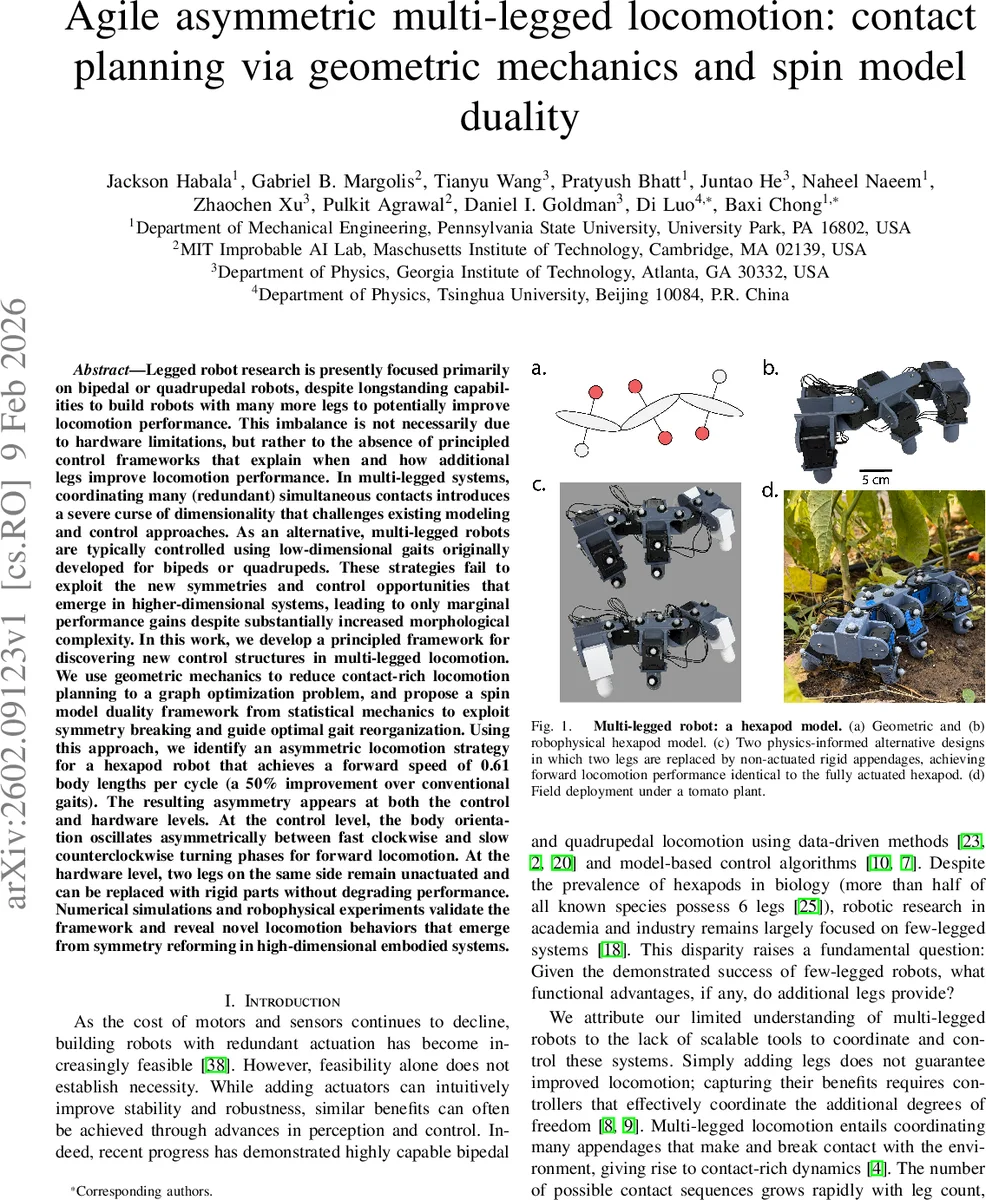
Legged robot research is presently focused on bipedal or quadrupedal robots, despite capabilities to build robots with many more legs to potentially improve locomotion performance. This imbalance is not necessarily due to hardware limitations, but rather to the absence of principled control frameworks that explain when and how additional legs improve locomotion performance. In multi-legged systems, coordinating many simultaneous contacts introduces a severe curse of dimensionality that challenges existing modeling and control approaches. As an alternative, multi-legged robots are typically controlled using low-dimensional gaits originally developed for bipeds or quadrupeds. These strategies fail to exploit the new symmetries and control opportunities that emerge in higher-dimensional systems. In this work, we develop a principled framework for discovering new control structures in multi-legged locomotion. We use geometric mechanics to reduce contact-rich locomotion planning to a graph optimization problem, and propose a spin model duality framework from statistical mechanics to exploit symmetry breaking and guide optimal gait reorganization. Using this approach, we identify an asymmetric locomotion strategy for a hexapod robot that achieves a forward speed of 0.61 body lengths per cycle (a 50% improvement over conventional gaits). The resulting asymmetry appears at both the control and hardware levels. At the control level, the body orientation oscillates asymmetrically between fast clockwise and slow counterclockwise turning phases for forward locomotion. At the hardware level, two legs on the same side remain unactuated and can be replaced with rigid parts without degrading performance. Numerical simulations and robophysical experiments validate the framework and reveal novel locomotion behaviors that emerge from symmetry reforming in high-dimensional embodied systems.
💡 Research Summary
The paper tackles the long‑standing challenge of planning and controlling contact‑rich locomotion for robots with many legs. While most robotic research concentrates on bipeds and quadrupeds, the authors argue that the lack of scalable tools—not hardware constraints—has prevented the exploitation of the potential benefits of additional legs. To address this, they develop a two‑pronged theoretical framework that combines geometric mechanics with a spin‑model duality from statistical physics.
First, under the low‑coasting‑number regime (inertia negligible compared with friction), the robot’s body velocity ξ is related to the shape velocity ṙ through a local connection matrix A(r): ξ = A(r)·ṙ. The matrix encodes ground reaction forces derived from resistive‑force theory and depends on the current contact pattern I. By numerically solving the force‑balance equations, the authors obtain A(r) for each possible set of contacts. Using the Hodge‑Helmholtz decomposition, they separate the forward component Aₓ into a dominant curl‑free (conservative) part and a much smaller solenoidal part. Because the conservative part is an order of magnitude larger, the net forward displacement over a closed gait loop can be approximated by the difference of a scalar potential P(r) evaluated at the start and end shapes, making the displacement path‑independent. This insight reduces the originally high‑dimensional contact‑planning problem to a linear optimization over potential differences.
Second, they map the linear problem onto a graph where each node represents a specific combination of shape r_j and contact pattern i. Edges that change shape while keeping the contact pattern carry a weight equal to the potential difference P_i(r_j) − P_i(r_l); edges that change only the contact pattern have zero weight. Adding a penalty term λ·S_I for the number of contact switches yields an objective that balances displacement gain against switching cost. The resulting problem is equivalent to finding a maximum‑weight cycle in a directed graph, which can be expressed as a Potts spin model (multi‑state Ising system). By exploiting the Potts‑Ising duality, the authors obtain globally optimal gait cycles in polynomial time, effectively breaking the “curse of dimensionality” that plagues exhaustive search.
Applying this framework to a hexapod with two body‑bending joints, the optimizer discovers a strikingly asymmetric gait. The robot alternates between a short, fast clockwise rotation phase and a long, slow counter‑clockwise rotation phase, producing a net forward motion without net yaw. This left‑right symmetry breaking yields a forward speed of 0.61 body lengths per cycle—about a 50 % improvement over conventional quadrupedal‑derived gaits, reinforcement‑learning controllers, and bio‑inspired patterns. Remarkably, the optimal gait leaves two legs on the same side permanently unactuated; replacing them with rigid, passive appendages does not degrade performance, demonstrating a hardware‑level asymmetry that reduces weight and mechanical complexity.
The authors validate their predictions with both high‑fidelity simulations and physical robophysical experiments, showing consistent speed gains and confirming that the conservative‑field approximation holds in practice (fixed‑contact undulation produces negligible net displacement). They also discuss how the penalty λ can be tuned to reflect real‑world energy or time costs of contact switching, making the method adaptable to various terrains and actuation limits.
Beyond the specific hexapod, the paper offers a generalizable tool for any multi‑legged or multi‑appendage system where shape changes and contact patterns interact. By systematically exploiting additional symmetries (diagonal, middle‑leg reflection, etc.) and allowing controlled symmetry breaking, designers can uncover locomotion strategies that would be invisible to traditional gait templates. The work bridges geometric mechanics, graph theory, and statistical physics, providing a principled pathway from high‑dimensional embodiment to tractable, optimal control policies.
Comments & Academic Discussion
Loading comments...
Leave a Comment