Universality classes split by strong and weak symmetries
Dissipative phase transitions are strongly shaped by the symmetries of the Liouvillian, yet the quantitative impact of weak and strong symmetries on critical behavior has remained unclear. We study a squeezed-photon model with single- and two-photon losses, realizing weak and strong symmetries in the simplest possible setting. The two symmetries exhibit identical Gaussian static fluctuations, whereas the order parameter and the asymptotic decay rate display distinct scaling behaviors. Our one-loop Keldysh analysis, together with cumulant-expansion numerics, reveals sharply different critical scaling with respect to the thermodynamic scaling parameter. This establishes that weak and strong symmetries lead to distinct dynamical universality classes despite originating from the same symmetry group in the closed system. Our results provide a clear quantitative demonstration that strong symmetries fundamentally reshape dissipative criticality.
💡 Research Summary
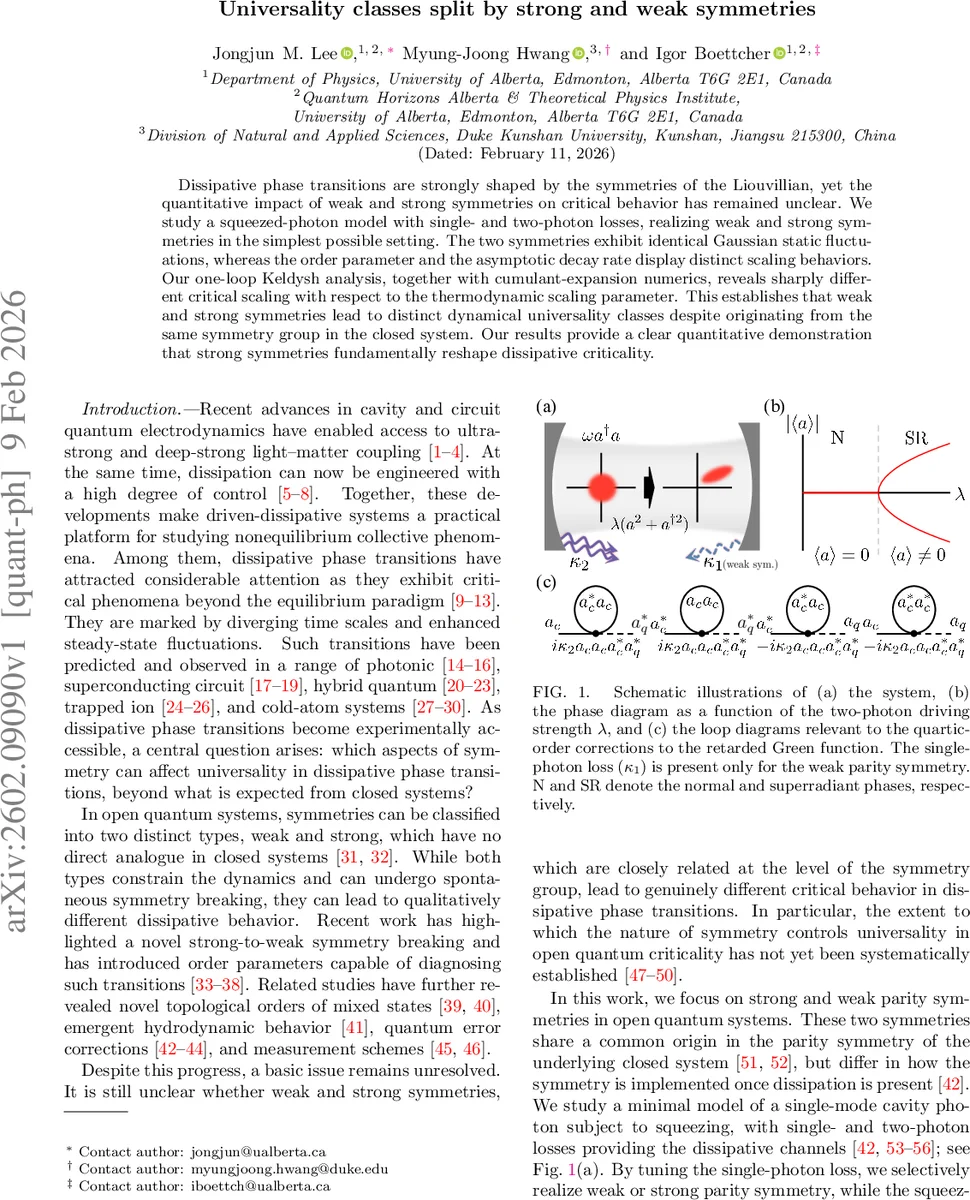
The authors investigate how weak and strong symmetries affect universal behavior in dissipative phase transitions. They consider a minimal single‑mode photonic system driven parametrically (two‑photon drive λ) and coupled to an environment via two loss channels: single‑photon loss (rate κ₁) and two‑photon loss (rate κ₂). The Hamiltonian is H = ω a†a + λ(a² + a†²). The parity operator Π = exp(iπa†a) commutes with H and the two‑photon loss, but anticommutes with the single‑photon loss. Consequently, when κ₁≠0 the Lindbladian possesses only a weak parity symmetry (L
Comments & Academic Discussion
Loading comments...
Leave a Comment