The Reawakening of 4U 1755-338 after 25 Years of Quiescence: Spectro-temporal Analysis Using Multi-instrument X-ray Data
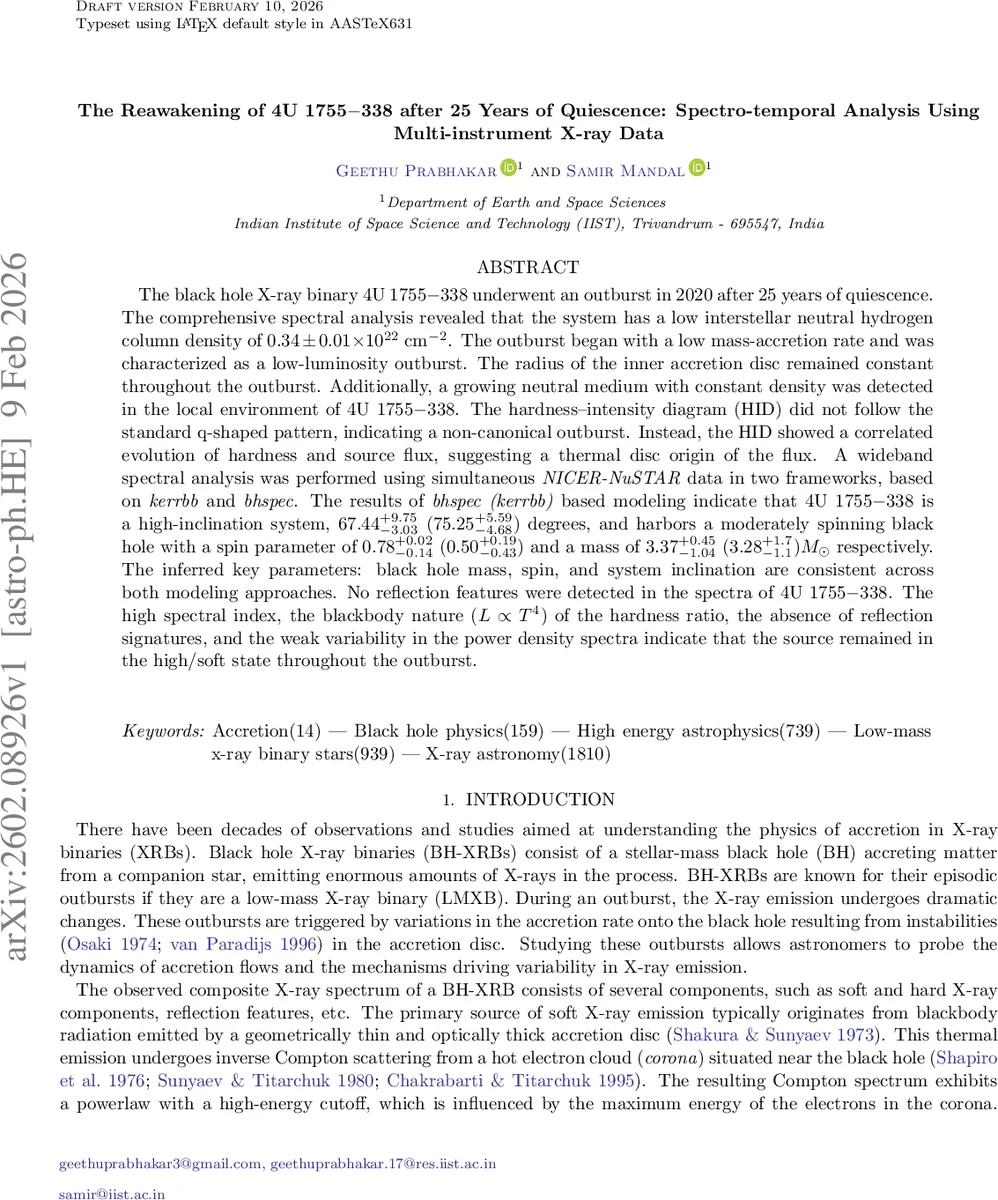
The black hole X-ray binary 4U 1755$-$338 underwent an outburst in 2020 after 25 years of quiescence. The comprehensive spectral analysis revealed that the system has a low interstellar neutral hydrogen column density of $0.34\pm0.01 \times$10$^{22}$ cm$^{-2}$. The outburst began with a low mass-accretion rate and was characterized as a low-luminosity outburst. The radius of the inner accretion disc remained constant throughout the outburst. Additionally, a growing neutral medium with constant density was detected in the local environment of 4U 1755$-$338.The hardness-intensity diagram (HID) did not follow the standard q-shaped pattern, indicating a non-canonical outburst. Instead, the HID showed a correlated evolution of hardness and source flux, suggesting a thermal disc origin of the flux. A wideband spectral analysis was performed using simultaneous NICER-NuSTAR data in two frameworks, based on kerrbb and bhspec. The results of bhspec (kerrbb) based modeling indicate that 4U 1755$-$338 is a high-inclination system, $67.44_{-3.03}^{+9.75}$ ($75.25_{-4.68}^{+5.59}$) degrees, and harbors a moderately spinning black hole with a spin parameter of $0.78_{-0.14}^{+0.02}$ ($0.50_{-0.43}^{+0.19}$) and a mass of $3.37_{-1.04}^{+0.45} (3.28_{-1.1}^{+1.7})M_{\odot}$ respectively. The inferred key parameters: black hole mass, spin, and system inclination are consistent across both modeling approaches. No reflection features were detected in the spectra of 4U 1755$-$338. The high spectral index, the blackbody nature ($L\propto T^4$) of the hardness ratio, the absence of reflection signatures, and the weak variability in the power density spectra indicate that the source remained in the high/soft state throughout the outburst.
💡 Research Summary
The paper presents a comprehensive spectro‑temporal study of the black‑hole X‑ray binary 4U 1755‑338, which re‑brightened in April 2020 after a 25‑year quiescent interval. Using continuous NICER monitoring from MJD 58941 to 60173 (April 2020 – August 2023) and a single simultaneous NuSTAR observation (32 ks on MJD 58948), the authors characterize the outburst as low‑luminosity and non‑canonical.
The MAXI/GSC light curve shows a gradual rise in the 2–10 keV band, with the hardest band (10–20 keV) remaining faint, leading the authors to define hardness as the 4–10 keV / 2–4 keV flux ratio. The hardness‑intensity diagram (HID) displays a monotonic, positively correlated track rather than the classic counter‑clockwise “q‑shape”, indicating that the source never entered a hard state and that the flux is dominated by thermal disc emission throughout the event.
Spectral analysis proceeds in two stages. First, each NICER observation (exposures > 500 s) is fitted with an absorbed multicolour disc model (tbabs × diskbb). Residuals below 1 keV reveal a low‑energy absorption feature that is best modeled by a partial‑covering neutral absorber (tbpcf). The final NICER‑only model (tbabs × tbpcf × diskbb) yields a fixed interstellar column density NH = 0.34 × 10²² cm⁻², a partial covering column NpcH ≈ 0.24 × 10²² cm⁻², covering fraction ≈ 0.65, inner disc temperature Tin ≈ 1.1 keV, and a stable diskbb normalization (≈ 55) across the outburst, implying an essentially constant inner disc radius.
Second, the simultaneous NICER‑NuSTAR spectrum (0.3–78 keV) is fitted with two sophisticated relativistic disc models: kerrbb and bhspec. Both models incorporate the same absorption components and find consistent system parameters: a high inclination (≈ 67–75°), a moderate spin (a* ≈ 0.5–0.8), and a low black‑hole mass (≈ 3.3 M⊙). Specifically, kerrbb gives i = 75.3° (‑4.68 + 5.59), a* = 0.78 (‑0.14 + 0.02), M = 3.37 M⊙ (‑1.04 + 0.45); bhspec yields i = 67.4° (‑3.03 + 9.75), a* = 0.50 (‑0.43 + 0.19), M = 3.28 M⊙ (‑1.10 + 1.70). The agreement between the two independent frameworks strengthens confidence in these fundamental parameters.
No reflection signatures (Fe Kα line, Compton hump) are detected in any of the spectra, despite the high inclination, suggesting either a low covering factor of the reflecting material, a highly ionised disc surface, or simply that the corona is weak and does not illuminate the disc sufficiently. Power density spectra derived from NICER data show very low rms variability (< 3 %) and lack any quasi‑periodic oscillations, consistent with a source residing in the high/soft state throughout the outburst.
The authors also identify a growing neutral medium in the local environment, modeled as a constant‑density partial‑covering absorber, which may be related to the observed dips in historic data and could influence the observed spectral evolution.
In summary, 4U 1755‑338’s 2020 outburst is characterized by:
- Low interstellar NH (0.34 × 10²² cm⁻²) and an additional partial‑covering neutral absorber.
- A stable inner disc radius and disc temperature, indicating a geometrically thin, optically thick disc that does not recede.
- A HID that deviates from the canonical q‑shape, reflecting a non‑canonical, soft‑state‑dominated outburst.
- Consistent high‑inclination, moderate‑spin, low‑mass black‑hole parameters from both kerrbb and bhspec modeling.
- Absence of reflection features and weak timing variability, reinforcing the high/soft state classification.
These findings demonstrate that not all low‑mass X‑ray binary outbursts follow the standard state‑transition paradigm, and that systems with modest mass, moderate spin, and high inclination can produce prolonged soft‑state‑only events, possibly shaped by local neutral material. The work adds a valuable data point to the growing catalog of “non‑canonical” black‑hole transients and underscores the importance of broadband, simultaneous observations for robust parameter estimation.
Comments & Academic Discussion
Loading comments...
Leave a Comment