Zero-freeness of a multivariate monomer-dimer-cycle polynomial on bounded-degree graphs
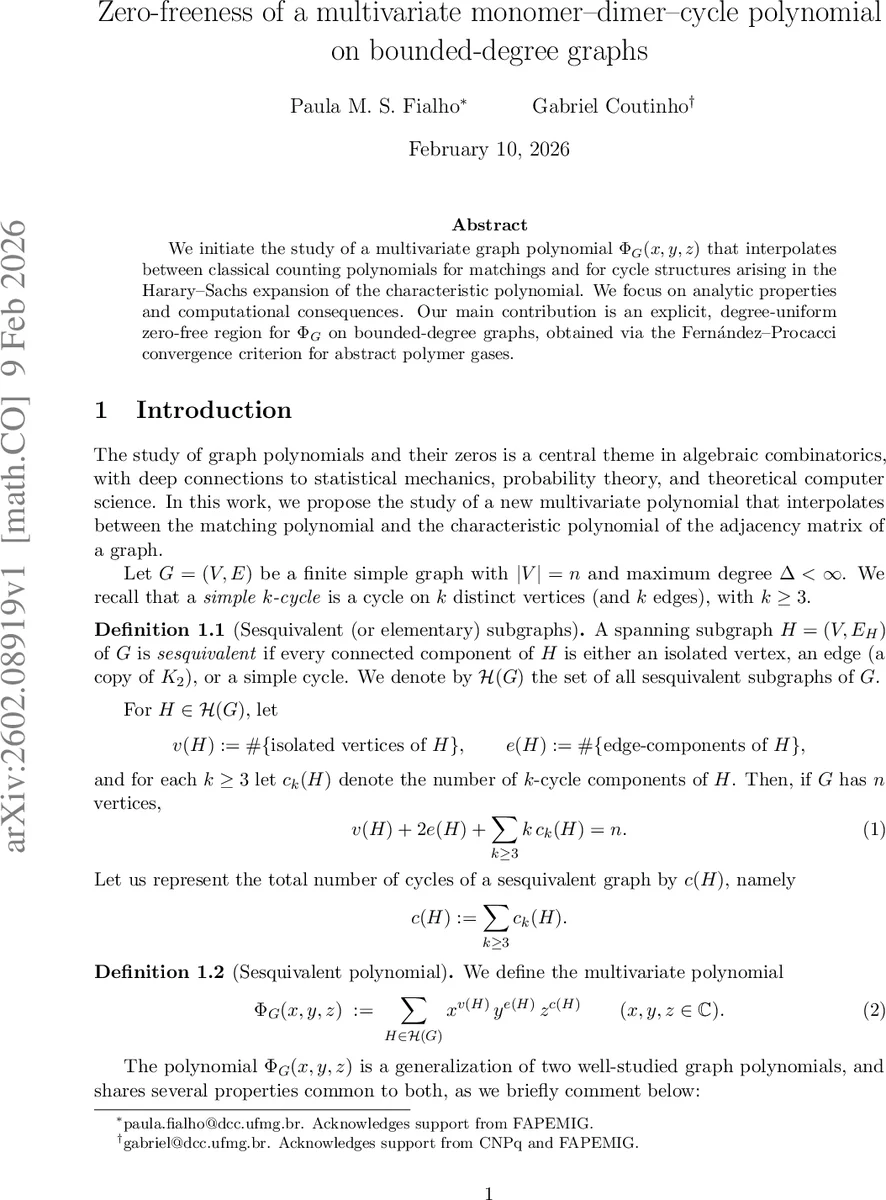
We initiate the study of a multivariate graph polynomial $Φ_G(x,y,z)$ that interpolates between classical counting polynomials for matchings and for cycle structures arising in the Harary–Sachs expansion of the characteristic polynomial. We focus on analytic properties and computational consequences. Our main contribution is an explicit, degree-uniform zero-free region for $Φ_G$ on bounded-degree graphs, obtained via the Fernández–Procacci convergence criterion for abstract polymer gases.
💡 Research Summary
The paper introduces a new multivariate graph polynomial Φ_G(x, y, z) defined on a finite simple graph G = (V,E) with maximum degree Δ. For each “sesquivalent” spanning subgraph H (i.e., each connected component is either an isolated vertex, a single edge, or a simple cycle) the polynomial contributes a monomial x^{v(H)} y^{e(H)} z^{c(H)}, where v(H), e(H), and c(H) count isolated vertices, edge‑components, and total cycles, respectively. This construction interpolates between two classical graph polynomials: setting y = −1, z = −2 yields the Harary–Sachs expansion of the characteristic polynomial, while setting z = 0 reduces Φ_G to the monomer‑dimer (matching) partition function.
The central technical achievement is an explicit, degree‑uniform zero‑free region for Φ_G on bounded‑degree graphs. The authors map Φ_G to the partition function Ξ(ω) of a hard‑core abstract polymer gas: polymers are all edges and all simple cycles of G, two polymers are incompatible if they share a vertex, and the activities are ω(e) = y x^{−2} for edges and ω(C_k) = z x^{−k} for a k‑cycle. Consequently Φ_G(x,y,z) = x^{|V|} Ξ(ω).
To prove zero‑freeness they apply the Fernández–Procacci convergence criterion for abstract polymer gases. This criterion states that if there exists a>0 such that for every vertex v, \
Comments & Academic Discussion
Loading comments...
Leave a Comment