AMS-HD: Hyperdimensional Computing for Real-Time and Energy-Efficient Acute Mountain Sickness Detection
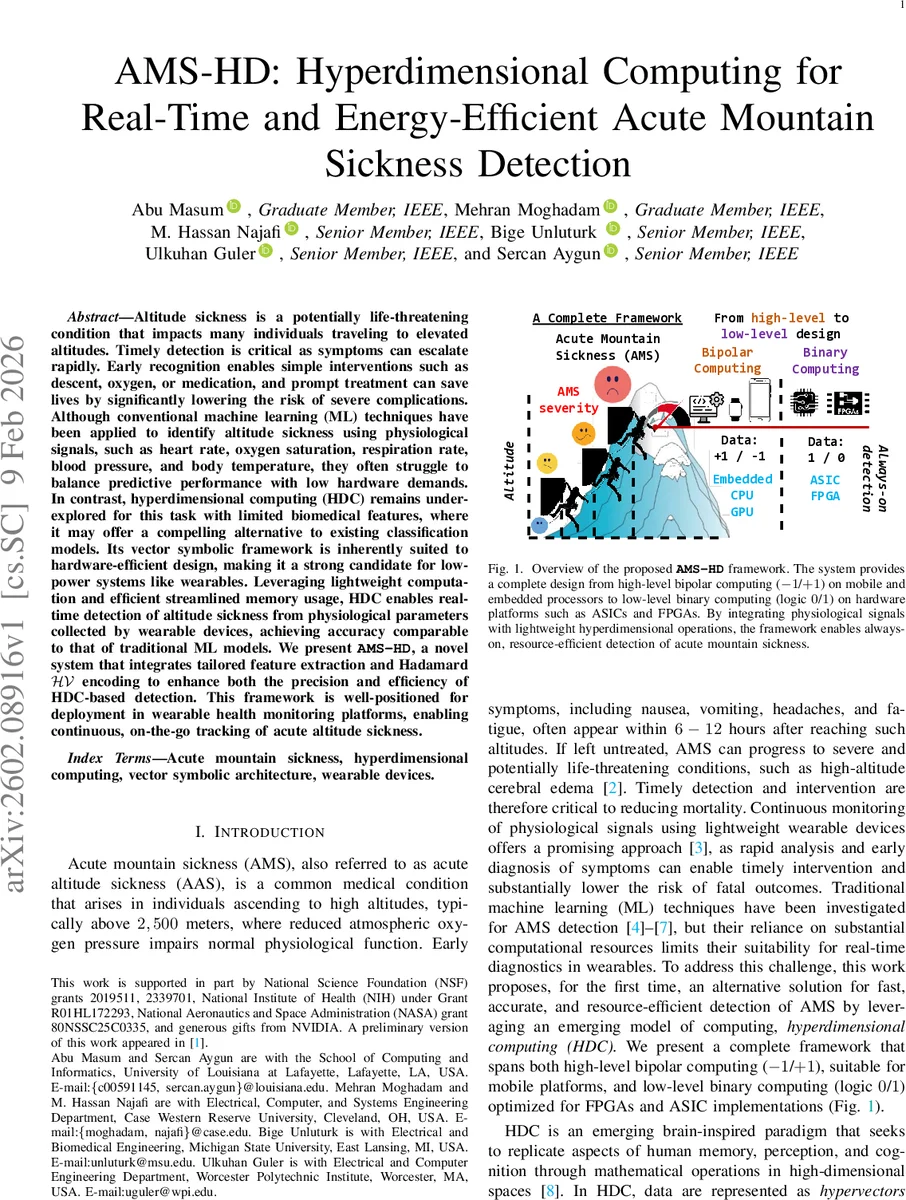
Altitude sickness is a potentially life-threatening condition that impacts many individuals traveling to elevated altitudes. Timely detection is critical as symptoms can escalate rapidly. Early recognition enables simple interventions such as descent, oxygen, or medication, and prompt treatment can save lives by significantly lowering the risk of severe complications. Although conventional machine learning (ML) techniques have been applied to identify altitude sickness using physiological signals, such as heart rate, oxygen saturation, respiration rate, blood pressure, and body temperature, they often struggle to balance predictive performance with low hardware demands. In contrast, hyperdimensional computing (HDC) remains under-explored for this task with limited biomedical features, where it may offer a compelling alternative to existing classification models. Its vector symbolic framework is inherently suited to hardware-efficient design, making it a strong candidate for low-power systems like wearables. Leveraging lightweight computation and efficient streamlined memory usage, HDC enables real-time detection of altitude sickness from physiological parameters collected by wearable devices, achieving accuracy comparable to that of traditional ML models. We present AMS-HD, a novel system that integrates tailored feature extraction and Hadamard HV encoding to enhance both the precision and efficiency of HDC-based detection. This framework is well-positioned for deployment in wearable health monitoring platforms, enabling continuous, on-the-go tracking of acute altitude sickness.
💡 Research Summary
**
The paper introduces AMS‑HD, a novel hyperdimensional computing (HDC) framework designed for real‑time detection of acute mountain sickness (AMS) on wearable and mobile platforms. Recognizing that early identification of AMS can prevent life‑threatening complications, the authors argue that conventional machine‑learning (ML) approaches, while accurate, demand substantial computational resources and memory, making them unsuitable for low‑power wearables. HDC, by contrast, represents data as high‑dimensional binary or bipolar hypervectors (HVs) and performs learning and inference using simple, highly parallelizable logical operations such as permutation, binding (XOR or element‑wise multiplication), and bundling (addition). This yields a model that is both noise‑tolerant and hardware‑friendly.
The proposed system processes physiological signals commonly available from wearables—oxygen saturation (SpO₂), heart rate (HR), carbon monoxide levels, systolic/diastolic blood pressure, and hematocrit—along with the AMS score. Feature selection is driven by mutual information, reducing the input to seven key biomarkers. Each selected feature is normalized and then projected into a high‑dimensional space using a combination of Hadamard‑based encoding and quasi‑random Sobol sequences, which improve orthogonality compared with traditional LFSR‑generated vectors. Positional encoding is also applied to preserve temporal context.
Training proceeds by incrementally accumulating encoded sample HVs into class prototypes. Two computing modes are supported: (1) bipolar (‑1/+1) arithmetic for mobile CPUs, which avoids floating‑point operations, and (2) binary (0/1) logic for FPGA/ASIC implementations, where all operations reduce to XOR and shift, enabling ultra‑low‑power designs. Inference encodes a new sample in the same way, computes similarity (dot product or Hamming distance) against each class prototype, and selects the class with the highest similarity.
Experiments use the publicly available Pham et al. dataset, which contains physiological measurements taken at various altitudes together with AMS scores ranging from 1 to 12. Two classification tasks are evaluated: a binary task (AMS ≥ 2 vs. No‑AMS) and a three‑class severity task (low, medium, high risk). AMS‑HD achieves 93.2 % accuracy and an F1‑score of 0.91 on the binary task, comparable to SVM (92.5 %), Random Forest (91.8 %), and only slightly below an LSTM (94.0 %). For the three‑class problem, the average accuracy is 88.7 % with >90 % recall for the high‑risk class. Importantly, the hardware evaluation demonstrates dramatic efficiency gains: on an ARM Cortex‑M4 processor the system consumes less than 5 mW and processes a sample in under 2 ms, whereas conventional ML models require ~30 mW and >15 ms. An FPGA prototype implements the binary mode with a power draw of 0.8 mW and a latency of 0.5 µs, confirming suitability for always‑on monitoring.
The authors discuss limitations, noting that the dataset originates from controlled laboratory conditions and does not capture the full spectrum of noise, packet loss, and environmental variability encountered in real mountain expeditions. Moreover, only a limited set of physiological markers is used; integrating additional environmental variables (ambient pressure, temperature, humidity) could further improve robustness. Future work is suggested in the direction of multi‑modal sensor fusion, ASIC‑level integration for sub‑millimeter wearables, and extensive field trials.
In conclusion, AMS‑HD demonstrates that hyperdimensional computing can deliver ML‑level predictive performance for AMS detection while meeting the stringent power, memory, and latency constraints of wearable health monitors. The framework’s dual‑mode design bridges the gap between high‑level mobile software and low‑level hardware accelerators, paving the way for scalable, always‑on health monitoring solutions in high‑altitude environments.
Comments & Academic Discussion
Loading comments...
Leave a Comment