Ancient solutions to free boundary mean curvature flow
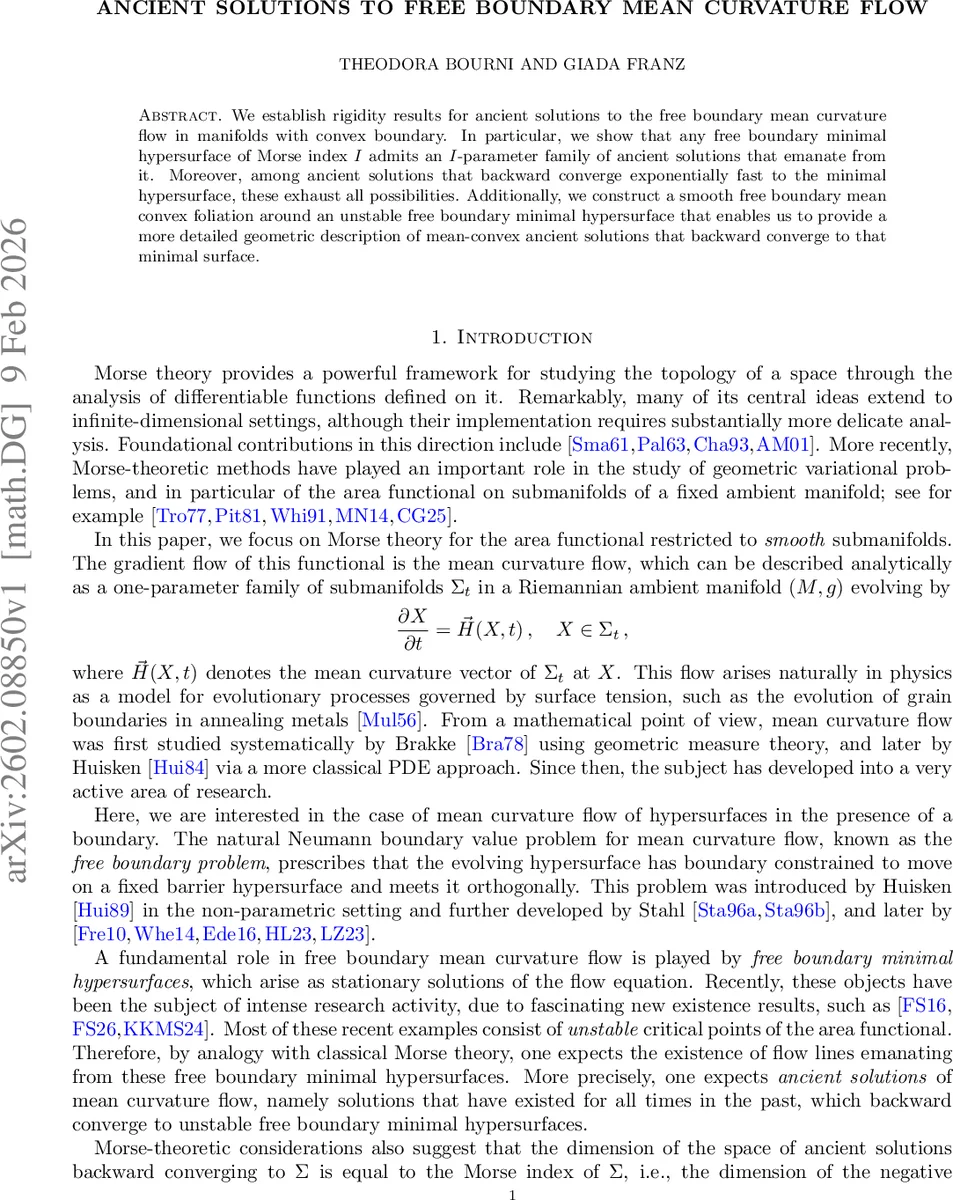
We establish rigidity results for ancient solutions to the free boundary mean curvature flow in manifolds with convex boundary. In particular, we show that any free boundary minimal hypersurface of Morse index I admits an I-parameter family of ancient solutions that emanate from it. Moreover, among ancient solutions that backward converge exponentially fast to the minimal hypersurface, these exhaust all possibilities. Additionally, we construct a smooth free boundary mean convex foliation around an unstable free boundary minimal hypersurface that enables us to provide a more detailed geometric description of mean-convex ancient solutions that backward converge to that minimal surface.
💡 Research Summary
The paper investigates ancient solutions of the free‑boundary mean curvature flow (FBMCF) in a compact Riemannian manifold (M^{m+1},g) whose boundary ∂M is convex. A free‑boundary minimal hypersurface Σ ⊂ M (i.e., Σ meets ∂M orthogonally and has zero mean curvature) is a stationary point of the flow. The authors address the natural Morse‑theoretic question: given an unstable minimal hypersurface, how many ancient flows emanate from it, and can they be classified?
The first main result (Theorem A) shows that if Σ has Morse index I (the number of negative eigenvalues of the Jacobi operator J_Σ), then there exists an I‑parameter family of ancient FBMCF solutions that converge backward in time to Σ. Moreover, any ancient solution that converges to Σ at an exponential rate belongs to this family. This establishes a precise correspondence between the Morse index and the dimension of the space of ancient solutions, extending the classical picture from closed minimal hypersurfaces to the free‑boundary setting.
The second main result (Theorem B) concerns mean‑convex ancient solutions. If Σ is unstable and non‑degenerate (no zero eigenvalue of J_Σ), then there is a unique (up to time translation) mean‑convex ancient solution that converges exponentially fast to Σ, with the decay rate dictated by the first eigenvalue λ₁ of J_Σ. The authors construct a smooth free‑boundary mean‑convex foliation around Σ, which serves as a geometric barrier and provides a more detailed description of these solutions.
The paper is organized as follows. Section 2 introduces the necessary geometric background, defines the Jacobi operator, weighted parabolic norms, and recalls the variational characterization of eigenvalues. Section 3 develops precise estimates for graphs over Σ. Using a tubular neighborhood given by the ν‑flow ψ_Σ, a function u:Σ→ℝ defines a perturbed hypersurface Σ_u. The authors compute the mean curvature and contact‑angle conditions for Σ_u, isolating nonlinear error terms E(u) (interior) and ε(u) (boundary). Schauder estimates and weighted L²‑norms show that these errors are quadratic in u, which is crucial for the subsequent fixed‑point argument.
In Section 4 the existence of the I‑parameter family is proved. By projecting the flow onto the unstable eigenspace of J_Σ and applying a contraction‑mapping theorem in a suitable Banach space of functions with small parabolic C^{2,α} norm, the authors construct a manifold of initial data whose forward evolution yields ancient solutions. The construction respects the free‑boundary condition thanks to a careful treatment of the boundary linearization (the term –∂η u + II∂M(ν,ν)u).
Section 5 establishes uniqueness within the exponential‑convergence class. An ODE lemma due to Merle–Zaag, adapted by Choi–Mantoulidis for the boundaryless case, is employed to show that any ancient solution with sufficiently fast decay must have its projection onto the unstable eigenspace governed solely by the leading eigenmode. Consequently, such a solution coincides with one of the previously constructed ones.
Section 6 provides an alternative, more geometric proof of Theorem B. Using the implicit function theorem, the authors build a smooth family of free‑boundary hypersurfaces {Σ_s} that foliate a neighborhood of Σ and are mean‑convex (their mean curvature points inward). These hypersurfaces serve as barriers for the flow, allowing a comparison argument that yields existence of a mean‑convex ancient solution and, when Σ is non‑degenerate, its uniqueness up to time translation.
The technical heart of the work lies in handling the free‑boundary condition: the linearization of the contact angle introduces a nontrivial boundary operator involving the second fundamental form of ∂M. The authors manage this by incorporating the term II_∂M(ν,ν) into the Jacobi quadratic form and establishing precise boundary error estimates. Weighted parabolic norms (with exponential weights) are essential for controlling the backward‑in‑time behavior and for proving exponential convergence.
Overall, the paper delivers the first systematic classification of higher‑dimensional ancient solutions to FBMCF, linking Morse index to the dimension of the solution space, providing uniqueness results for mean‑convex ancient flows, and introducing a novel free‑boundary foliation technique. These contributions deepen the understanding of geometric flows with boundary conditions and open avenues for further study of singularity formation, min‑max theory, and the role of unstable minimal hypersurfaces in the dynamics of curvature flows.
Comments & Academic Discussion
Loading comments...
Leave a Comment