On the Inefficiency of Social Learning
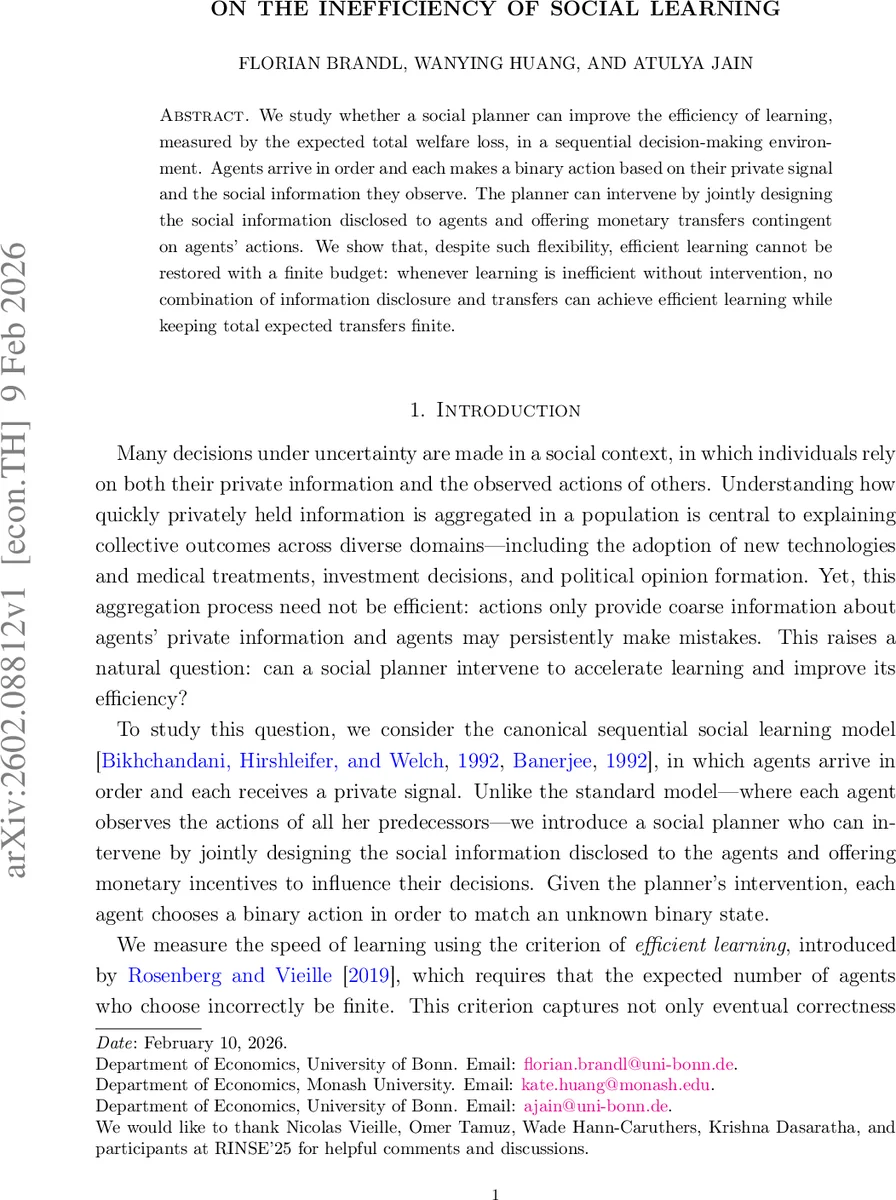
We study whether a social planner can improve the efficiency of learning, measured by the expected total welfare loss, in a sequential decision-making environment. Agents arrive in order and each makes a binary action based on their private signal and the social information they observe. The planner can intervene by jointly designing the social information disclosed to agents and offering monetary transfers contingent on agents’ actions. We show that, despite such flexibility, efficient learning cannot be restored with a finite budget: whenever learning is inefficient without intervention, no combination of information disclosure and transfers can achieve efficient learning while keeping total expected transfers finite.
💡 Research Summary
The paper investigates whether a social planner can restore efficient learning in a classic sequential social learning environment when learning is otherwise inefficient. In the baseline model, agents arrive one by one, each receiving a private signal about an unknown binary state and observing the actions of all predecessors. Agents choose a binary action to match the state, receiving a payoff of one for a correct choice and zero otherwise. Learning efficiency is measured by the expected total number of incorrect actions; efficient learning requires this expectation to be finite.
The authors introduce a planner who can (i) design the social information disclosed to each agent and (ii) offer monetary transfers contingent on the agent’s action and the disclosed information. The disclosed information is modeled as a signal νₜ that is a mean‑preserving contraction of the planner’s posterior belief πₜ = P(θ = h | history). This framework encompasses full disclosure (νₜ = πₜ), no disclosure, and any intermediate garbling. Transfers τₜ(aₜ, νₜ) can subsidize either action, thereby shaping incentives.
A key technical assumption is that private signals are “tail‑regular”: the unconditional distribution F of posterior beliefs behaves like q^α near zero, for some α > 0. This captures a wide class of unbounded signals while allowing a single parameter α to determine the speed of learning. Prior work (Rosenberg and Vieille 2019) shows that learning is efficient iff ∫₀¹ 1/F(x) dx < ∞, which under tail‑regularity reduces to α < 1. When α ≥ 1, the baseline model exhibits inefficient learning: the expected number of mistakes diverges.
The main result (Theorem 1) states that if the signal distribution yields inefficient learning in the absence of intervention (α ≥ 1), then no combination of information‑disclosure policy and transfer scheme can achieve efficient learning while keeping the expected total transfers finite. In other words, any policy that succeeds in driving the expected mistake count to a finite value must incur an infinite expected budget. Corollary 2 follows: information disclosure alone, no matter how cleverly garbled, cannot restore efficient learning.
The intuition behind the theorem is a fundamental trade‑off. Precise social information reduces the current agent’s mistake probability but makes the agent’s action less informative for future agents, because the agent relies heavily on the disclosed belief and ignores her private signal. Coarse social information makes the agent’s action more informative (the agent leans on her private signal) but raises the current mistake probability. Transfers can, in principle, tilt the balance by subsidizing the “contrarian” action—i.e., the action opposite to what the social signal recommends—thereby encouraging agents to heed their private signals. However, the authors show that to keep the mistake probability low enough for efficient learning, the required subsidies must grow without bound over time, leading to an infinite expected total transfer.
The proof technique departs from traditional analyses of belief trajectories; instead, it studies the induced distribution of agents’ posterior beliefs directly, allowing a clean characterization of the impossibility. This methodological contribution may be useful for other multi‑period learning problems where the planner observes only actions.
The paper situates its contribution within a broad literature. It contrasts with earlier works that focus on signal structure (e.g., showing that full information can be sufficient when signals are sufficiently informative) and with papers that allow the planner to dictate agents’ strategies (Rosenberg and Vieille 2017). It also relates to recent studies on misspecification, networked learning, and the role of over‑confidence, highlighting that the present model assumes fully rational agents and thus the positive effects of misspecification do not apply.
In sum, the authors demonstrate a robust impossibility: even with maximal flexibility in shaping both information and incentives, a planner with a finite budget cannot overcome the inefficiency inherent in certain signal environments. The result underscores that strategic incentives, rather than merely the coarseness of observed actions, are the primary source of learning failure in sequential social learning.
Comments & Academic Discussion
Loading comments...
Leave a Comment