Topological properties of spin block magnetic ladders in proximity of a superconductor: application to BaFe$_{2}$S$_{3}$
Monoatomic chains with magnetic order in proximity of a s-wave superconductor can host Majorana edge modes. In this paper, we extend this idea to more complex spin-block chains such as the BaFe${2}$S${3}$ magnetic material that has a spin-ladder like structure. We investigate the topological phase diagram of such a system as function of the system parameters. We show that the coupling between chains within the ladder leads to the topological phase with a winding number larger than the sum of two single magnetic chains. Furthermore, strong coupling between chains leads to fractal-like substructure in the topological phase diagram. By investigating the real space properties of such a system and particularly its edge modes, we find that the system spectrum contains several in-gap states that we analyze in detail.
💡 Research Summary
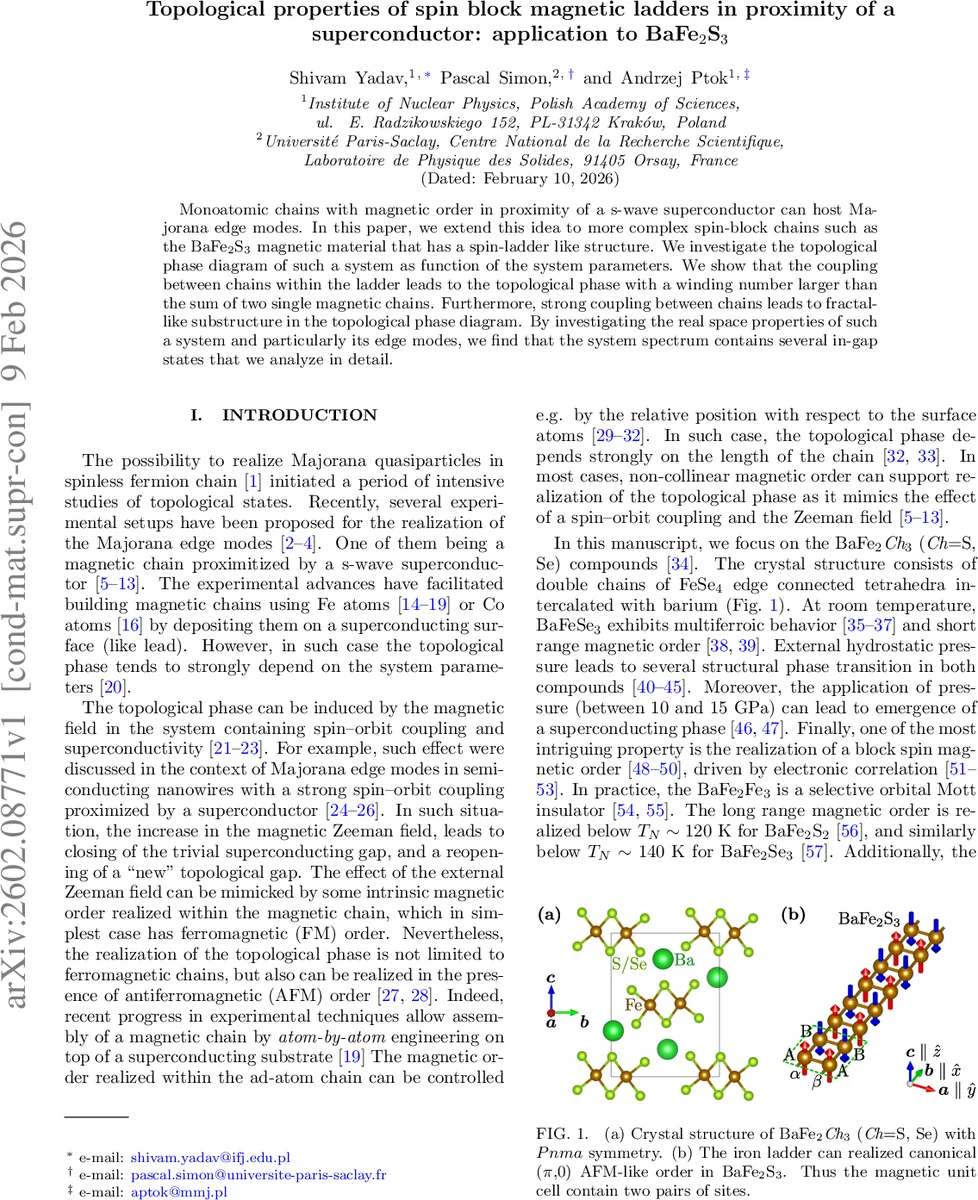
The manuscript extends the well‑established concept that a single magnetic atom chain proximitized by an s‑wave superconductor can host Majorana zero‑energy edge modes to a more intricate system: a spin‑block magnetic ladder, exemplified by the iron‑based ladder compound BaFe₂S₃ (and its Se analogue). The authors construct a tight‑binding Bogoliubov‑de Gennes (BdG) model that captures two parallel chains (labeled α and β) forming a ladder. Electrons hop along each chain with amplitude t and between the chains with amplitude t⊥. Rashba‑type spin‑orbit couplings are introduced both along the chains (λ) and across the rungs (η). A staggered magnetic exchange term m₀ implements the experimentally observed block‑antiferromagnetic order, where sublattices A and B carry opposite spin polarizations. Proximity‑induced s‑wave pairing Δ completes the Hamiltonian.
By Fourier transforming to momentum space and arranging the operators in a Nambu basis, the Hamiltonian becomes an 8 × 8 matrix expressed as a tensor product of Pauli matrices acting in particle‑hole (τ), sublattice (ρ), chain (ν) and spin (σ) spaces. The system belongs to symmetry class BDI in one dimension, allowing an integer topological invariant – the winding number W – to be defined. The authors block‑diagonalize the BdG matrix into off‑diagonal blocks A(k) and A†(−k) and compute W from the phase winding of det A(k) across the reduced Brillouin zone (k ∈
Comments & Academic Discussion
Loading comments...
Leave a Comment