Conformally flat factorization homology in Ind-Hilbert spaces and Conformal field theory
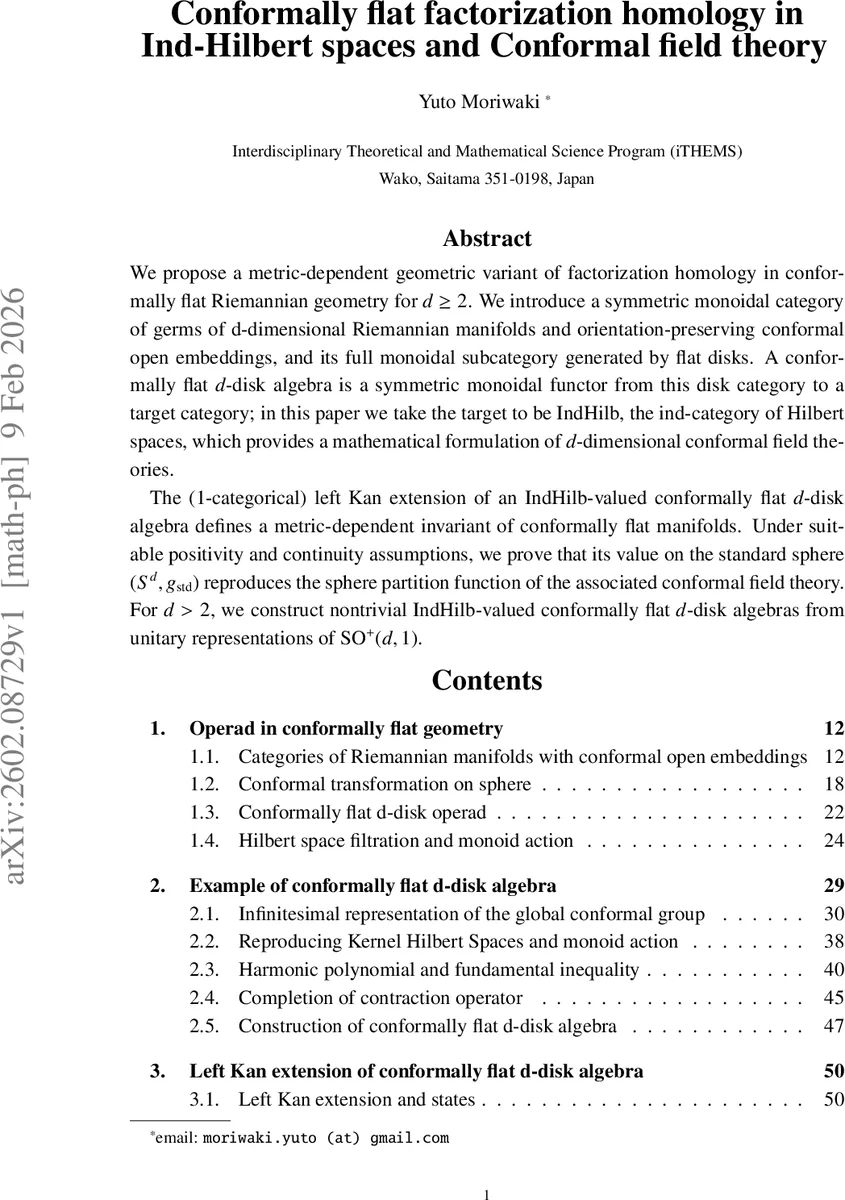
We propose a metric-dependent geometric variant of factorization homology in conformally flat Riemannian geometry for $d \geq 2$. We introduce a symmetric monoidal category of germs of d-dimensional Riemannian manifolds and orientation-preserving conformal open embeddings, and its full monoidal subcategory generated by flat disks. A conformally flat $d$-disk algebra is a symmetric monoidal functor from this disk category to a target category; in this paper we take the target to be $\mathrm{IndHilb}$, the ind-category of Hilbert spaces, which provides a mathematical formulation of $d$-dimensional conformal field theories. The (1-categorical) left Kan extension of an $\mathrm{IndHilb}$-valued conformally flat $d$-disk algebra defines a metric-dependent invariant of conformally flat manifolds. Under suitable positivity and continuity assumptions, we prove that its value on the standard sphere $(S^d,g_{\mathrm{std}})$ reproduces the sphere partition function of the associated conformal field theory. For $d>2$, we construct nontrivial $\mathrm{IndHilb}$-valued conformally flat $d$-disk algebras from unitary representations of $\mathrm{SO}^+(d,1)$.
💡 Research Summary
The paper introduces a metric‑dependent variant of factorization homology tailored to conformally flat Riemannian geometry in dimensions d ≥ 2. The authors first define a symmetric monoidal category Mfld CO₍d₎ whose objects are germs of oriented d‑dimensional Riemannian manifolds (a compact core together with an open neighborhood) and whose morphisms are orientation‑preserving conformal open embeddings defined on neighborhoods of the cores. Inside this category they isolate the full monoidal subcategory Disk CO₍d₎ generated by the flat unit disk Dᵈ. The morphism spaces CE₍d₎(n)=Hom_Mfld(⊔ⁿD, D) form an operad of disjoint conformal disk embeddings; for d ≥ 3 this operad coincides with the monoid of restrictions of elements of SO⁺(d+1,1) that send the unit disk into itself, while in dimension 2 it is a proper sub‑monoid of holomorphic embeddings that extend to a neighborhood.
The target of the “disk algebra’’ is taken to be IndHilb, the ind‑category of separable Hilbert spaces and bounded operators. A CE₍d₎‑algebra A in IndHilb is required to carry a Hilbert space filtration A = ⋃ₖ Hₖ where each Hₖ is a Hilbert space, the inclusions are isometric, and the action of the operad respects the filtration in the sense that for any n‑ary operation and any choice of filtration levels there exists a higher level K such that the induced map H_{k₁}⊗⋯⊗H_{kₙ}→H_K is bounded. This filtration makes it possible to speak of continuity for the structure maps and to define continuous states on manifolds.
Given a CE₍d₎‑algebra A, the authors consider its left Kan extension along the inclusion Disk CO₍d₎ ↪ Mfld CO₍d₎. In the 1‑categorical setting this yields a symmetric monoidal functor
Lan A : Mfld CO₍d₎ → IndHilb.
For each object M of Mfld CO₍d₎, a state is a morphism χ_M : Lan A(M) → ℂ. By unpacking the Kan extension, a state is equivalent to a compatible family of multilinear maps
χ_n : Hom_Mfld(⊔ⁿD, M) → Hom(H^{⊗n}, ℂ)
that intertwine the operad composition (the analogue of the operator product expansion). Continuity of a state forces the kernel of χ_M to be a closed ideal of A; if A is simple (has no non‑trivial closed ideals) then any non‑zero continuous state has trivial radical.
The main physical result is that, under suitable positivity (the vacuum state is positive and cyclic) and continuity assumptions, the value of the Kan‑extended functor on the standard sphere reproduces the sphere partition function of the associated conformal field theory:
Lan A(Sᵈ, g_std) = Z_{CFT}(Sᵈ).
This theorem (3.22) provides a rigorous categorical realization of the familiar statement that a CFT assigns a number to a closed manifold, now derived from local Hilbert‑space data via factorization homology.
The paper then supplies concrete examples for d > 2. Starting from a unitary representation of the conformal group SO⁺(d,1) on a Hilbert space V, the authors construct a CE₍d₎‑algebra A_V. The construction proceeds through several steps: (i) the infinitesimal action of the Lie algebra yields a reproducing‑kernel Hilbert space of harmonic polynomials; (ii) a contraction operator is defined using the kernel and shown to be bounded precisely when the underlying conformal embeddings belong to the refined operad CE₍d₎ (Theorem 2.31); (iii) completing this operator gives a well‑defined action of the operad on the filtered Hilbert spaces; (iv) the resulting algebra satisfies the positivity and continuity hypotheses, and its Kan extension recovers the free massless scalar field partition function on spheres. Thus the authors produce non‑trivial IndHilb‑valued disk algebras that correspond to genuine CFTs.
The authors discuss the special case d = 2, where holomorphic embeddings do not always extend to neighborhoods, making the operad CE₂ strictly smaller than the full monoid of injective holomorphic maps. They note that the boundedness criterion is subtler in this dimension and point to ongoing work linking their construction to Segal’s functorial CFT, Huang’s vertex‑operator‑algebra approach, and the Stolz‑Teichner bordism categories.
In summary, the paper establishes a new bridge between conformal geometry, operator‑algebraic quantum field theory, and higher‑categorical factorization homology. By working with the ind‑category of Hilbert spaces, the authors manage to encode unbounded field operators in a bounded, categorical framework, obtain a rigorous definition of states and partition functions via left Kan extensions, and produce explicit examples from representation theory of the conformal group. The work opens avenues for extending these ideas to two‑dimensional theories, supersymmetric models, and connections with existing functorial CFT formalisms.
Comments & Academic Discussion
Loading comments...
Leave a Comment