Discovering hypergeometric series with harmonic numbers via Wilf-Zeilberger seeds
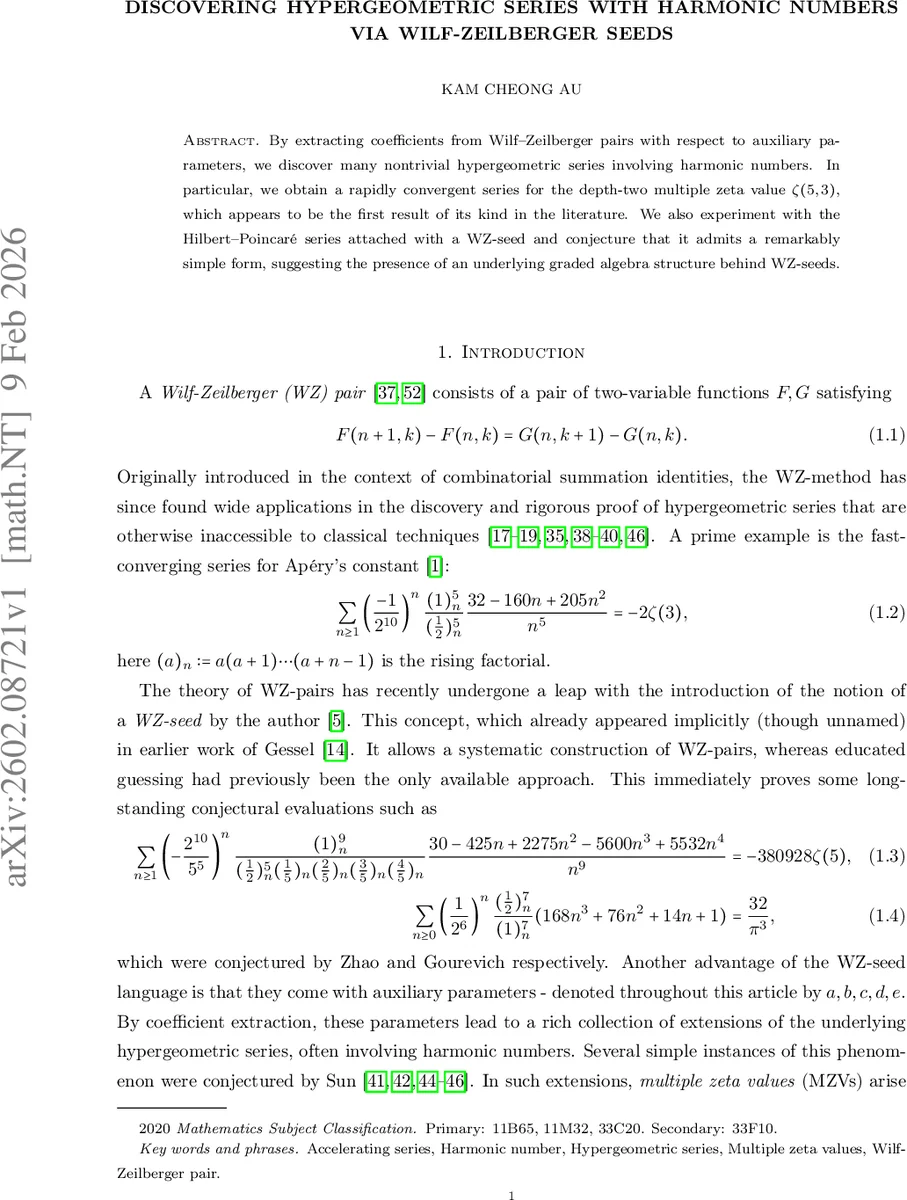
By extracting coefficients from Wilf-Zeilberger pairs with respect to auxiliary parameters, we discover many nontrivial hypergeometric series involving harmonic numbers. In particular, we obtain a rapidly convergent series for the depth-two multiple zeta value $ζ(5,3)$, which appears to be the first result of its kind in the literature. We also experiment with the Hilbert-Poincare series attached with a WZ-seed and conjecture that it admits a remarkably simple form, suggesting the presence of an underlying graded algebra structure behind WZ-seeds.
💡 Research Summary
The paper introduces a systematic framework for generating and proving hypergeometric series that involve harmonic numbers, based on the concept of a Wilf‑Zeilberger (WZ) seed. A WZ seed is a hypergeometric term f(a₁,…,a_m,k) whose parameters are allowed to depend linearly on an auxiliary integer n. By applying Gosper’s algorithm to such a seed one obtains a WZ‑pair (F,G) satisfying the fundamental telescoping relation F(n+1,k)−F(n,k)=G(n,k+1)−G(n,k). The authors focus on the case where the sum over k of F(0,k) is straightforward to evaluate, while the sum over n of G(0,n) is more intricate.
The key technical device is coefficient extraction with respect to the auxiliary parameters a,b,c,d,e. Expanding the rising factorial (γ+a)^n around a=0 yields a series whose coefficients are harmonic numbers H^{(s)}_N(γ). Consequently, each coefficient of total degree N in the multivariate expansion belongs to a Q‑vector space V_N. The authors compute dim V_N for several concrete seeds and observe a striking pattern: for the Dougall 5F4 seed the dimensions form the sequence 1, 2, 4, 7, 12, 18, 27, 38,…, which matches the coefficients of the rational generating function
\
Comments & Academic Discussion
Loading comments...
Leave a Comment