Ecosystems in the Anthropocene: transformative drivers
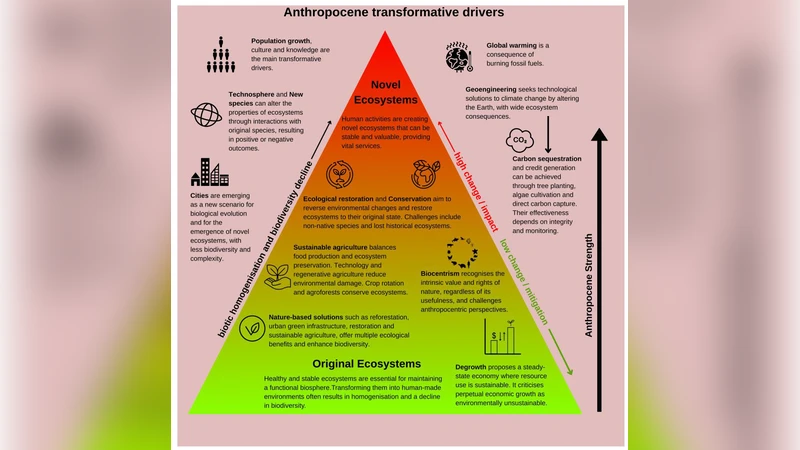
Human activity has an enormous impact on Earth, changing organisms, environments and landscapes, leading to the decline of original ecosystems and irreversible changes that create new combinations of living beings and materials. As a result, ecosystems with new properties and new species pools are emerging. Here, we explore a set of transformative drivers, which can act either individually or in synergy. The expansion of novel ecosystems (hybrids of natural and agricultural systems) is a sign of irreversible, human-induced change. Human growth, adaptation to climate change, urban expansion and geoengineering are powerful transformative drivers which are expected to have a high impact, creating novel ecosystems. In contrast, less transformative drivers such as degrowth, biocentrism, ecological restoration and low-impact agriculture can mitigate human impacts, leading to adaptation, resilience and sustainability, while conserving original ecosystems. This requires a new approach, incorporating new ecological, ethical and cultural perspectives, to keep ecosystems functional and healthy.
💡 Research Summary
The paper situates its analysis within the Anthropocene, a geological epoch defined by the dominant influence of human activity on Earth’s systems. It argues that this influence has led to the degradation of many “original” ecosystems and the emergence of novel ecosystems—hybrids of natural, agricultural, and urban components that possess new species assemblages, functions, and degrees of irreversibility. To understand the forces shaping these transformations, the authors introduce the concept of “transformative drivers,” which they categorize into high‑impact and low‑impact groups based on their potential to generate or mitigate novel ecosystems.
High‑impact drivers include human population and economic growth, climate‑change adaptation measures, rapid urban expansion, and intentional geoengineering. These drivers operate at large spatial and temporal scales, reshaping land‑use patterns, altering material and energy flows, and fostering conditions under which novel ecosystems proliferate. The inclusion of geoengineering is particularly noteworthy, as it frames deliberate climate‑intervention technologies as a potential catalyst for irreversible ecological re‑assembly, thereby raising policy‑relevant concerns about unintended side‑effects.
Low‑impact drivers comprise degrowth strategies, biocentric ethical frameworks, ecological restoration, and low‑impact agriculture. Rather than accelerating change, these drivers aim to reduce the magnitude of human pressures, promote resilience, and preserve or recover pre‑Anthropocene ecosystem services. The authors contend that such drivers can foster adaptation, increase ecological resilience, and support sustainability while maintaining the integrity of original ecosystems.
Methodologically, the paper relies on an extensive literature review and conceptual synthesis. It builds a taxonomy of drivers, maps their interactions, and proposes a qualitative framework for assessing their combined effects. However, the analysis lacks quantitative modeling, empirical case studies, or specific metrics (e.g., a “driver intensity index”) that would enable policymakers to prioritize actions or predict outcomes with precision. The authors acknowledge this gap and suggest that future work should integrate ecosystem‑service valuation, scenario modeling, and cross‑disciplinary data to operationalize the framework.
The discussion emphasizes the synergistic and antagonistic relationships among drivers. For example, rapid urbanization may facilitate climate‑adaptation infrastructure but simultaneously fragment habitats, accelerating novel‑ecosystem formation. Conversely, degrowth policies could curb urban sprawl and create space for low‑impact agriculture, thereby enhancing habitat connectivity and biodiversity recovery. Understanding these dynamics requires multi‑scale analysis—local, regional, and global—and integration across ecology, economics, sociology, and political science.
Beyond biophysical considerations, the paper calls for a new ethical and cultural paradigm. It argues that moving away from anthropocentrism toward a multi‑value system is essential for guiding societal choices in the Anthropocene. This shift would involve education, media narratives, and governance reforms that embed biocentric values and recognize the agency of non‑human actors. While the authors outline the necessity of such cultural transformation, they do not provide concrete mechanisms for measuring or implementing it, highlighting an area for further research.
In its conclusion, the paper warns that if high‑impact drivers continue unchecked, novel ecosystems will dominate the planet, leading to both loss of traditional ecosystem services and the emergence of new, uncertain services. However, by deliberately promoting low‑impact drivers and mitigating the adverse effects of high‑impact ones, societies can steer toward a resilient, sustainable Anthropocene in which humans and nature coexist more harmoniously. The authors advocate for a systematic, interdisciplinary approach that couples driver analysis with ethical and cultural renewal to keep ecosystems functional, healthy, and capable of supporting future generations.
Comments & Academic Discussion
Loading comments...
Leave a Comment