An arithmetic method algorithm optimizing k-nearest neighbors compared to regression algorithms and evaluated on real world data sources
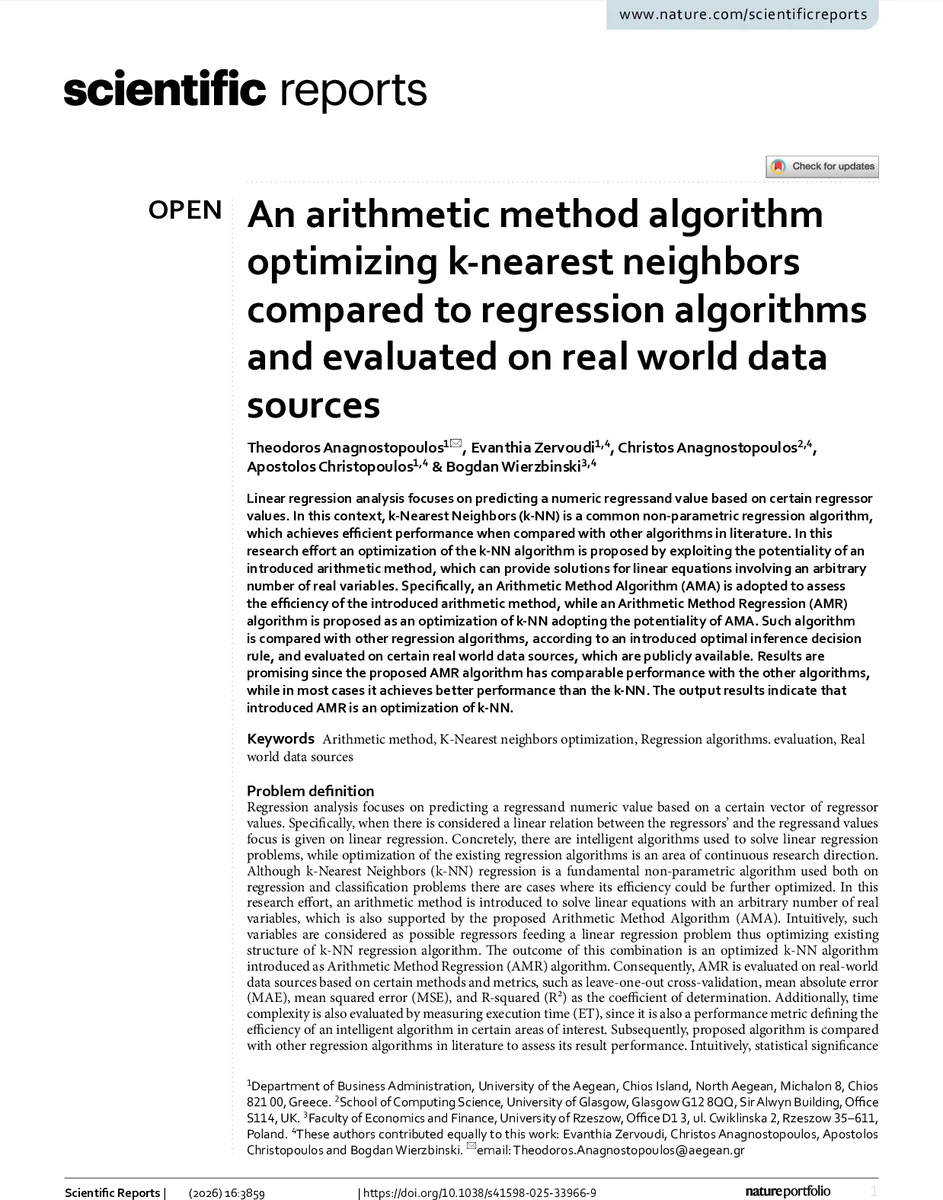
Linear regression analysis focuses on predicting a numeric regressand value based on certain regressor values. In this context, k-Nearest Neighbors (k-NN) is a common non-parametric regression algorithm, which achieves efficient performance when compared with other algorithms in literature. In this research effort an optimization of the k-NN algorithm is proposed by exploiting the potentiality of an introduced arithmetic method, which can provide solutions for linear equations involving an arbitrary number of real variables. Specifically, an Arithmetic Method Algorithm (AMA) is adopted to assess the efficiency of the introduced arithmetic method, while an Arithmetic Method Regression (AMR) algorithm is proposed as an optimization of k-NN adopting the potentiality of AMA. Such algorithm is compared with other regression algorithms, according to an introduced optimal inference decision rule, and evaluated on certain real world data sources, which are publicly available. Results are promising since the proposed AMR algorithm has comparable performance with the other algorithms, while in most cases it achieves better performance than the k-NN. The output results indicate that introduced AMR is an optimization of k-NN.
💡 Research Summary
The manuscript introduces a novel “Arithmetic Method” (AM) for solving systems of linear equations with an arbitrary number of real variables and builds an “Arithmetic Method Algorithm” (AMA) to implement this technique. The authors then embed AMA into the classic k‑Nearest Neighbors (k‑NN) regression framework, creating an “Arithmetic Method Regression” (AMR) algorithm that purportedly re‑weights neighbor contributions based on solutions of linear equations rather than relying solely on distance‑based weighting.
The paper begins with a conventional overview of regression analysis and the role of k‑NN as a non‑parametric method. It argues that traditional k‑NN uses a fixed distance metric (usually Euclidean) and simple averaging of the target values of the k nearest points, which may be sub‑optimal. By solving a linear system that incorporates the predictor variables, AMA is claimed to generate a set of weights that better reflect the underlying relationships among the features. These weights are then applied within the k‑NN prediction step, forming the AMR algorithm.
Unfortunately, the manuscript provides only a high‑level description of AMA. No explicit mathematical formulation, algorithmic pseudocode, or complexity analysis is presented. The authors mention that AMA can handle “an arbitrary number of real variables,” but they do not compare it to standard techniques such as Gaussian elimination, LU decomposition, or QR factorisation, nor do they discuss numerical stability, conditioning, or scalability. Consequently, the novelty and practical advantage of AMA remain unclear.
The experimental section claims to evaluate AMR against a broad suite of regression models—Linear Regression (LR), Decision Trees (DT), Support Vector Regression (SVR), Random Forest (RF), XGBoost, Convolutional Neural Networks (CNN), and the baseline k‑NN—across a large collection of publicly available datasets. These datasets span diverse domains: dental age estimation, biological age, continuous glucose monitoring, depression detection, climate and air‑pollution, heart‑rate accelerometer data, lung‑cancer incidence, life‑satisfaction surveys, epigenetic age, blood‑pressure monitoring, ovarian‑cancer survival, NMR‑based metabolic clocks, Li‑ion battery reliability, spinal‑cord injury outcomes, athlete motion capture, preventive healthcare, and several specialized k‑NN variants. For each dataset the authors report standard regression metrics (MAE, MSE, RMSE, R²) and execution time (ET). They also state that a two‑tailed permutation test was used to assess statistical significance.
However, the paper lacks any tables, figures, or raw numbers; all results are described only in prose. Without concrete values, readers cannot verify the claimed superiority of AMR, nor can they assess effect sizes or confidence intervals. The description of the permutation test omits critical details such as the number of permutations, the exact null hypothesis, p‑values, and any correction for multiple comparisons. Moreover, hardware specifications, software libraries, and hyper‑parameter settings (e.g., choice of k, distance metric, AMA parameters) are not disclosed, making reproducibility impossible.
The literature review is extensive but functions more as a catalog of prior works that used various regression algorithms in specific application areas. It does not critically compare those methods to AMR, nor does it situate AMR within the existing body of k‑NN enhancements (e.g., distance‑metric learning, weighted k‑NN, locally adaptive k, or kernel‑based neighbor selection). Consequently, the paper’s contribution appears to be a re‑branding of a generic linear‑system solver inserted into a k‑NN pipeline, without demonstrating a clear theoretical or empirical advantage over well‑established alternatives.
In the discussion, the authors conclude that AMR “optimizes” k‑NN and achieves comparable or better performance on most datasets. While this statement aligns with the narrative, the lack of transparent methodology, missing quantitative evidence, and insufficient statistical rigor undermine the credibility of the claim. The manuscript would benefit from:
- A precise mathematical definition of AMA, including algorithmic steps, computational complexity, and numerical stability analysis.
- Pseudocode or flowcharts for the AMR pipeline, clarifying how AMA‑derived weights replace or augment traditional distance‑based weighting.
- Detailed experimental protocols: dataset splits, cross‑validation strategy, hyper‑parameter tuning, hardware/software environment, and full result tables with statistical significance markers.
- Direct comparisons with existing k‑NN improvement techniques to demonstrate genuine novelty.
- Open‑source code and reproducibility packages to allow independent verification.
Overall, the idea of integrating a linear‑system solution into k‑NN weighting is intriguing, but the current manuscript falls short of the standards required for a rigorous contribution to the machine‑learning literature. Substantial revisions are needed to clarify the algorithm, substantiate the empirical claims, and position the work within the broader context of regression and k‑NN optimization research.
Comments & Academic Discussion
Loading comments...
Leave a Comment