Trajectory Stitching for Solving Inverse Problems with Flow-Based Models
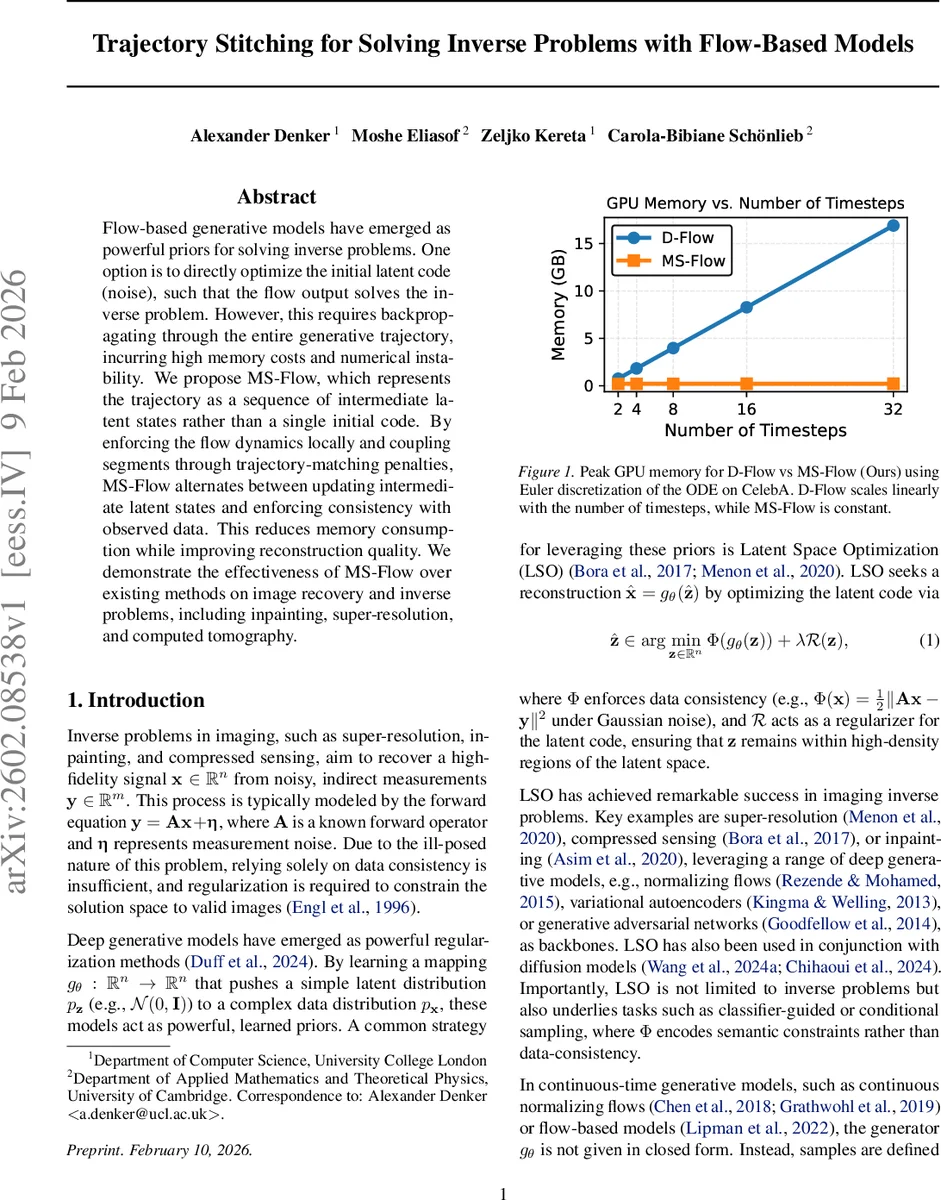
Flow-based generative models have emerged as powerful priors for solving inverse problems. One option is to directly optimize the initial latent code (noise), such that the flow output solves the inverse problem. However, this requires backpropagating through the entire generative trajectory, incurring high memory costs and numerical instability. We propose MS-Flow, which represents the trajectory as a sequence of intermediate latent states rather than a single initial code. By enforcing the flow dynamics locally and coupling segments through trajectory-matching penalties, MS-Flow alternates between updating intermediate latent states and enforcing consistency with observed data. This reduces memory consumption while improving reconstruction quality. We demonstrate the effectiveness of MS-Flow over existing methods on image recovery and inverse problems, including inpainting, super-resolution, and computed tomography.
💡 Research Summary
This paper addresses two fundamental bottlenecks that arise when using flow‑based generative models as priors for image inverse problems: (1) the high memory consumption required to back‑propagate through the entire continuous normalizing flow (CNF) trajectory, and (2) the poor conditioning caused by the highly nonlinear dependence of the final image on the initial latent code. Existing approaches such as D‑Flow adopt a single‑shooting formulation, optimizing only the initial latent variable z while integrating the ODE dx/dt = vθ(x,t) over the full interval
Comments & Academic Discussion
Loading comments...
Leave a Comment