Global observables and identified-hadron production in pp, O-O and Pb-Pb collisions at LHC Run 3 energies with EPOS4
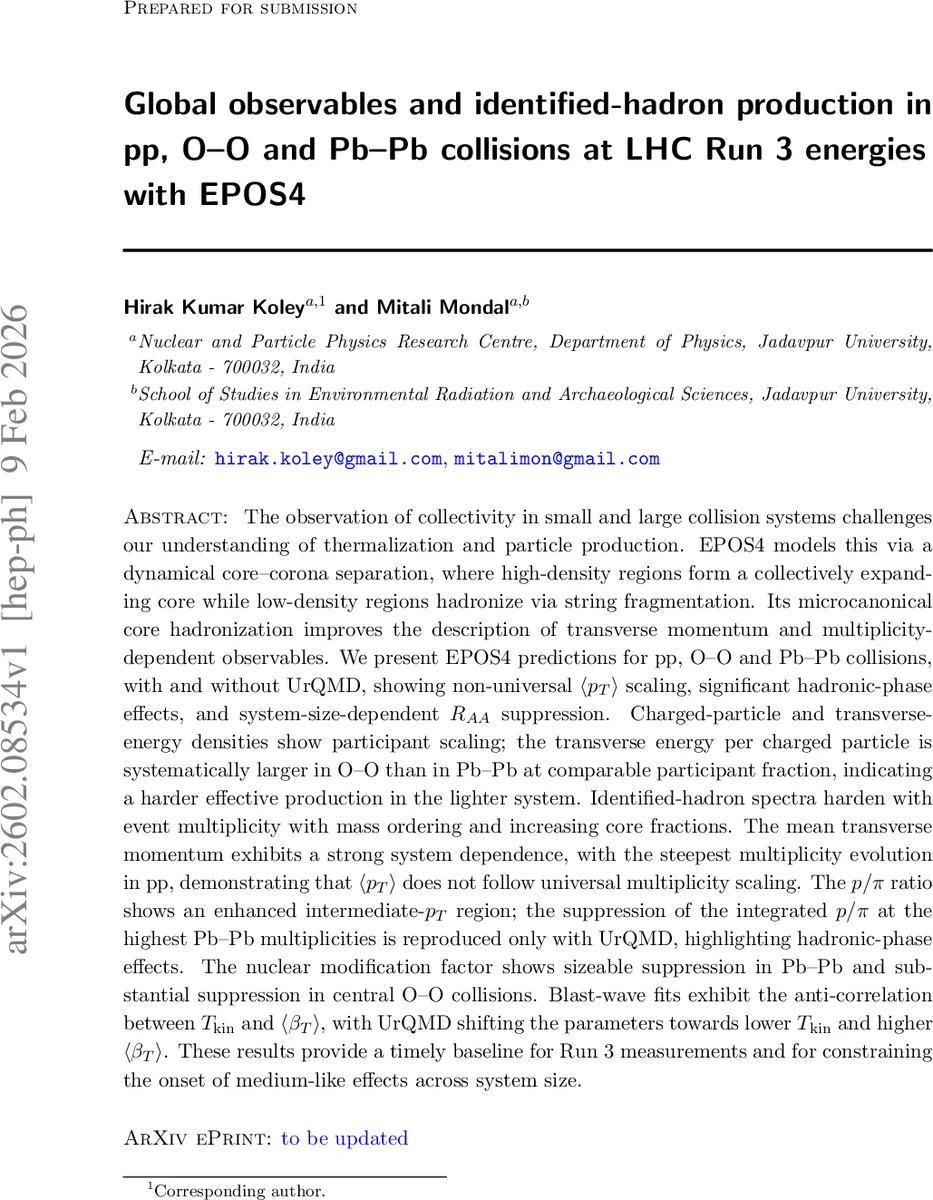
The observation of collectivity in small and large collision systems challenges our understanding of thermalization and particle production. EPOS4 models this via a dynamical core–corona separation, where high-density regions form a collectively expanding core while low-density regions hadronize via string fragmentation. Its microcanonical core hadronization improves the description of transverse momentum and multiplicity-dependent observables. We present EPOS4 predictions for pp, O-O and Pb-Pb collisions, with and without UrQMD, showing non-universal $\langle p_T\rangle$ scaling, significant hadronic-phase effects, and system-size-dependent $R_{AA}$ suppression. Charged-particle and transverse-energy densities show participant scaling; the transverse energy per charged particle is systematically larger in O–O than in Pb–Pb at comparable participant fraction, indicating a harder effective production in the lighter system. Identified-hadron spectra harden with event multiplicity with mass ordering and increasing core fractions. The mean transverse momentum exhibits a strong system dependence, with the steepest multiplicity evolution in pp, demonstrating that $\langle p_T\rangle$ does not follow universal multiplicity scaling. The $p/π$ ratio shows an enhanced intermediate-$p_T$ region; the suppression of the integrated $p/π$ at the highest Pb–Pb multiplicities is reproduced only with UrQMD, highlighting hadronic-phase effects. The nuclear modification factor shows sizeable suppression in Pb–Pb and substantial suppression in central O–O collisions. Blast-wave fits exhibit the anti-correlation between $T_{\rm kin}$ and $\langleβ_T\rangle$, with UrQMD shifting the parameters towards lower $T_{\rm kin}$ and higher $\langleβ_T\rangle$. These results provide a timely baseline for Run~3 measurements and for constraining the onset of medium-like effects across system size.
💡 Research Summary
This paper presents comprehensive predictions for the upcoming LHC Run 3 measurements in proton‑proton (√s = 13.6 TeV), oxygen‑oxygen (√sₙₙ = 5.36 TeV) and lead‑lead (√sₙₙ = 5.36 TeV) collisions using the latest EPOS4 event generator. EPOS4 implements a dynamical core‑corona separation based on local energy‑density: high‑density regions form a thermalised core that undergoes full 3 + 1 D viscous hydrodynamics, while low‑density strings fragment independently as a non‑collective corona. The core hadronises on a hypersurface via a micro‑canonical statistical approach, guaranteeing exact conservation of baryon number, charge and strangeness – a crucial improvement for small systems where phase‑space constraints are severe. After hadronisation, the model can optionally feed the final particles into the UrQMD afterburner to simulate the non‑equilibrium hadronic cascade (elastic and inelastic rescattering, resonance decays).
The authors first validate EPOS4 against existing Run 2 data for Pb‑Pb at √sₙₙ = 5.02 TeV, showing good agreement for the charged‑particle pseudorapidity density dN_ch/dη across centrality classes and for identified‑hadron p_T spectra (π, K, p) in the most central 0‑5 % events. Small discrepancies (up to ~40 % at intermediate p_T) are noted but the overall shape and high‑p_T tail are well reproduced.
Key results for the three systems are:
-
Global observables – Both dN_ch/dη and transverse‑energy density dE_T/dη scale linearly with the number of participating nucleons (N_part). However, at a given N_part fraction the O‑O system yields a systematically larger dE_T/dη per charged particle than Pb‑Pb, indicating a harder effective particle production in the lighter system.
-
Identified‑hadron spectra – With increasing event multiplicity the p_T spectra of π, K and p become progressively harder, exhibiting the classic mass ordering. The core fraction grows with multiplicity, and the mean transverse momentum ⟨p_T⟩ rises accordingly. Crucially, ⟨p_T⟩ does not follow a universal multiplicity scaling: the steepest rise is observed in pp, while O‑O and Pb‑Pb show a milder dependence, demonstrating that system size influences the collective boost.
-
Particle ratios – The p/π ratio shows an enhancement in the intermediate‑p_T region (≈2–4 GeV/c). The integrated p/π ratio at the highest Pb‑Pb multiplicities is suppressed only when UrQMD is switched on, highlighting the importance of hadronic rescattering in reshaping baryon‑to‑meson yields.
-
Nuclear modification factor (R_AA) – Strong suppression (R_AA ≈ 0.2–0.4) is predicted for high‑p_T hadrons in central Pb‑Pb, consistent with jet quenching. Remarkably, a sizable suppression (R_AA ≈ 0.6) also appears in central O‑O collisions, suggesting that even the light‑ion system can generate a medium capable of attenuating energetic partons.
-
Blast‑wave analysis – Simultaneous fits to the identified‑hadron spectra yield an anti‑correlation between kinetic freeze‑out temperature T_kin and average transverse flow ⟨β_T⟩. Inclusion of UrQMD shifts the fit towards lower T_kin and higher ⟨β_T⟩, reflecting the additional radial push from the hadronic phase.
Overall, EPOS4 provides a unified description that smoothly interpolates from the dilute pp environment to the dense Pb‑Pb fireball, with O‑O serving as a crucial intermediate system to disentangle initial‑state geometry from final‑state collective effects. The predictions presented here constitute a timely baseline for Run 3 analyses and will help constrain the minimal conditions required for QGP‑like behaviour, the role of the hadronic afterburner, and the system‑size dependence of jet quenching and bulk flow.
Comments & Academic Discussion
Loading comments...
Leave a Comment