Consumption-Investment with anticipative noise
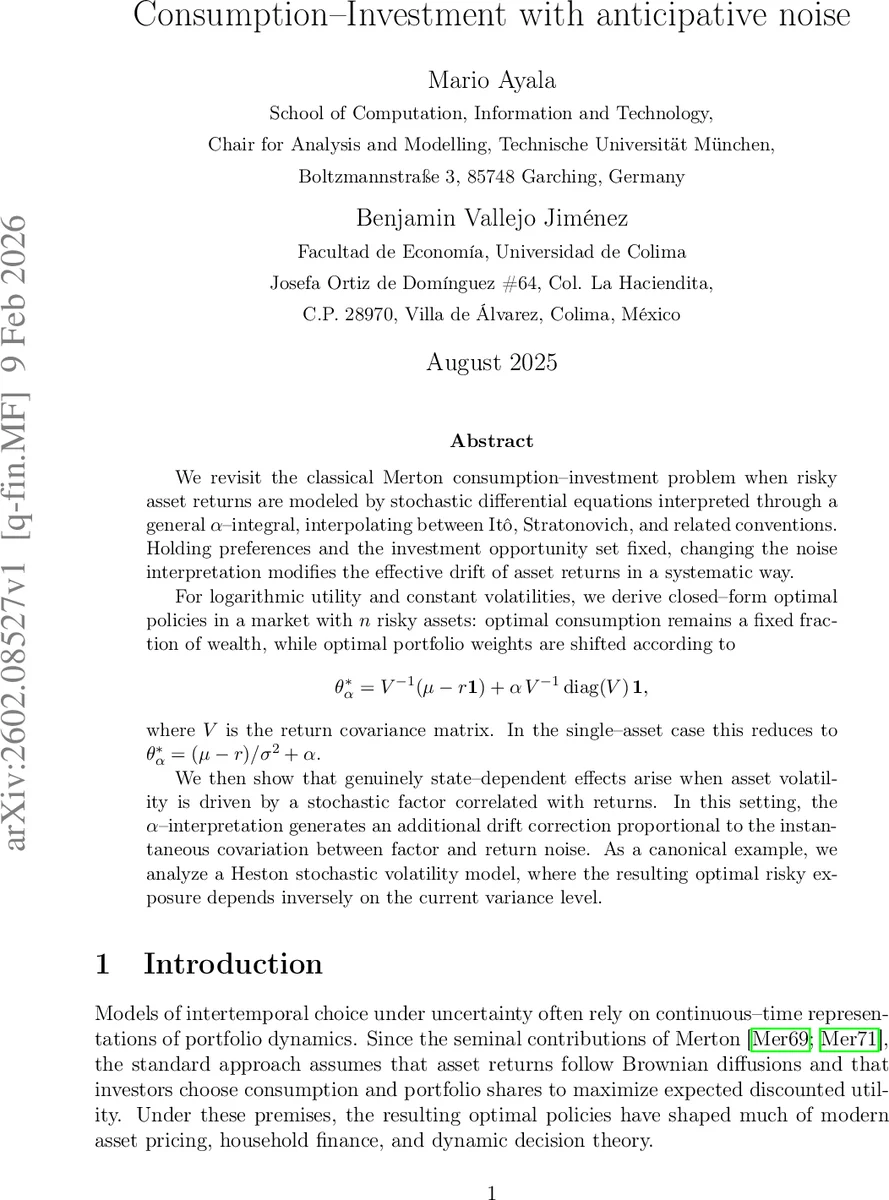
We revisit the classical Merton consumption–investment problem when risky-asset returns are modeled by stochastic differential equations interpreted through a general $α$-integral, interpolating between Itô, Stratonovich, and related conventions. Holding preferences and the investment opportunity set fixed, changing the noise interpretation modifies the effective drift of asset returns in a systematic way. For logarithmic utility and constant volatilities, we derive closed-form optimal policies in a market with $n$ risky assets: optimal consumption remains a fixed fraction of wealth, while optimal portfolio weights are shifted according to $θ_α^\ast = V^{-1}(μ-r\mathbf{1})+α,V^{-1}\operatorname{diag}(V)\mathbf{1}$, where $V$ is the return covariance matrix and $\operatorname{diag}(V)$ denotes the diagonal matrix with the same diagonal as $V$. In the single-asset case this reduces to $θ_α^\ast=(μ-r)/σ^{2}+α$. We then show that genuinely state-dependent effects arise when asset volatility is driven by a stochastic factor correlated with returns. In this setting, the $α$-interpretation generates an additional drift correction proportional to the instantaneous covariation between factor and return noise. As a canonical example, we analyze a Heston stochastic volatility model, where the resulting optimal risky exposure depends inversely on the current variance level.
💡 Research Summary
The paper revisits the classic Merton continuous‑time consumption‑investment problem by replacing the standard Itô stochastic integral with a general α‑integral, a parametrized family of stochastic calculus conventions that interpolates between Itô (α = 0), Stratonovich (α = ½) and other intermediate interpretations. The authors keep preferences, the investment opportunity set, and the self‑financing constraint fixed, and isolate the effect of the noise interpretation on optimal behavior.
First, in a market with n risky assets whose returns have constant volatilities, the α‑interpretation induces a deterministic drift correction equal to α diag(V) 1, where V is the return covariance matrix and 1 is a vector of ones. Under logarithmic utility (u(c)=ln c) the Hamilton‑Jacobi‑Bellman (HJB) equation can be solved in closed form. The optimal consumption rule remains myopic: c*ₜ = ρ aₜ, where ρ is the subjective discount rate and aₜ is wealth. The optimal portfolio weights become
θ*α = V⁻¹(μ − r 1) + α V⁻¹diag(V) 1.
Thus each asset’s weight is shifted by a term proportional to its own variance and to the parameter α. In the single‑asset case this reduces to the familiar Merton fraction (μ − r)/σ² plus an additive α, i.e. θ*α = (μ − r)/σ² + α. Consequently, interpretations closer to the anticipative end of the α‑scale (larger α) prescribe higher risky exposure than the Itô benchmark.
Second, the authors examine a setting where asset volatility is driven by a stochastic factor that is correlated with returns. The asset price dynamics are written as
dSₜ = μ Sₜ dt + √Vₜ Sₜ dWₜ,
dVₜ = κ(θ − Vₜ)dt + ξ√Vₜ dBₜ,
with dWₜ dBₜ = ρ dt. Applying the α‑integral and converting to Itô form yields an extra drift term α ρ ξ / Vₜ in the effective expected return. For logarithmic utility the optimal consumption stays proportional to wealth, while the optimal risky fraction becomes
π*ₜ = (μ − r)/Vₜ + α ρ ξ / Vₜ².
Hence the α‑correction is inversely proportional to the current variance level: it is amplified in low‑volatility regimes and muted when volatility is high. This state‑dependent effect is absent under constant volatility and represents a genuine impact of the noise interpretation on intertemporal decisions.
The paper also provides the necessary conversion formulas between Itô, Stratonovich, Klimontovich, and the general α‑integral, and discusses how the α‑parameter can be estimated from high‑frequency data where microstructure effects (discreteness, bid‑ask bounce, order‑flow imbalances, latency) cause observed returns to deviate from the pure Itô assumption.
Overall, the contribution is threefold: (i) it shows that the choice of stochastic integral convention systematically shifts the effective drift of asset returns; (ii) it derives explicit, analytically tractable optimal policies for logarithmic utility under both constant and stochastic volatility, highlighting a simple linear α‑shift in the former and a variance‑inverse α‑adjustment in the latter; (iii) it underscores that what is often treated as a harmless modeling convention can have economically meaningful, state‑dependent consequences for optimal consumption and portfolio choice, especially in environments with stochastic volatility and correlated sources of uncertainty. This insight opens new avenues for both theoretical extensions (e.g., other utility specifications, constraints) and empirical work that calibrates α to capture real‑world anticipative effects.
Comments & Academic Discussion
Loading comments...
Leave a Comment