Coupling between CaWO$_4$ phonons and Er$^{3+}$ dopants
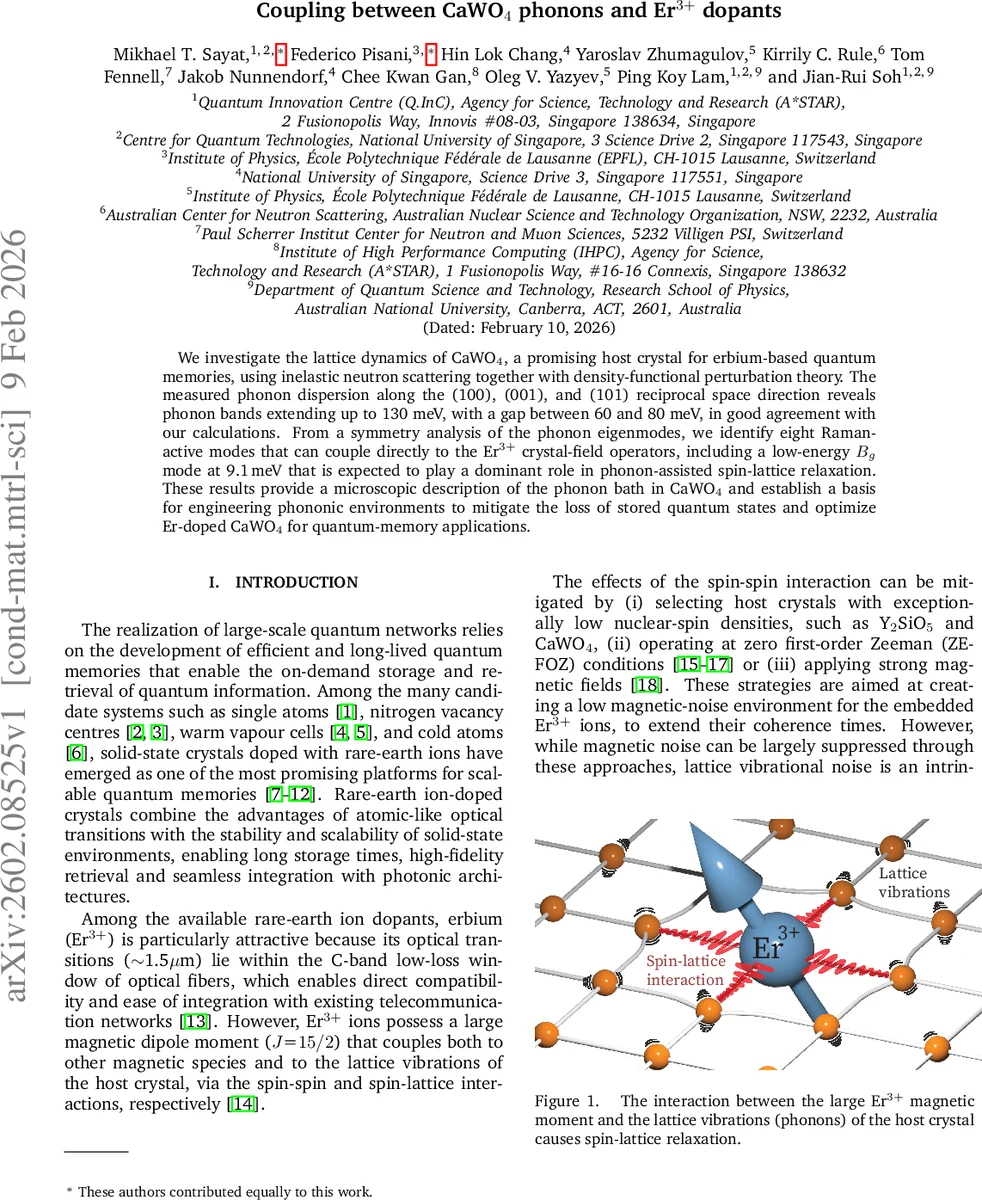
We investigate the lattice dynamics of CaWO$_4$, a promising host crystal for erbium-based quantum memories, using inelastic neutron scattering together with density-functional perturbation theory. The measured phonon dispersion along the (100), (001), and (101) reciprocal space direction reveals phonon bands extending up to 130 meV, with a gap between 60 and 80 meV, in good agreement with our calculations. From a symmetry analysis of the phonon eigenmodes, we identify eight Raman-active modes that can couple directly to the Er$^{3+}$ crystal-field operators, including a low-energy $B_g$ mode at 9.1 meV that is expected to play a dominant role in phonon-assisted spin-lattice relaxation. These results provide a microscopic description of the phonon bath in CaWO$_4$ and establish a basis for engineering phononic environments to mitigate the loss of stored quantum states and optimize Er-doped CaWO$_4$ for quantum-memory applications.
💡 Research Summary
This paper presents a comprehensive investigation of the lattice dynamics of calcium tungstate (CaWO₄), a material of growing interest as a host crystal for erbium‑based quantum memories. By combining inelastic neutron scattering (INS) experiments with density‑functional perturbation theory (DFPT) calculations, the authors map the full phonon dispersion of CaWO₄ across the Brillouin zone, identify the phonon modes that couple most strongly to the crystal‑field (CEF) levels of Er³⁺ dopants, and discuss strategies for phononic engineering to mitigate decoherence.
The experimental work utilizes large, high‑quality single crystals (≈2 × 2 × 1 cm³) measured at 200 K on two triple‑axis spectrometers (EIGER for low‑energy phonons, 2–60 meV, and Taipan for high‑energy phonons, 80–130 meV). Energy scans were performed along the high‑symmetry directions (100), (001), and (101) within the (h,0,l) scattering plane, providing momentum‑resolved data that extend far beyond the Γ‑point information accessible by Raman or infrared spectroscopy. The measured dispersion curves reveal acoustic branches up to ~10 meV, a dense manifold of low‑energy optical modes (10–58 meV) dominated by Ca and W vibrations, a pronounced phonon band gap between 60 and 80 meV, and high‑energy optical branches (98–115 meV) associated with stiff W–O stretching in the WO₄ tetrahedra. The overall agreement between experiment and DFPT is excellent; minor softening of high‑energy modes is attributed to anharmonic effects at the measurement temperature.
DFPT calculations were performed with QUANTUM ESPRESSO using norm‑conserving LDA pseudopotentials, a plane‑wave cutoff of 80 Ry, and an 8 × 8 × 8 k‑point mesh. Phonons were computed on a 6 × 6 × 6 q‑grid and interpolated throughout the Brillouin zone, yielding 36 branches consistent with the 12‑atom primitive cell. The theoretical dispersion reproduces the experimental features, confirming the reliability of the computational approach for both low‑ and high‑energy regimes.
The central focus of the paper is the coupling between Γ‑point phonons and the Er³⁺ CEF manifold. Er³⁺ substitutes for Ca²⁺ and experiences S₄ site symmetry, which restricts the Stevens operator expansion to terms with q = 0 and q = 4. The crystal‑field Hamiltonian is expressed as H_CEF = ∑ B_q^k O_q^k. Phonon‑induced displacements of the surrounding eight oxygen ligands modify the B_q^k parameters, leading to a crystal‑field‑phonon interaction Hamiltonian that contains linear (single‑phonon) and quadratic (two‑phonon) terms. Group‑theoretical analysis shows that only phonons whose irreducible representations, when multiplied by those of the Stevens operators, contain the totally symmetric A_g representation can produce non‑zero matrix elements. For CaWO₄’s I4₁/a space group, the Γ‑point Raman‑active sector consists of 3 A_g + 5 B_g + 5 E_g modes, while the infrared‑active sector comprises 4 A_u + 4 E_u modes. Among these, eight Raman‑active modes (all A_g and B_g) satisfy the symmetry condition for direct CEF coupling.
A particularly important mode is a low‑energy B_g phonon at 9.1 meV. This mode involves a collective distortion of the ErO₈ polyhedron that directly modulates the Stevens parameters, thereby enabling the “direct” spin‑lattice relaxation process. Unlike Raman or Orbach mechanisms, which involve two‑ or three‑phonon processes and are strongly temperature‑dependent, the direct process persists even at millikelvin temperatures and therefore sets a fundamental limit on the coherence time of Er³⁺ spin states. The identification of this mode provides a clear target for phonon‑engineering strategies.
The authors discuss possible routes to suppress the detrimental phonon‑induced relaxation. By altering the frequency or symmetry of the 9.1 meV B_g mode—through strain engineering, acoustic phononic crystals, or isotopic substitution—one can reduce the linear coupling constant g_kq,λ and thus the direct relaxation rate. Moreover, the intrinsic phonon band gap (60–80 meV) can be exploited to design phononic structures that forbid resonant phonons at frequencies relevant to higher‑order processes, further extending coherence times. Such phononic band‑gap engineering has been demonstrated in other rare‑earth‑doped systems and is directly applicable to Er³⁺:CaWO₄.
In summary, the paper delivers three major contributions: (1) a full, experimentally validated phonon dispersion for CaWO₄ spanning low and high energies; (2) a symmetry‑based identification of the specific Raman‑active phonons that couple to Er³⁺ CEF levels, with quantitative emphasis on the 9.1 meV B_g mode; and (3) a roadmap for phonon‑engineered quantum memories that mitigate spin‑lattice relaxation. These results lay the groundwork for developing Er³⁺‑doped CaWO₄ quantum memories operating at telecom wavelengths, with the potential for long storage times and integration into scalable quantum networks.
Comments & Academic Discussion
Loading comments...
Leave a Comment