Some notes on tensor triangular geometry
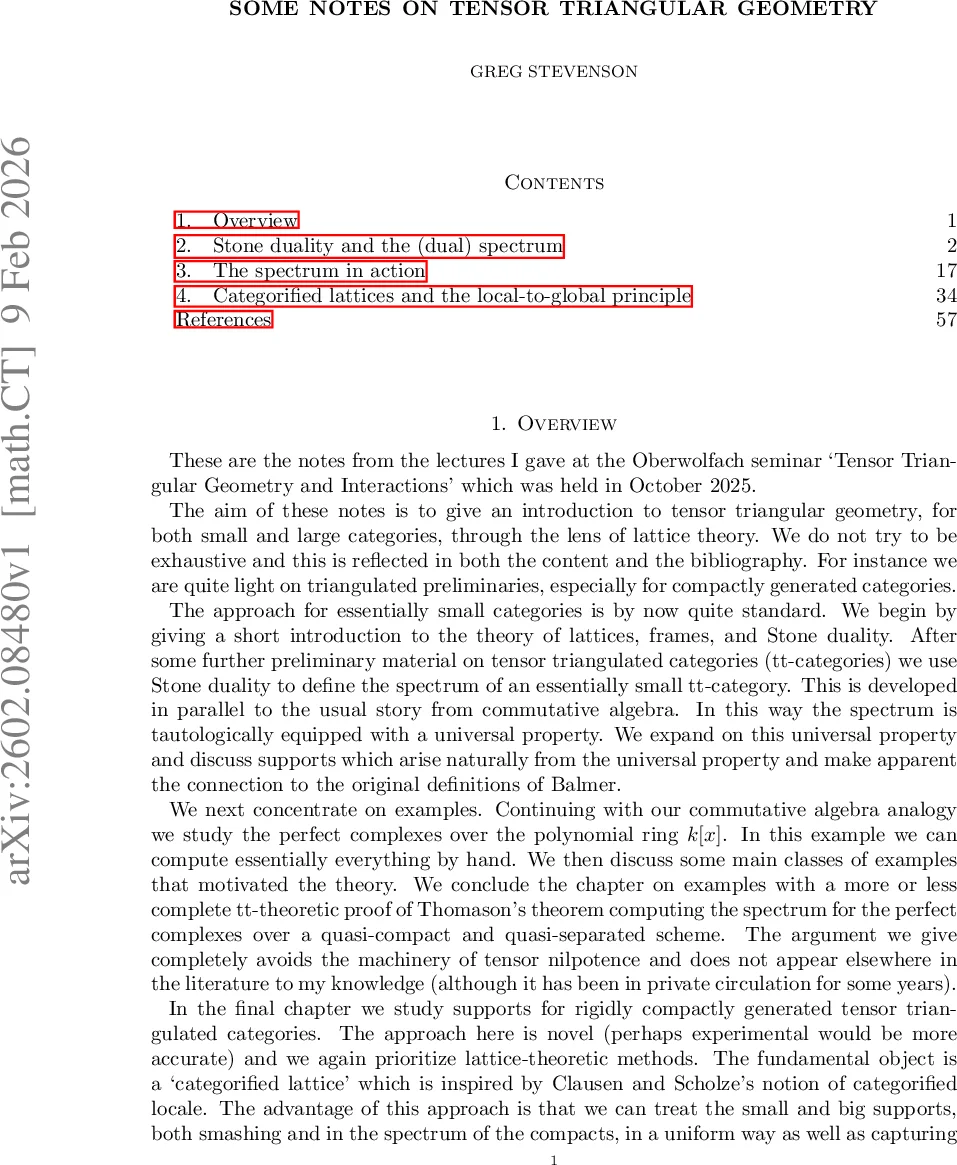
These are notes from the lectures I gave at the Oberwolfach seminar `Tensor Triangular Geometry and Interactions’ which was held in October 2025. The aim of these notes is to give an introduction to tensor triangular geometry, for both small and large categories, through the lens of lattice theory. We do not try to be exhaustive and this is reflected in both the content and the bibliography. For instance we are quite light on triangulated preliminaries, especially for compactly generated categories. The first three sections treat the essentially small case and conclude with a tensor triangular proof of Thomason’s theorem computing the spectrum of the perfect complexes on a quasi-compact and quasi-separated scheme. The last section treats the compactly generated case. This final section is somewhat experimental and contains some new thoughts.
💡 Research Summary
These notes, based on the Oberwolfach seminar “Tensor Triangular Geometry and Interactions” (October 2025), provide a lattice‑theoretic perspective on tensor triangular geometry (TT‑geometry). The author’s aim is to introduce the Balmer spectrum of a tensor triangulated category (tt‑category) using Stone duality between frames (complete distributive lattices satisfying infinite distributivity) and sober topological spaces, and to treat both the essentially small and the compactly generated (large) cases in a unified way.
The paper begins with a concise overview that explains why lattice theory is a natural language for TT‑geometry: the collection of thick ⊗‑ideals in a tt‑category forms a complete lattice, and the prime elements of this lattice correspond to points of the Balmer spectrum. The author deliberately minimizes triangulated preliminaries, focusing instead on the algebraic structure of lattices, frames, and their points.
Section 2 develops the necessary background on Stone duality. After recalling basic definitions (lattice, complete lattice, distributive lattice, frame) the author defines a point of a frame as a morphism to the two‑element frame 2, showing that points are in bijection with prime elements (Lemma 2.1.23). The adjunction Ω ⊣ pt between frames and topological spaces is presented, leading to the classical Stone duality theorem: the category of spatial frames is equivalent to the category of sober spaces. The author then introduces coherent frames (algebraic frames whose compact elements form a bounded sublattice) and explains their equivalence with spectral spaces (the underlying spaces of affine schemes). This material sets the stage for defining the spectrum of a tt‑category purely in lattice‑theoretic terms.
In Section 3 the spectrum is constructed for an essentially small tt‑category K. The thick ⊗‑ideals of K form a bounded distributive lattice L; the frame Idl(L) of its ideals is taken, and the set of points pt(Idl(L)) is defined to be Spc(K). By the previous duality, Spc(K) is a sober topological space equipped with a universal support datum: for each object x∈K, the support supp(x) is the set of points whose corresponding prime ideal does not contain the ⊗‑ideal generated by x. This reproduces Balmer’s original support theory but makes the universal property explicit: any other support satisfying the usual axioms factors uniquely through this construction. The author illustrates the theory with the elementary example of perfect complexes over the polynomial ring k
Comments & Academic Discussion
Loading comments...
Leave a Comment